

Top 3 Price Prediction Bitcoin, Ethereum, Ripple: Expect more from altcoins with BTC stuck in range trade

Source Fxstreet
  • Bitcoin price could drop all the way to $52,000 where many bulls wait to interact with BTC.
  • Ethereum price consolidation in a falling wedge could send ETH to $3,750 as bulls defend $2,900 level.  
  • Ripple price eyes 5% correction, a mean reversal that could precipitate a strong move north.

Bitcoin (BTC) price remains range-bound with markets likely to endure a sideways weekend. The outlook is different for altcoins, however, as they try to break off from the BTC cues. Ethereum (ETH) and Ripple (XRP) prices could show more action even as markets wave off the halving excitement.

Also Read: Bitcoin Weekly Forecast: BTC’s next breakout could propel it to $80,000

Altcoins to show more action

Halving events often lead to increased interest and positive price movements for both Bitcoin and altcoins in the short term due to the anticipation of reduced supply. However, altcoins may experience more exaggerated price movements after a halving event compared to Bitcoin.

Some altcoins may see significant gains as investors shift their focus to alternative cryptocurrencies with potential for growth. On the other hand, some altcoins may struggle to maintain their value or face selling pressure as investors consolidate their positions into Bitcoin.

As Bitcoin price consolidates, forward-looking investors are already looking at altcoins.

Read More: A revisit of $56K is highly likely to shake weak hands before the next leg up for BTC

Bitcoin price needs a catalyst for momentum

Bitcoin price has been chopping sideways ahead of an eventful week starting Monday. For now, the odds lean in favor of the downside, with a low-hanging liquidity having an effective bearish pull on Bitcoin price.

With Bitcoin price suffering massive bearish momentum between the range of $65,500 and $69,000, the odds for further downside continue to increase. The yellow spikes on the volume profile show a lot of bullish activity waiting to interact with BTC around the $62,000 range. Should this area fail to hold as support, BTC could drop into the liquidity pool that extends between $60,600 and $59,005.

In a dire case, Bitcoin price could extend a leg down to $52,000, where multiple bulls await to interact with Bitcoin price. This would mean a fall of around 20% below current levels.

The Relative Strength Index (RSI) is recording lower highs that have seen it drop below the mean level of 50. Coupling this with the position of the Moving Average Convergence Divergence (MACD) in negative territory, what follows next could be a fall before a possible recovery.
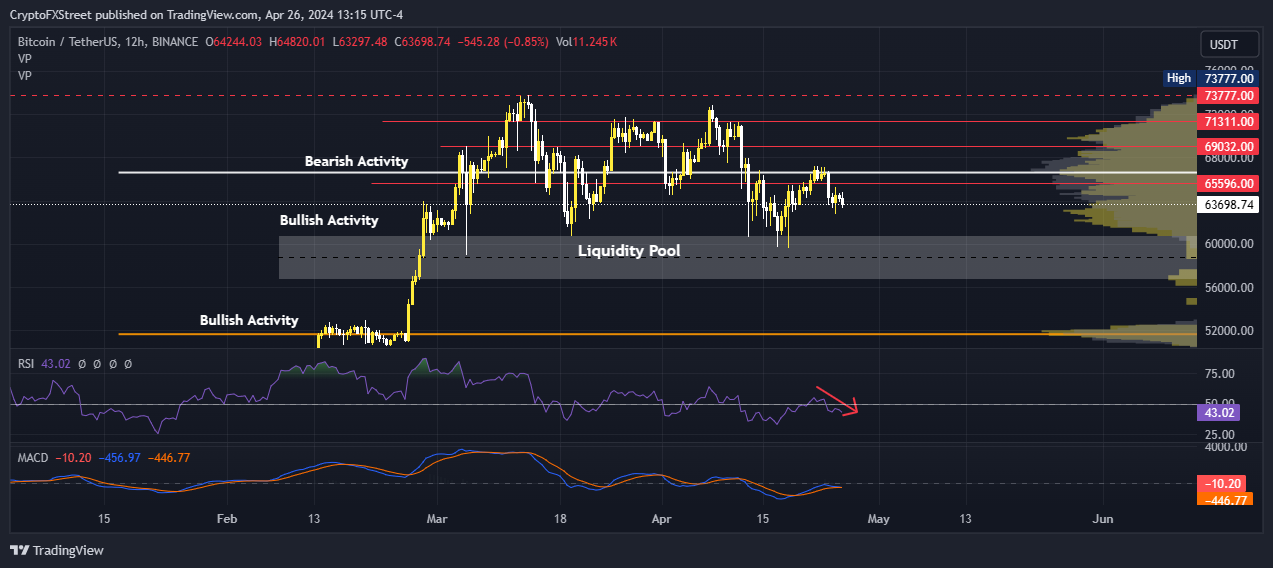
BTC/USDT 12-hour chart

On the other hand, if the area around $62,000 holds as support, with multiple bulls also waiting to buy BTC, Bitcoin price could recover. For confirmation of an uptrend, BTC price must record a candlestick close above $69,032. Such a move would pave the way for a retake of the $73,777 peak or set the tone for a new all-time high.

Also Read: Bitcoin price drop extends as SEC delays decision and opens comment period on options trading on spot BTC ETFs

Ethereum price’s falling wedge precipitates a bullish reversal

Ethereum price is consolidating within a falling wedge pattern, a bullish reversal technical formation that will be executed with a breakout above the upper trendline. With a lot of bullish activity waiting to interact with ETH just above the $2,900 level, Ethereum price could reverse or bounce above this base.

Notice the lower highs on the RSI, reinforced by the MACD holding above the signal line. Investors looking to take long positions for ETH should wait for both these momentum indicators to close above their respective mean levels decisively in the 12-hour time frame. A breakout could see ETH nick the $3,750 threshold as it chases the nearly 25% target objective of the descending wedge around the $4,290 level.
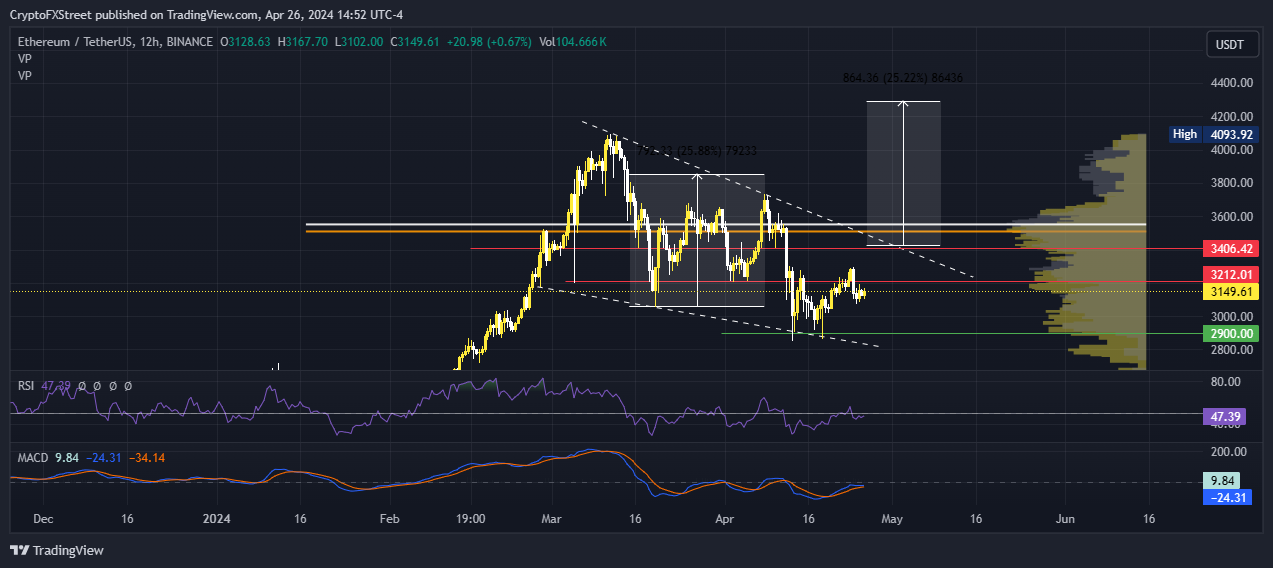
ETH/USDT 12-hour chart

On the other hand, if the $2,900 level fails to hold as support, the Ethereum price could spiral to the $2,800 level where bulls are expected to step in based on spikes on the volume nodes.

Also Read: Ethereum cancels rally expectations as Consensys sues SEC over ETH security status

Ripple price could fall 5% before correction

Ripple price is scaling a recovery rally as it holds in the upper section of the market range. Before a further upside, however, XRP price is likely to retest the 50% Fibonacci placeholder at $0.4952 before a pullback toward the $0.6000 psychological level.
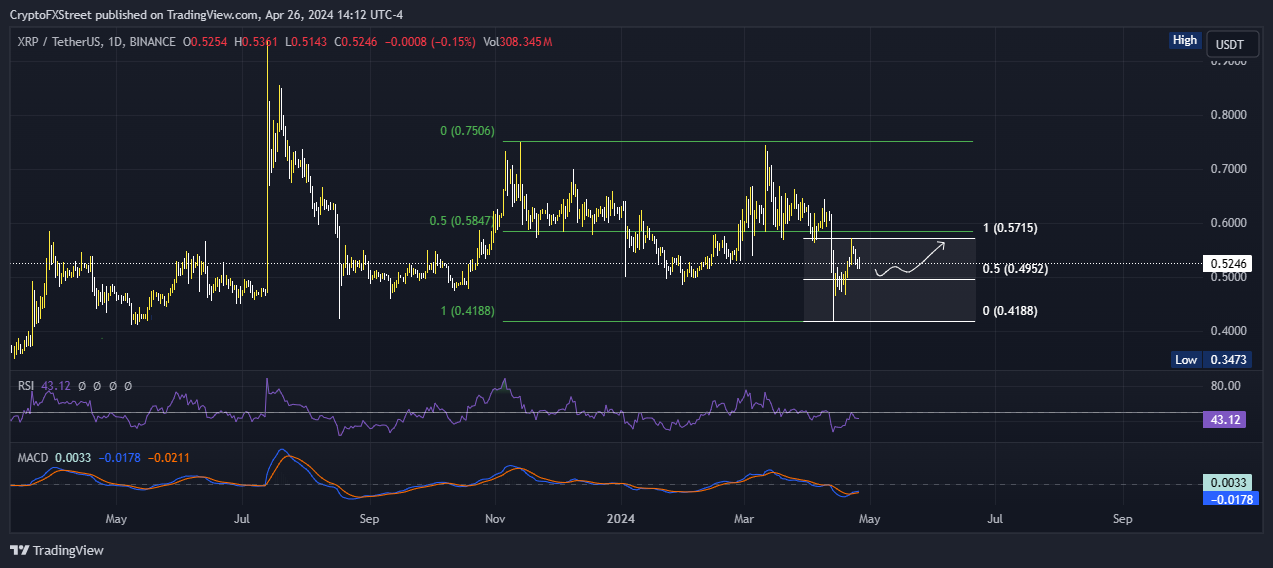
XRP/USDT 1-day chart

Conversely, if the $0.4952 level fails to hold as a support, XRP price could extend the fall to the bottom of the market range at $0.4188. A break and close below this level would invalidate the bullish thesis.

Also Read: XRP hovers near $0.50 as Ripple CTO addresses concerns related to stablecoin launch

Cryptocurrency prices FAQs

Token launches like Arbitrum’s ARB airdrop and Optimism OP influence demand and adoption among market participants. Listings on crypto exchanges deepen the liquidity for an asset and add new participants to an asset’s network. This is typically bullish for a digital asset.

A hack is an event in which an attacker captures a large volume of the asset from a DeFi bridge or hot wallet of an exchange or any other crypto platform via exploits, bugs or other methods. The exploiter then transfers these tokens out of the exchange platforms to ultimately sell or swap the assets for other cryptocurrencies or stablecoins. Such events often involve an en masse panic triggering a sell-off in the affected assets.

Macroeconomic events like the US Federal Reserve’s decision on interest rates influence risk assets like Bitcoin, mainly through the direct impact they have on the US Dollar. An increase in interest rate typically negatively influences Bitcoin and altcoin prices, and vice versa. If the US Dollar index declines, risk assets and associated leverage for trading gets cheaper, in turn driving crypto prices higher.

Halvings are typically considered bullish events as they slash the block reward in half for miners, constricting the supply of the asset. At consistent demand if the supply reduces, the asset’s price climbs. This has been observed in Bitcoin and Litecoin.

Disclaimer: For information purposes only. Past performance is not indicative of future results.
placeholder
U.S. November Nonfarm Payrolls: What Does the Rare "Weak Jobs, Strong Economy" Mix Mean for U.S. Equities?1. IntroductionAfter retreating from the late-October highs, U.S. equities embarked on a bottoming rebound in mid-to-late November, a trend driven by the interplay of multiple factors. That said, it i
Author  TradingKey
7 hours ago
1. IntroductionAfter retreating from the late-October highs, U.S. equities embarked on a bottoming rebound in mid-to-late November, a trend driven by the interplay of multiple factors. That said, it i
placeholder
Senate Delays Crypto Market Structure Hearings to Early 2026The Senate Banking Committee has postponed cryptocurrency market structure hearings until 2026, citing ongoing bipartisan negotiations.
Author  Mitrade
12 hours ago
The Senate Banking Committee has postponed cryptocurrency market structure hearings until 2026, citing ongoing bipartisan negotiations.
placeholder
Bitcoin Slides 5% as Sellers Lean In — Can BTC Reclaim $88,000?Bitcoin has dropped back below $88,000 after rolling over from $90,500, with price still trading under the 100-hour Simple Moving Average. The sell-off found a floor at $85,151, and BTC is now consolidating near that base, but rebounds are facing pressure from a bearish trend line around $89,000. Bulls need to retake $88,000–$89,000 to ease downside risk; failure to do so keeps $85,500–$85,000 and then $83,500 in play, with $80,000 as the deeper “line in the sand.” Bitcoin (BTC) is back in damage-control mode after a sharp pullback wiped out recent gains. The price failed to reclaim the $90,000–$90,500 band, rolled over, and slid through $88,500 before briefly dipping under $87,000. Buyers did show up around $85,000, but the rebound so far looks more like stabilization than a clear trend reversal. Bitcoin dips hard, finds a bid near $85,000(h3) BTC’s latest move lower began when it couldn’t build follow-through above $90,000 and $90,500. Once that upside stalled, sellers took control and pushed price down through $88,500. The slide accelerated enough to spike below $87,000, but the market didn’t free-fall. Bulls defended the $85,000 zone, printing a low at $85,151. Since then, Bitcoin has been consolidating below the 23.6% Fibonacci retracement of the drop from the $93,560 swing high to the $85,151 low — a clue that the bounce is still shallow and that sellers haven’t fully backed off yet. Structurally, BTC is still on the back foot: It’s trading below $88,000, and It remains below the 100-hour Simple Moving Average, keeping short-term trend pressure pointed downward. Resistance is layered, and $89,000 is the problem area(h3) If bulls try to turn this into a recovery, they’ll have to climb through multiple ceilings in quick succession. First, BTC faces resistance around $87,150, followed by a more meaningful barrier near $87,500. From there, the market’s attention snaps back to $88,000 — the level BTC just lost and now needs to reclaim. A close back above $88,000 would improve the tone, but it doesn’t solve the bigger issue: there’s a bearish trend line on the hourly BTC/USD chart (Kraken feed) with resistance near $89,000, which also lines up with the next technical hurdle. If BTC can push through $89,000 and hold, the rebound could extend toward $90,000, with follow-through targets at $91,000 and $91,500. But until price clears that $88,000–$89,000 zone, rallies are at risk of being sold rather than chased. If BTC fails to reclaim resistance, the downside path is clear(h3) The near-term bear case is simple: if Bitcoin can’t climb back above the $87,000 area and keep traction, sellers may attempt another leg lower. Support levels line up like this: Immediate support: $85,500 First major support: $85,000 Next support: $83,500 Then $82,500 in the near term Below that, the major “don’t break this” level is still $80,000. If BTC slips under $80,000, the risk of acceleration to the downside increases significantly — not because it’s magic, but because it’s the kind of psychological and structural level that tends to trigger forced de-risking. Indicators: momentum still leans bearish(h3) The intraday indicators aren’t offering much comfort yet: Hourly MACD is losing pace in the bearish zone. Hourly RSI remains below 50, suggesting sellers still have the upper hand on short timeframes. So while the $85,000 defense held for now, the market hasn’t flipped bullish — it’s just stopped bleeding.
Author  Mitrade
15 hours ago
Bitcoin has dropped back below $88,000 after rolling over from $90,500, with price still trading under the 100-hour Simple Moving Average. The sell-off found a floor at $85,151, and BTC is now consolidating near that base, but rebounds are facing pressure from a bearish trend line around $89,000. Bulls need to retake $88,000–$89,000 to ease downside risk; failure to do so keeps $85,500–$85,000 and then $83,500 in play, with $80,000 as the deeper “line in the sand.” Bitcoin (BTC) is back in damage-control mode after a sharp pullback wiped out recent gains. The price failed to reclaim the $90,000–$90,500 band, rolled over, and slid through $88,500 before briefly dipping under $87,000. Buyers did show up around $85,000, but the rebound so far looks more like stabilization than a clear trend reversal. Bitcoin dips hard, finds a bid near $85,000(h3) BTC’s latest move lower began when it couldn’t build follow-through above $90,000 and $90,500. Once that upside stalled, sellers took control and pushed price down through $88,500. The slide accelerated enough to spike below $87,000, but the market didn’t free-fall. Bulls defended the $85,000 zone, printing a low at $85,151. Since then, Bitcoin has been consolidating below the 23.6% Fibonacci retracement of the drop from the $93,560 swing high to the $85,151 low — a clue that the bounce is still shallow and that sellers haven’t fully backed off yet. Structurally, BTC is still on the back foot: It’s trading below $88,000, and It remains below the 100-hour Simple Moving Average, keeping short-term trend pressure pointed downward. Resistance is layered, and $89,000 is the problem area(h3) If bulls try to turn this into a recovery, they’ll have to climb through multiple ceilings in quick succession. First, BTC faces resistance around $87,150, followed by a more meaningful barrier near $87,500. From there, the market’s attention snaps back to $88,000 — the level BTC just lost and now needs to reclaim. A close back above $88,000 would improve the tone, but it doesn’t solve the bigger issue: there’s a bearish trend line on the hourly BTC/USD chart (Kraken feed) with resistance near $89,000, which also lines up with the next technical hurdle. If BTC can push through $89,000 and hold, the rebound could extend toward $90,000, with follow-through targets at $91,000 and $91,500. But until price clears that $88,000–$89,000 zone, rallies are at risk of being sold rather than chased. If BTC fails to reclaim resistance, the downside path is clear(h3) The near-term bear case is simple: if Bitcoin can’t climb back above the $87,000 area and keep traction, sellers may attempt another leg lower. Support levels line up like this: Immediate support: $85,500 First major support: $85,000 Next support: $83,500 Then $82,500 in the near term Below that, the major “don’t break this” level is still $80,000. If BTC slips under $80,000, the risk of acceleration to the downside increases significantly — not because it’s magic, but because it’s the kind of psychological and structural level that tends to trigger forced de-risking. Indicators: momentum still leans bearish(h3) The intraday indicators aren’t offering much comfort yet: Hourly MACD is losing pace in the bearish zone. Hourly RSI remains below 50, suggesting sellers still have the upper hand on short timeframes. So while the $85,000 defense held for now, the market hasn’t flipped bullish — it’s just stopped bleeding.
placeholder
AUD/USD remains depressed below mid-0.6600s; downside seems limited ahead of US NFP reportThe AUD/USD pair attracts some sellers for the fourth straight day on Tuesday and trades around the 0.6630 region, down just over 0.10%, during the Asian session.
Author  FXStreet
16 hours ago
The AUD/USD pair attracts some sellers for the fourth straight day on Tuesday and trades around the 0.6630 region, down just over 0.10%, during the Asian session.
placeholder
Macro Analysts: Hawkish Japan Could Push Bitcoin Below $70KAnalysts predict Bitcoin may face further declines towards the $70,000 mark if the Bank of Japan raises interest rates as expected.
Author  Mitrade
Yesterday 05: 48
Analysts predict Bitcoin may face further declines towards the $70,000 mark if the Bank of Japan raises interest rates as expected.
goTop
quote