


WTI Price Forecast: Slides below $80 on US-Iran deal finalization
- The Oil price plummets to near $79.50 as US President Trump announces the reopening of the Strait of Hormuz.
- Iran said the Hormuz reopening would take place within 30 days under Iranian arrangements.
- The oil supply could remain limited as the war has damaged the Middle East’s energy infrastructure.
West Texas Intermediate (WTI), futures on NYMEX, trade over 4% down to near $79.50 in the European trading session on Monday. The Oil price faces intense selling pressure as United States (US) President Donald Trump announces the reopening of the Strait of Hormuz, a vital passage to almost 20% of global energy supply, after finalizing a memorandum of understanding (MoU) with Iran, which will be signed on June 19 in Switzerland.
On Sunday, US President Trump said in a post on Truth Social, “I hereby fully authorize the toll free opening of the Strait of Hormuz, and, simultaneously herewith, authorize the immediate removal of the United States Naval blockade.”
However, Iranian Mehr News Agency has reported that the reopening of the Strait would take place within 30 days “under Iranian arrangements”. Similarly, the US blockade of Iran would be lifted within 30 days, as per Seatrade Maritime News.
The oil price surged significantly when the war started as Iran closed the Hormuz, and demanded recognition of Tehran’s authority on the same.
While oil prices have recovered strongly, market experts doubt that the downfall will continue due to the damage to Middle East energy infrastructure in the exchange of attacks between the US-Israel and Iran.
"You may see (oil) break $80 on just, you know, happy days today...but then maybe the market will realize that, oh, wait a minute, maybe the terms of the deal may not be as lucrative. We also think that oil prices will remain a little bit on the higher side only because infrastructure has been damaged," analysts at ANZ said, Reuters report.
WTI technical analysis
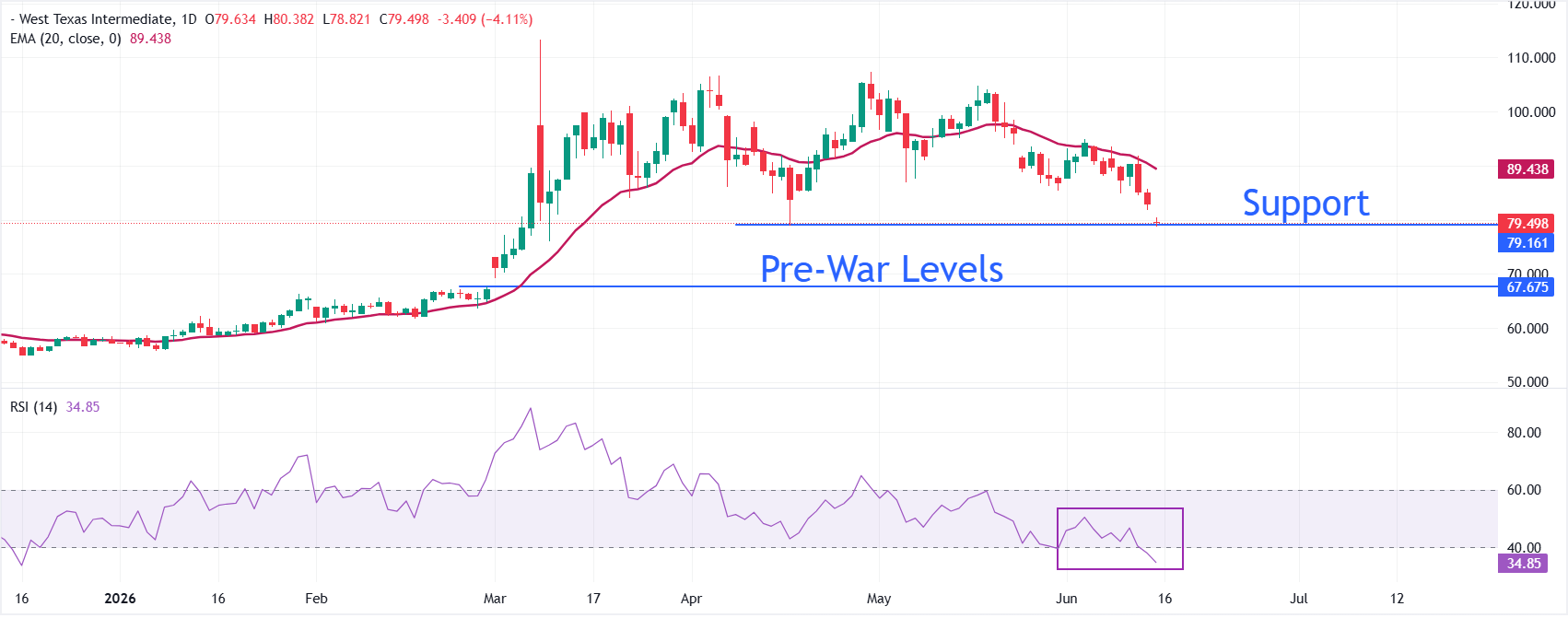
The WTI US Oil trades lower at around $79.50 at press time. The near-term bias is bearish as price holds well below the 20-day Exponential Moving Average (EMA) at $89.44, underscoring persistent overhead supply after the recent slide.
The Relative Strength Index (RSI) slides to 34.84, which suggests that the downside momentum remains in place and could intensify further.
On the topside, the 20-day EMA at $89.44 forms the first meaningful resistance, and a recovery above this dynamic cap would be needed to ease the immediate bearish tone and open the door to a deeper corrective bounce. Looking down, the oil price could slide to the March 10 low at $75.95 if it extends its decline below the April 17 low at $78.88. Further support levels are $70.00, and the February 27 high at $67.74, which is the pre-war level.
(The technical analysis of this story was written with the help of an AI tool.)
WTI Oil FAQs
WTI Oil is a type of Crude Oil sold on international markets. The WTI stands for West Texas Intermediate, one of three major types including Brent and Dubai Crude. WTI is also referred to as “light” and “sweet” because of its relatively low gravity and sulfur content respectively. It is considered a high quality Oil that is easily refined. It is sourced in the United States and distributed via the Cushing hub, which is considered “The Pipeline Crossroads of the World”. It is a benchmark for the Oil market and WTI price is frequently quoted in the media.
Like all assets, supply and demand are the key drivers of WTI Oil price. As such, global growth can be a driver of increased demand and vice versa for weak global growth. Political instability, wars, and sanctions can disrupt supply and impact prices. The decisions of OPEC, a group of major Oil-producing countries, is another key driver of price. The value of the US Dollar influences the price of WTI Crude Oil, since Oil is predominantly traded in US Dollars, thus a weaker US Dollar can make Oil more affordable and vice versa.
The weekly Oil inventory reports published by the American Petroleum Institute (API) and the Energy Information Agency (EIA) impact the price of WTI Oil. Changes in inventories reflect fluctuating supply and demand. If the data shows a drop in inventories it can indicate increased demand, pushing up Oil price. Higher inventories can reflect increased supply, pushing down prices. API’s report is published every Tuesday and EIA’s the day after. Their results are usually similar, falling within 1% of each other 75% of the time. The EIA data is considered more reliable, since it is a government agency.
OPEC (Organization of the Petroleum Exporting Countries) is a group of 12 Oil-producing nations who collectively decide production quotas for member countries at twice-yearly meetings. Their decisions often impact WTI Oil prices. When OPEC decides to lower quotas, it can tighten supply, pushing up Oil prices. When OPEC increases production, it has the opposite effect. OPEC+ refers to an expanded group that includes ten extra non-OPEC members, the most notable of which is Russia.
Recommended Articles


