


Australian Dollar extends gains following higher S&P/ASX 200 amid a stable US Dollar
- Australian Dollar strengthened in response to the increase in the S&P/ASX 200 Index.
- Australian capital market surged to new record highs, buoyed by gains in Wall Street overnight.
- Chinese Manufacturing PMI declined to 49.1 and Non-Manufacturing PMI improved to 51.4 in February.
- US Dollar Index (DXY) maintains stability amid the improved US Treasury yields.
The Australian Dollar (AUD) remains in positive territory on Friday, buoyed by a rise in the S&P/ASX 200 Index to new record highs, coupled with gains in Wall Street overnight. However, the AUD/USD pair saw some retracement on Thursday as the US Dollar (USD) strengthened following the release of the Federal Reserve's preferred inflation gauge, the US Personal Consumption Expenditures - Price Index, which met expectations.
Australian Dollar received a boost after the release of Australia's Retail Sales and Private Capital Expenditure data on Thursday. Additionally, the Judo Bank Manufacturing PMI indicated a slight improvement in Australia's manufacturing sector, with the February reading rising to 47.8 from 47.7 in the previous period.
The US Dollar Index (DXY) remains stable with the uptick in US Treasury yields. The delay in expectations for the Federal Reserve's first rate cut, prompted by recent Gross Domestic Product (GDP) data from the United States (US), has lent support to the Greenback. Investors are now turning their attention to the final US S&P Global Manufacturing PMI for February, which is due to be released on Friday.
Daily Digest Market Movers: Australian Dollar improves on higher equity market
- The seasonally adjusted Australian Retail Sales (MoM) grew by 1.1% in January, lower than expected 1.5% but swinging from the previous decline of 2.7%.
- Australian Private Capital Expenditure improved by 0.8% in the fourth quarter of 2023, from the expected 0.5% and 0.6% prior.
- Australian Monthly Consumer Price Index (CPI) was unchanged at 3.4% for January, which was below market expectations of 3.5%.
- Warren Hogan, Chief Economist Advisor at Judo Bank, expressed concerns about Australia's manufacturing sector, stating that it is not experiencing growth. This observation calls into question the notion of a post-pandemic manufacturing revival.
- Chinese Manufacturing PMI met expectations at 49.1 in February but fell slightly from the previous reading of 49.2. Non-manufacturing PMI improved to 51.4 from the prior 50.7, surpassing the expected reading of 50.8.
- Atlanta Fed President Raphael W. Bostic remarked that recent inflation data suggests the path to achieving the central bank's 2% inflation target will be challenging.
- Chicago Fed President Austan Dean Goolsbee stated that he anticipates the first-rate cuts later this year but refrained from specifying the exact timeline.
- New York Federal Reserve (Fed) President John Williams stated on Wednesday that while there remains some ground to cover in reaching the Fed's 2% inflation target, the possibility of interest rate cuts this year is on the table, contingent upon incoming data.
- According to the CME FedWatch Tool, the probability of rate cuts in March stands at 3.0%, while the likelihood of cuts in May and June is estimated at 23.1% and 52.2%, respectively.
- US Personal Consumption Expenditure (PCE) Price Index grew by 2.4% YoY in January, against the 2.6% prior, in line with the market expectation. The index increased by 0.3% month-over-month, against 0.1% prior.
- US Core PCE (YoY), the Fed preferred inflation gauge, rose by 2.8% compared to December’s reading of 2.9, matching with the consensus. The monthly figure showed a rise of 0.4% as expected, above the previous rise of 0.1%.
- The preliminary US Gross Domestic Product Annualized grew by 3.2% in the fourth quarter of 2023, slightly below market expectations of remaining steady at 3.3%.
- The preliminary US Gross Domestic Product Price Index (Q4) increased by 1.7% against the expected and previous rise of 1.5%.
- US Housing Price Index (MoM) increased by 0.1% in December, falling short of the 0.3% expected and 0.4% prior.
Technical Analysis: Australian Dollar hovers around the psychological level of 0.6500
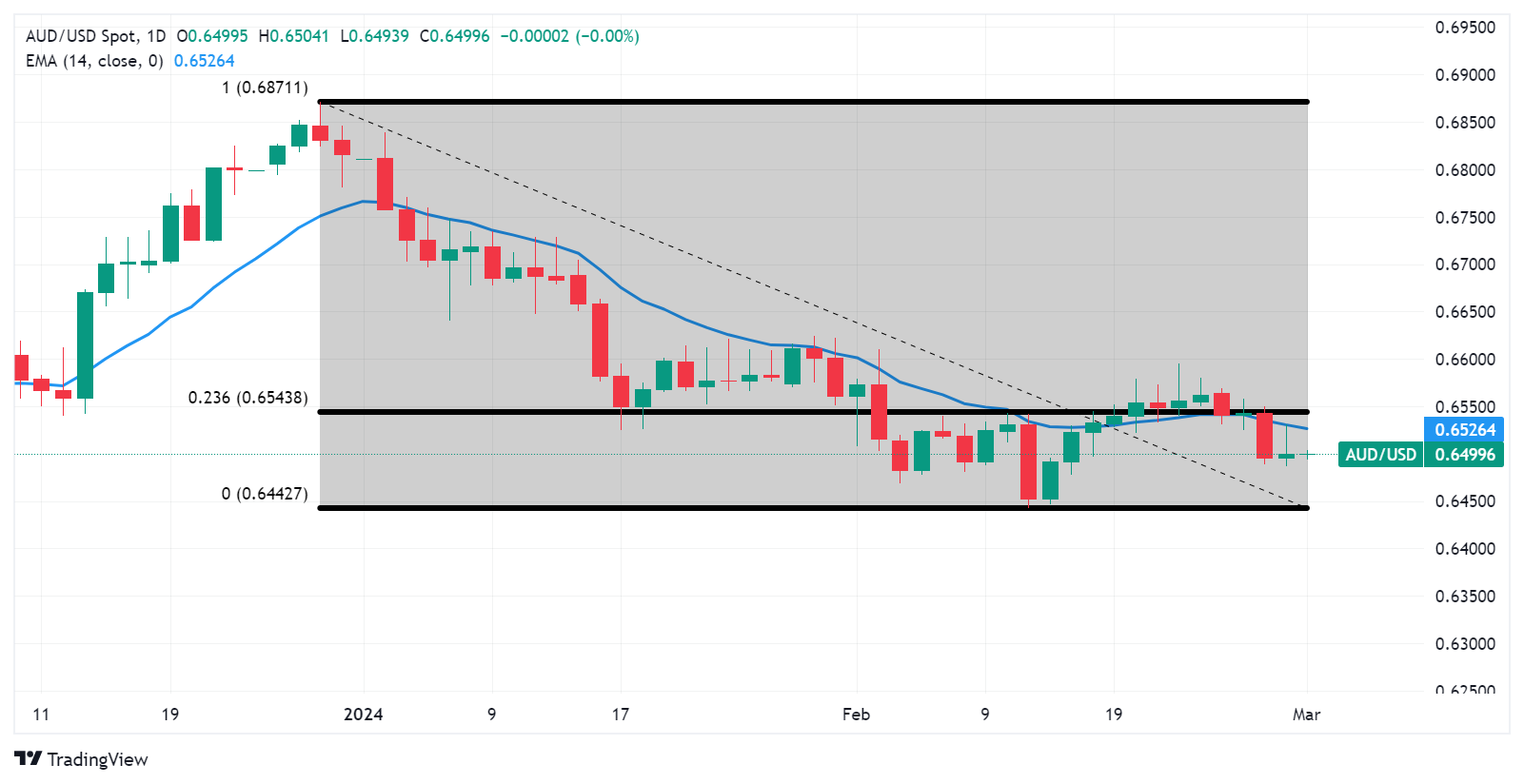
The Australian Dollar hovers around the psychological level of 0.6500 on Friday. A breach below this level could potentially trigger a downward move in the AUD/USD pair, targeting the area around the major support level of 0.6450 and February’s low at 0.6442. Conversely, on the upside, immediate resistance is observed around the 14-day Exponential Moving Average (EMA) at 0.6526, followed by the 23.6% Fibonacci retracement level at 0.6543 and the major level of 0.6550. If the pair breaks above this resistance zone, it may approach the psychological level of 0.6600.
AUD/USD: Daily Chart
Australian Dollar price today
The table below shows the percentage change of Australian Dollar (AUD) against listed major currencies today. Australian Dollar was the strongest against the Japanese Yen.
| USD | EUR | GBP | CAD | AUD | JPY | NZD | CHF | |
| USD | -0.13% | -0.05% | -0.06% | -0.08% | 0.17% | -0.13% | -0.04% | |
| EUR | 0.13% | 0.08% | 0.06% | 0.06% | 0.31% | 0.01% | 0.09% | |
| GBP | 0.06% | -0.08% | -0.02% | -0.01% | 0.24% | -0.07% | 0.02% | |
| CAD | 0.06% | -0.06% | 0.02% | 0.00% | 0.26% | -0.06% | 0.03% | |
| AUD | 0.08% | -0.06% | 0.02% | 0.00% | 0.26% | -0.06% | 0.03% | |
| JPY | -0.17% | -0.30% | -0.22% | -0.25% | -0.25% | -0.31% | -0.21% | |
| NZD | 0.13% | -0.02% | 0.06% | 0.07% | 0.04% | 0.30% | 0.08% | |
| CHF | 0.04% | -0.10% | -0.01% | -0.03% | -0.03% | 0.22% | -0.08% |
The heat map shows percentage changes of major currencies against each other. The base currency is picked from the left column, while the quote currency is picked from the top row. For example, if you pick the Euro from the left column and move along the horizontal line to the Japanese Yen, the percentage change displayed in the box will represent EUR (base)/JPY (quote).
Australian Dollar FAQs
What key factors drive the Australian Dollar?
One of the most significant factors for the Australian Dollar (AUD) is the level of interest rates set by the Reserve Bank of Australia (RBA). Because Australia is a resource-rich country another key driver is the price of its biggest export, Iron Ore. The health of the Chinese economy, its largest trading partner, is a factor, as well as inflation in Australia, its growth rate and Trade Balance. Market sentiment – whether investors are taking on more risky assets (risk-on) or seeking safe-havens (risk-off) – is also a factor, with risk-on positive for AUD.
How do the decisions of the Reserve Bank of Australia impact the Australian Dollar?
The Reserve Bank of Australia (RBA) influences the Australian Dollar (AUD) by setting the level of interest rates that Australian banks can lend to each other. This influences the level of interest rates in the economy as a whole. The main goal of the RBA is to maintain a stable inflation rate of 2-3% by adjusting interest rates up or down. Relatively high interest rates compared to other major central banks support the AUD, and the opposite for relatively low. The RBA can also use quantitative easing and tightening to influence credit conditions, with the former AUD-negative and the latter AUD-positive.
How does the health of the Chinese Economy impact the Australian Dollar?
China is Australia’s largest trading partner so the health of the Chinese economy is a major influence on the value of the Australian Dollar (AUD). When the Chinese economy is doing well it purchases more raw materials, goods and services from Australia, lifting demand for the AUD, and pushing up its value. The opposite is the case when the Chinese economy is not growing as fast as expected. Positive or negative surprises in Chinese growth data, therefore, often have a direct impact on the Australian Dollar and its pairs.
How does the price of Iron Ore impact the Australian Dollar?
Iron Ore is Australia’s largest export, accounting for $118 billion a year according to data from 2021, with China as its primary destination. The price of Iron Ore, therefore, can be a driver of the Australian Dollar. Generally, if the price of Iron Ore rises, AUD also goes up, as aggregate demand for the currency increases. The opposite is the case if the price of Iron Ore falls. Higher Iron Ore prices also tend to result in a greater likelihood of a positive Trade Balance for Australia, which is also positive of the AUD.
How does the Trade Balance impact the Australian Dollar?
The Trade Balance, which is the difference between what a country earns from its exports versus what it pays for its imports, is another factor that can influence the value of the Australian Dollar. If Australia produces highly sought after exports, then its currency will gain in value purely from the surplus demand created from foreign buyers seeking to purchase its exports versus what it spends to purchase imports. Therefore, a positive net Trade Balance strengthens the AUD, with the opposite effect if the Trade Balance is negative.
Recommended Articles


