


EUR/USD drops as Fed sees no rush for monetary policy adjustments
- EUR/USD falls to near 1.0815 as the Fed is in no rush to cut interest rates soon.
- US President Trump’s tariff agenda could lead to cost-push inflation globally.
- ECB Lagarde expects potential Trump-led inflation in the Eurozone won’t be persistent.
EUR/USD trades lower to near the 10-day low of 1.0815 in Friday’s European session. The major currency pair faces selling pressure as the US Dollar (USD) strengthens after the Federal Reserve (Fed) expressed that interest rate cuts are not on the table in the current scenario. The US Dollar Index (DXY), which tracks the Greenback’s value against six major currencies, rises to near 104.15.
On Wednesday, the Fed kept interest rates steady in the range of 4.25%-4.50% for the second time in a row, as expected. Fed Chair Jerome Powell said in the press conference that the central bank is not going to be in a “hurry” to move onto “interest rate cuts”. His comments supporting a restrictive monetary policy stance stemmed from “unusually elevated” uncertainty over the United States (US) economic outlook.
Powell commented that the implementation of new policies by US President Donald Trump could lead to an economic slowdown and a resurgence in inflationary pressures in the near term.
Meanwhile, investors seek meaningful updates on Trump’s plan of imposing reciprocal tariffs on April 2. Market participants expect tariffs might affect economic growth and boost price pressures across the globe. Globally, manufacturers will be forced to underutilize their production capacity, which could result in fresh escalation in cost-push inflation.
On the economic front, investors will focus on the flash US S&P Global Purchasing Managers Index (PMI) data for March, which will be released on Monday.
Daily digest market movers: EUR/USD drops amid weakness in Euro
- The downside move in the EUR/USD pair is also driven by weakness in the Euro (EUR). The major currency underperforms its peers as investors expect US President Trump’s reciprocal tariffs to significantly impact the Eurozone’s economic growth.
- European Central Bank President Christine Lagarde has also warned about downside economic risks from the Trump-led trade war and dials back fears of persistently higher Eurozone inflation. On Thursday, Lagarde said before the European Parliament Committee that the inflationary impact of the trade war would be temporary as the effect would “ease in the medium term” due to “lower economic activity dampening inflationary pressures”.
- The major victim of Trump’s reciprocal tariffs is expected to be Germany, a leading trading partner of the US. The US charges a 2.5% levy on the import of German cars while the Eurozone takes 10% duty. Till now, Trump has threatened to impose 25% tariffs on foreign automobiles and introduce reciprocal tariffs soon. Investors seek to know whether the US will impose 10% or 25% tariffs on German cars.
- Meanwhile, the approval for the infusion of billions of Euros into the German economy through the expansion of borrowing limit by officials at Bundestag lower house of parliament is expected to support the economy from potential US tariff fears. This week, likely Chancellor Frederich Merz-led-Conservatives and the Social Democratic Party (SDP) secured support from the Greens for the creation of an infrastructure fund worth 500 billion Euro (EUR) and breaking fiscal conservatism to boost defense spending.
Technical Analysis: EUR/USD falls to near 1.0815
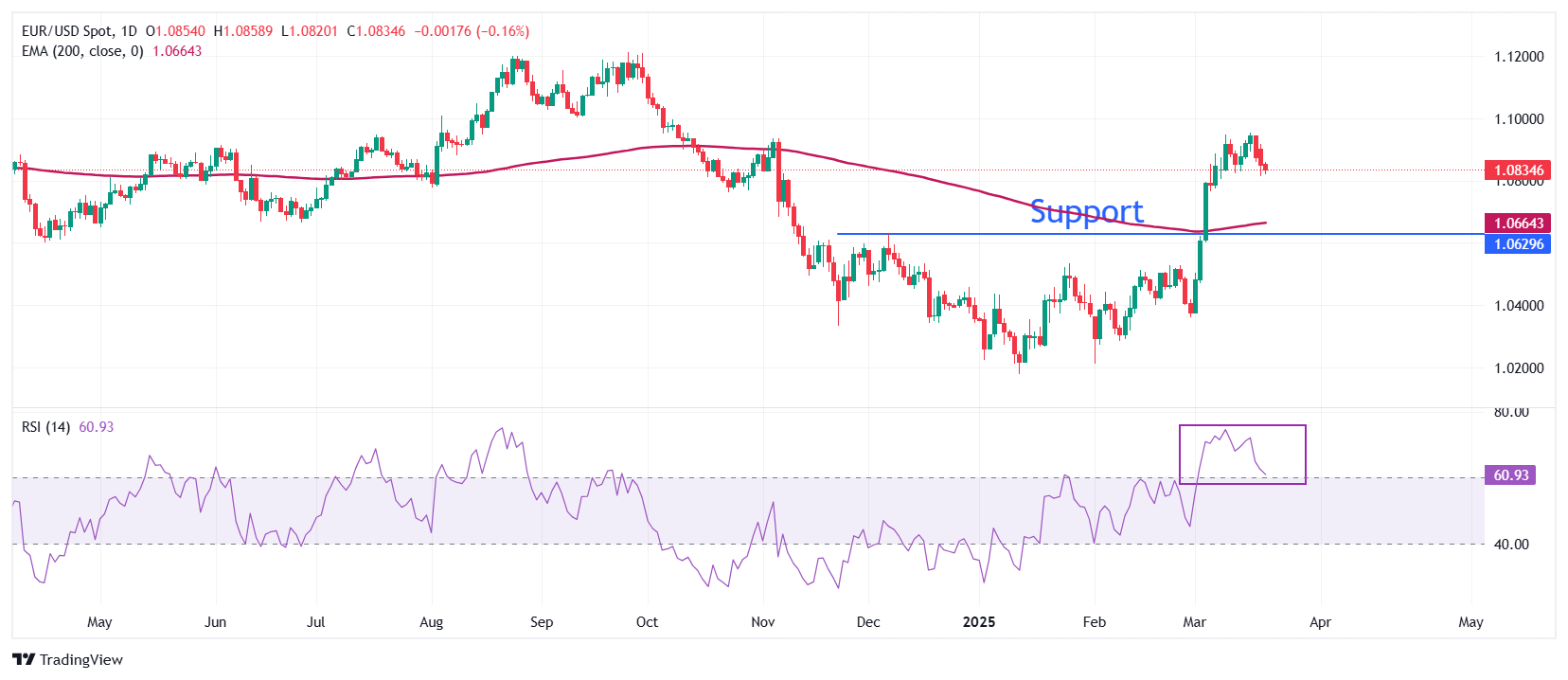
EUR/USD declines to near 1.0815 after failing to hold the key level of 1.0900. However, the long-term outlook of the major currency pair is still bullish as it holds above the 200-day Exponential Moving Average (EMA), which trades around 1.0664.
The pair strengthened after a decisive breakout above the December 6 high of 1.0630 on March 5.
The 14-day Relative Strength Index (RSI) cools down after turning overbought around 75.00, suggesting that the bullish momentum has moderated, but the upside bias remains intact.
Looking down, the December 6 high of 1.0630 will act as the major support zone for the pair. Conversely, the psychological level of 1.1000 will be the key barrier for the Euro bulls.
Euro FAQs
The Euro is the currency for the 19 European Union countries that belong to the Eurozone. It is the second most heavily traded currency in the world behind the US Dollar. In 2022, it accounted for 31% of all foreign exchange transactions, with an average daily turnover of over $2.2 trillion a day. EUR/USD is the most heavily traded currency pair in the world, accounting for an estimated 30% off all transactions, followed by EUR/JPY (4%), EUR/GBP (3%) and EUR/AUD (2%).
The European Central Bank (ECB) in Frankfurt, Germany, is the reserve bank for the Eurozone. The ECB sets interest rates and manages monetary policy. The ECB’s primary mandate is to maintain price stability, which means either controlling inflation or stimulating growth. Its primary tool is the raising or lowering of interest rates. Relatively high interest rates – or the expectation of higher rates – will usually benefit the Euro and vice versa. The ECB Governing Council makes monetary policy decisions at meetings held eight times a year. Decisions are made by heads of the Eurozone national banks and six permanent members, including the President of the ECB, Christine Lagarde.
Eurozone inflation data, measured by the Harmonized Index of Consumer Prices (HICP), is an important econometric for the Euro. If inflation rises more than expected, especially if above the ECB’s 2% target, it obliges the ECB to raise interest rates to bring it back under control. Relatively high interest rates compared to its counterparts will usually benefit the Euro, as it makes the region more attractive as a place for global investors to park their money.
Data releases gauge the health of the economy and can impact on the Euro. Indicators such as GDP, Manufacturing and Services PMIs, employment, and consumer sentiment surveys can all influence the direction of the single currency. A strong economy is good for the Euro. Not only does it attract more foreign investment but it may encourage the ECB to put up interest rates, which will directly strengthen the Euro. Otherwise, if economic data is weak, the Euro is likely to fall. Economic data for the four largest economies in the euro area (Germany, France, Italy and Spain) are especially significant, as they account for 75% of the Eurozone’s economy.
Another significant data release for the Euro is the Trade Balance. This indicator measures the difference between what a country earns from its exports and what it spends on imports over a given period. If a country produces highly sought after exports then its currency will gain in value purely from the extra demand created from foreign buyers seeking to purchase these goods. Therefore, a positive net Trade Balance strengthens a currency and vice versa for a negative balance.
Recommended Articles


