


Mexican Peso rallies boosted by Trump’s friendly remarks
- Mexico's January mid-month inflation drops to below 4%, boosting optimism and supporting Banxico's dovish outlook.
- Unexpected rise in US jobless claims raises due to weather distortions.
- Trump's approving remarks about Mexico at WEF ease trade tensions and strengthen the Peso.
The Mexican Peso (MXN) strengthened against the Greenback during the North American session, hitting a ten-day high on upbeat inflation data from Mexico and a worse-than-expected jobs report from the United States (US). Furthermore, US President Donald Trump's positive comments about Mexico at the World Economic Forum (WEF) were a tailwind for the Mexican currency. The USD/MXN trades at 20.37, down 0.54%.
Inflation in Mexico fared better than expected, as headline mid-month inflation for January dipped to 3.69%, below the 4% mark for the first time in four years, revealed the Instituto Nacional de Estadistica Geografia e Informatica (INEGI). Underlying inflation rose moderately, though both readings remained within Banco de Mexico's (Banxico) 3% plus or minus 1%, justifying Banxico’s intentions to lower borrowing costs on February 6.
In the US, the number of Americans filing unemployment claims rose sharply last week, according to data revealed by the US Department of Labor. The report showed that bad weather, along with fires in Los Angeles, could increase claims in the upcoming weeks.
Meanwhile, the Federal Reserve (Fed) is expected to keep rates unchanged next week. The main reasons behind that decision are the robustness of the US economy, as portrayed by healthy economic growth, a strong labor market and stickier inflation numbers.
On the other hand, Mexico’s economy has continued to cool down and is expected to grow by just 1% in 2025. The slowdown benefited the disinflation process and supports Banxico’s dovish stance.
Recently, US President Donald Trump said he would demand respect from other nations and said that he’s dealing with Mexico “very well.” After these remarks, the USD/MXN pair extended its losses.
This week, Mexico’s economic docket will feature Economic Activity for November, which is expected to improve in monthly figures but not yearly. On the US side, traders are awaiting S&P Global Flash PMIs and Consumer Sentiment.
Daily digest market movers: Mexican Peso appreciates as inflation edges lower
- The Mexican Peso advances versus the US Dollar even though the lowest inflation figures suggest that Banxico will cut rates. Contrarily, the Fed is expected to keep monetary policy unchanged and wait for the March meeting.
- Mexico’s mid-month inflation in January rose by 3.69% YoY, down from 4.44%. Core inflation for the same period increased from 3.62% to 3.72% YoY.
- Citi revealed its Expectations Survey, in which Mexican private economists revised Gross Domestic Product (GDP) figures for 2025 downward to 1%.
- Regarding inflation expectations, analysts estimate headline and core to inflation to dip below 4%, each at 3.91% and 3.68%, while the exchange rate would likely end near 20.95.
- Economists estimate that Banco de Mexico (Banxico) will lower rates by 25 basis points (bps) from 10.00% to 9.75%, though some analysts expect a 50-bps cut at the February 6 meeting.
- The divergence between Banxico and the US Federal Reserve (Fed) favors further upside in the USD/MXN pair.
- US President Trump ordered a comprehensive review of US trade policy, setting an April 1 deadline for recommendations that could significantly transform the country’s trade relations, including the US-Mexico-Canada Agreement (USMCA), set for its first revision in 2026.
- Money market futures have priced in 44 bps of Fed rate cuts in 2025, according to CME FedWatch Tool data.
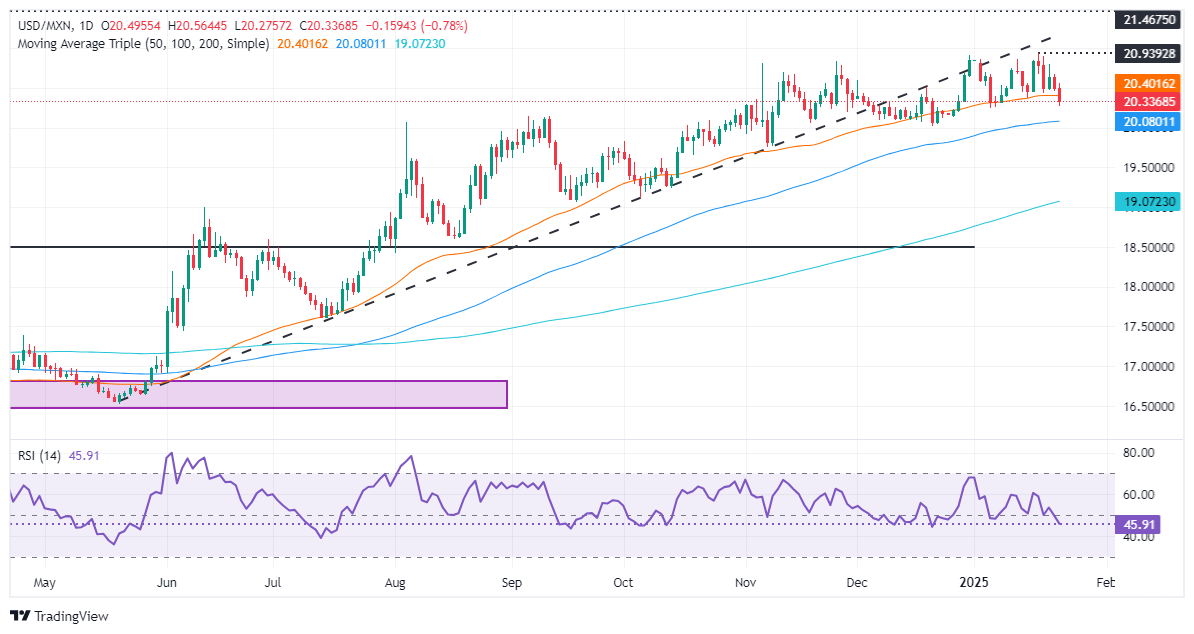
USD/MXN technical outlook: Mexican Peso climbs as USD/MXN tumbles below 20.30
USD/MXN tumbled below 20.50 sponsored by Trump’s friendly rhetoric on Mexico, which has pushed the exchange rate below key support levels like the 20 and 50-day Simple Moving Average (SMA) each at 20.55 and 20.37.
Despite this, the uptrend remains in play.f sellers push the price below the January 6 swing low of 20.22, it will clear the path to challenging the 100-day SMA at 20.05. On further weakness, the exotic pair could test 19.50.
Conversely, for a bullish resumption, the USD/MXN must climb above 20.55 so buyers have a clear path to challenge the year-to-date (YTD) high at 20.90. Once surpassed, the next stop would be 21.00, followed by March 8, 2022, peaking at 21.46 ahead of the 22.00 figure.
Mexican Peso FAQs
The Mexican Peso (MXN) is the most traded currency among its Latin American peers. Its value is broadly determined by the performance of the Mexican economy, the country’s central bank’s policy, the amount of foreign investment in the country and even the levels of remittances sent by Mexicans who live abroad, particularly in the United States. Geopolitical trends can also move MXN: for example, the process of nearshoring – or the decision by some firms to relocate manufacturing capacity and supply chains closer to their home countries – is also seen as a catalyst for the Mexican currency as the country is considered a key manufacturing hub in the American continent. Another catalyst for MXN is Oil prices as Mexico is a key exporter of the commodity.
The main objective of Mexico’s central bank, also known as Banxico, is to maintain inflation at low and stable levels (at or close to its target of 3%, the midpoint in a tolerance band of between 2% and 4%). To this end, the bank sets an appropriate level of interest rates. When inflation is too high, Banxico will attempt to tame it by raising interest rates, making it more expensive for households and businesses to borrow money, thus cooling demand and the overall economy. Higher interest rates are generally positive for the Mexican Peso (MXN) as they lead to higher yields, making the country a more attractive place for investors. On the contrary, lower interest rates tend to weaken MXN.
Macroeconomic data releases are key to assess the state of the economy and can have an impact on the Mexican Peso (MXN) valuation. A strong Mexican economy, based on high economic growth, low unemployment and high confidence is good for MXN. Not only does it attract more foreign investment but it may encourage the Bank of Mexico (Banxico) to increase interest rates, particularly if this strength comes together with elevated inflation. However, if economic data is weak, MXN is likely to depreciate.
As an emerging-market currency, the Mexican Peso (MXN) tends to strive during risk-on periods, or when investors perceive that broader market risks are low and thus are eager to engage with investments that carry a higher risk. Conversely, MXN tends to weaken at times of market turbulence or economic uncertainty as investors tend to sell higher-risk assets and flee to the more-stable safe havens.
Recommended Articles


