

Mexican Peso weakens on lower inflation data, USD revival

Source Fxstreet
  • The Mexican Peso weakens after the release of lower inflation data. 
  • This is expected to speed-up interest-rate cuts by the Bank of Mexico, reducing inflows. 
  • The US Dollar resurfaces from the depths, reviving USD/MXN’s medium-term uptrend. 

The Mexican Peso (MXN) seesaws between tepid gains and losses in its most heavily-traded pairs on Thursday after weakening for two days in a row. The Peso began to fall at the start of the week due to a pronounced risk-off tone permeating markets which tends to disproportionately disadvantage emerging market currencies. 

Sentiment soured as investors made clear their disappointment at the lack of stimulus measures announced by the China National Development and Reform Commission (NDRC) over the weekend. These concerns later eased, however, after China’s Finance Ministry said it would announce a fresh package of fiscal measures on October 12. 

On Wednesday the Peso continued to weaken following the release of lower-than-expected Mexican inflation data. This showed that in the 12 months to September the headline rate of inflation fell to 4.58%, from 4.99% recorded in August. A strengthening US Dollar (USD) supplied a further headwind.

The decline in inflation increases the probability of the Bank of Mexico (Banxico) will make deeper cuts to interest rates in the near future. This, in turn, could reduce foreign capital inflows, resulting in lower demand for the Mexican Peso. 

Mexican Peso could find support from new wage laws

The Mexican Peso might gain some support from new wage laws passed on Wednesday which enshrine in the constitution workers rights to see their wages rise in line with inflation. 

“With 124 votes in favor..the Senate of the Republic approved in general and in particular the reform to establish the annual fixing of general or professional minimum wages, as well as their revision, and that they never be below inflation,” reported El Financiero. 

“The purpose of the reform is to ensure that Mexicans' income does not fall below inflation, which will favor their purchasing power. Therefore, year after year, increases or adjustments could be made based on inflation,” the report went on. 

The benchmarking of wages to inflation could slow the disinflationary trend, if workers continue spending at current rates. In addition, if businesses pass on inflation-linked employee wage costs to consumers this will also maintain inflation. 

Continued elevated inflation would, in turn, delay any cuts to interest rates planned by Banxico – or make the reductions more gradual – with the side-effect of propping up the Mexican Peso. 

Sheinbaum takes control of Mexican Oil

The Mexican Peso has seen volatility due to rising political risk premia since the re-election of the Morena-led government in June and this could revive as foreign investors digest the news that President Claudia Sheinbaum is moving to take greater control of Mexico’s Oil state-backed industry.  

On Wednesday, Mexico’s Congress debated the reclassification of two of Mexico’s largest OIl producers, Pemex and the Federal Electricity Commission (FEC) with a view to increasing their control of the companies and renaming them as “public enterprises.” The change “would force them to prioritize the government's social and economic objectives over corporate profits,” according to El Financiero.

The reform was initially proposed by Sheinbaum's mentor and predecessor, former President Andrés Manuel López Obrador (AMLO), and is expected to win the approval of the ruling coalition's decisive majority in Congress.

Technical Analysis: USD/MXN starts rising from base of channel

USD/MXN starts to recover after touching the base of a medium-term rising channel.  

USD/MXN Daily Chart 
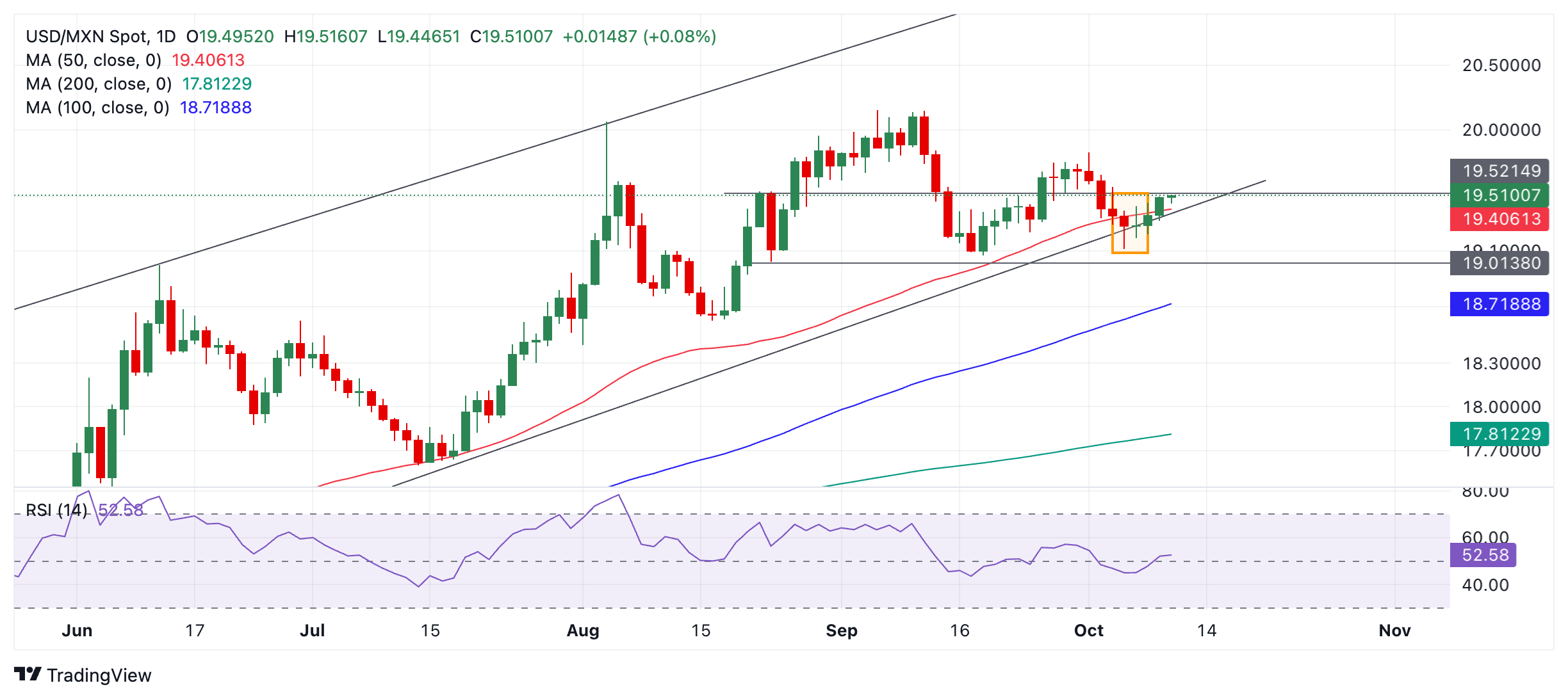
USD/MXN is probably starting a new uptrending leg within its ascending channel. The medium and longer-term trends are bullish, and given the technical analysis principle that “the trend is your friend,” this favors a continuation higher.

On October 4 the pair formed a bullish Japanese Hammer candlestick pattern at the base of the channel (orange rectangle on the chart). This was followed by a slightly bullish Japanese Doji candlestick and then two green up candles. This configuration marks the reversal of the short-term trend which is now technically bullish. 

USD/MXN has just reached resistance at 19.51 (August 22 high) if it can break above 19.57 it will signal a clearance of this resistance and a probable continuation higher to the next upside target at around 19.83 (October 1 high).

Economic Indicator

12-Month Inflation

The 12-month inflation index released by the Bank of Mexico is a measure of price movements by the comparison between the retail prices of a representative shopping basket of goods and services. The purchase power of Mexican Peso is dragged down by inflation. The inflation index is a key indicator since it is used by the central bank to set interest rates. Generally speaking, a high reading is seen as positive (or bullish) for the Mexican Peso, while a low reading is seen as negative (or Bearish).

Read more.

Last release: Wed Oct 09, 2024 12:00

Frequency: Monthly

Actual: 4.58%

Consensus: 4.62%

Previous: 4.99%

Source: National Institute of Statistics and Geography of Mexico


Disclaimer: For information purposes only. Past performance is not indicative of future results.
placeholder
Bitcoin CME gaps at $35,000, $27,000 and $21,000, which one gets filled first?Prioritize filling the $27,000 gap and even try higher.
Author  FXStreet
Aug 22, 2023
Prioritize filling the $27,000 gap and even try higher.
placeholder
Natural Gas sinks to pivotal level as China’s demand slumpsNatural Gas price (XNG/USD) edges lower and sinks to $2.56 on Monday, extending its losing streak for the fifth day in a row. The move comes on the back of China cutting its Liquified Natural Gas (LNG) imports after prices rose above $3.0 in June. It
Author  FXStreet
Jul 01, 2024
Natural Gas price (XNG/USD) edges lower and sinks to $2.56 on Monday, extending its losing streak for the fifth day in a row. The move comes on the back of China cutting its Liquified Natural Gas (LNG) imports after prices rose above $3.0 in June. It
placeholder
Bitcoin briefly loses 2025 gains as crypto plunges over the weekend.Bitcoin experienced a sharp decline this weekend, briefly erasing its 2025 gains and dipping below its year-opening value of $93,507. The cryptocurrency fell to a low of $93,029 on Sunday, representing a 25% drop from its all-time high in October. Although it has rebounded slightly to around $94,209, the pressures on the market remain significant. The downturn occurred despite the reopening of the U.S. government on Thursday, which many had hoped would provide essential support for crypto markets. This year initially appeared promising for cryptocurrencies, particularly after the inauguration of President Donald Trump, who has established the most pro-crypto administration thus far. However, ongoing political tensions—including Trump's tariff strategies and the recent government shutdown, lasting a historic 43 days—have contributed to several rapid price pullbacks for Bitcoin throughout the year. Market dynamics are also being influenced by Bitcoin whales—investors holding large amounts of Bitcoin—who have been offloading portions of their assets, consequently stalling price rallies even as positive regulatory developments emerge. Despite these sell-offs, analysts from Glassnode argue that this behavior aligns with typical patterns seen among long-term investors during the concluding stages of bull markets, suggesting it is not indicative of a mass exodus. Notably, Bitcoin is not alone in its struggles, as Ethereum and Solana have also recorded declines of 7.95% and 28.3%, respectively, since the start of the year, while numerous altcoins have faced even steeper losses. Looking ahead, questions linger regarding the viability of the four-year cycle thesis, particularly given the increasing institutional support and regulatory frameworks now in place in the crypto landscape. Matt Hougan, chief investment officer at Bitwise, remains optimistic, suggesting a potential Bitcoin resurgence in 2026 driven by the “debasement trade” thesis and a broader trend toward increased adoption of stablecoins, tokenization, and decentralized finance. Hougan emphasized the soundness of the underlying fundamentals, pointing to a positive outlook for the sector in the longer term.
Author  Mitrade
Nov 17, 2025
Bitcoin experienced a sharp decline this weekend, briefly erasing its 2025 gains and dipping below its year-opening value of $93,507. The cryptocurrency fell to a low of $93,029 on Sunday, representing a 25% drop from its all-time high in October. Although it has rebounded slightly to around $94,209, the pressures on the market remain significant. The downturn occurred despite the reopening of the U.S. government on Thursday, which many had hoped would provide essential support for crypto markets. This year initially appeared promising for cryptocurrencies, particularly after the inauguration of President Donald Trump, who has established the most pro-crypto administration thus far. However, ongoing political tensions—including Trump's tariff strategies and the recent government shutdown, lasting a historic 43 days—have contributed to several rapid price pullbacks for Bitcoin throughout the year. Market dynamics are also being influenced by Bitcoin whales—investors holding large amounts of Bitcoin—who have been offloading portions of their assets, consequently stalling price rallies even as positive regulatory developments emerge. Despite these sell-offs, analysts from Glassnode argue that this behavior aligns with typical patterns seen among long-term investors during the concluding stages of bull markets, suggesting it is not indicative of a mass exodus. Notably, Bitcoin is not alone in its struggles, as Ethereum and Solana have also recorded declines of 7.95% and 28.3%, respectively, since the start of the year, while numerous altcoins have faced even steeper losses. Looking ahead, questions linger regarding the viability of the four-year cycle thesis, particularly given the increasing institutional support and regulatory frameworks now in place in the crypto landscape. Matt Hougan, chief investment officer at Bitwise, remains optimistic, suggesting a potential Bitcoin resurgence in 2026 driven by the “debasement trade” thesis and a broader trend toward increased adoption of stablecoins, tokenization, and decentralized finance. Hougan emphasized the soundness of the underlying fundamentals, pointing to a positive outlook for the sector in the longer term.
placeholder
WTI Price Forecast: Seems vulnerable near $90.50 as technical breakdown comes into playWest Texas Intermediate (WTI) – the benchmark US Crude Oil price – plummets to a nearly two-week trough during the Asian session on Wednesday in reaction to news that the US and Iran have agreed to a two-week ceasefire.
Author  FXStreet
Yesterday 01: 48
West Texas Intermediate (WTI) – the benchmark US Crude Oil price – plummets to a nearly two-week trough during the Asian session on Wednesday in reaction to news that the US and Iran have agreed to a two-week ceasefire.
placeholder
Gold remains depressed as skepticism over US-Iran truce supports USDGold (XAU/USD) once again shows some resilience below the $4,700 mark during the Asian session on Thursday, and for now, seems to have stalled the previous day's retracement slide from a three-week high.
Author  FXStreet
8 hours ago
Gold (XAU/USD) once again shows some resilience below the $4,700 mark during the Asian session on Thursday, and for now, seems to have stalled the previous day's retracement slide from a three-week high.
Related Instrument
goTop
quote