


Indian Rupee outperforms amid strong foreign inflows, shrugging off surging US Dollar
- The Indian Rupee hits a fresh six-month high against the US Dollar.
- FIIs continue to raise their stake in the Indian stock market.
- The US Dollar outperforms its other peers as hopes of Fed’s bigger rate hike come into picture.
The Indian Rupee (INR) rises further against the US Dollar (USD) on Thursday, posting a fresh six-month low. The USD/INR pair falls to near 93.65 as the Indian currency outperforms on the back of strong inflows of overseas investment into the Indian stock market.
Foreign Institutional Investors (FIIs) continue to increase their investment in the Indian equity market as fresh headwinds in the global Artificial Intelligence (AI) stocks and falling energy prices have underpinned “India” as a competitive bet.
So far in November, FIIs have remained net buyers on all trading days, except Diwali Muhurat session, that fell on Sunday, November 08. Foreign investors have made a cumulative investment of Rs. 65,735.57 crore.
What are the fresh headwinds in global AI sector?
Concerns about the continuation of spending on AI infrastructure, following the victory of Democrats in the United States (US) midterm elections, pushed AI-related stocks into turmoil.
And now fears of replacement of Nvidia’s CEO Jensen Huang after reports from New York Times (NYT) of his extramarital affair with alleged Chinese spy Alice Huang and rumours of a relationship with his subordinate Kimberly Powell, Nvidia's vice president of health care, could put AI stocks under pressure.
The Wall Street Journal (WSJ) has reported that Nvidia's board was preparing to oust the CEO, adding that the next 48 hours as potentially volatile.
Lower oil prices – a tailwind for net energy importers
Falling oil prices due to hopes that the US and Iran would prefer a deal rather than renewing military attacks have improved the appeal of currencies from economies, such as India, which rely heavily on oil imports to meet their energy needs.
As of writing, the MCX Crude Oil contract expiring on November 19 is down 2.42%, slightly below Rs. 8,000.
Investors ignore US Dollar’s outperformance
The Indian currency continues to outperform the US Dollar even as the latter has surged significantly in the past few trading days. In the Asian trade, the US Dollar Index (DXY), which gauges the Greenback’s value against six major currencies, posts a fresh 18-month high at around 103.06.
The US Dollar strengthens as financial markets take the possibility of a bigger interest rate hike by the Federal Reserve (Fed) in the December policy meeting into consideration.
According to TD Securities, the “strong upside surprise in the Consumer Price Index (CPI) data makes a December hike all but certain,” with the bank reiterating that the data “certainly seals a Dec rate hike by the Fed.” Strategists note that “after Waller's speech on Tuesday, the debate has now shifted to whether the FOMC will go 25 or 50bps,” as Governor Waller’s pre-CPI remarks have sharpened the focus on the need for a potential “catch-up” move. TD Securities writes that the discussion will now centre on whether the Fed should implement a “catch-up 50bps rate hike in December, or whether to maintain course with a 25bps rate increase and provide strong guidance toward a potential January follow-through.” For now, they emphasize that “we still favor a 25bp hike with a rising risk of another hike in January.”
USD/INR Technical Analysis
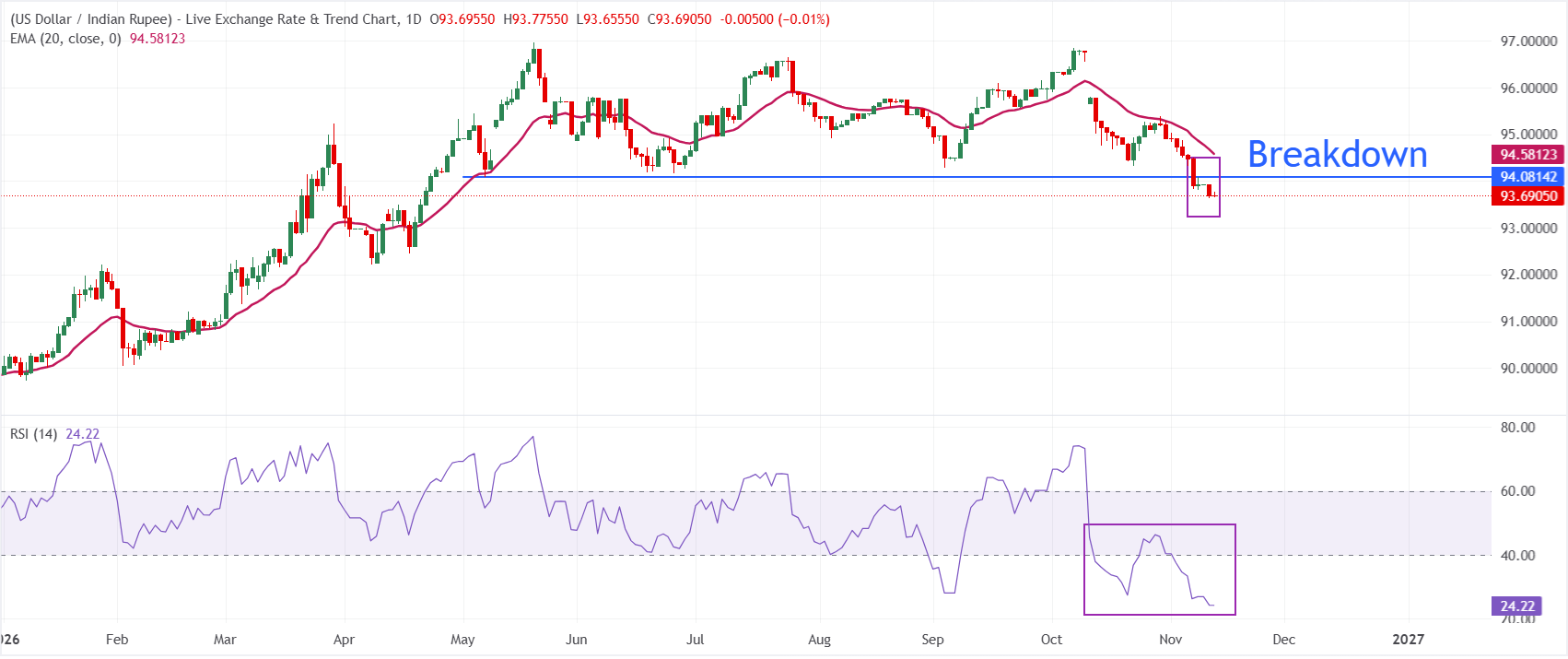
In the daily chart, USD/INR trades at 93.69, maintaining a bearish near-term bias as spot holds below the 20-period exponential moving average (EMA) at 94.58.
The pair’s slide under this short-term trend benchmark suggests sellers remain in control, while the Relative Strength Index (14) around 24 signals oversold conditions that could slow the downside without yet implying a confirmed reversal.
On the topside, immediate resistance aligns with the 20-day EMA at 94.5812, which caps recovery attempts and defines the first hurdle for any meaningful rebound. Looking down, the pair could extend its decline to near 93.00
(The technical analysis of this story was written with the help of an AI tool. Know more.)
Indian Rupee FAQs
The Indian Rupee (INR) is one of the most sensitive currencies to external factors. The price of Crude Oil (the country is highly dependent on imported Oil), the value of the US Dollar – most trade is conducted in USD – and the level of foreign investment, are all influential. Direct intervention by the Reserve Bank of India (RBI) in FX markets to keep the exchange rate stable, as well as the level of interest rates set by the RBI, are further major influencing factors on the Rupee.
The Reserve Bank of India (RBI) actively intervenes in forex markets to maintain a stable exchange rate, to help facilitate trade. In addition, the RBI tries to maintain the inflation rate at its 4% target by adjusting interest rates. Higher interest rates usually strengthen the Rupee. This is due to the role of the ‘carry trade’ in which investors borrow in countries with lower interest rates so as to place their money in countries’ offering relatively higher interest rates and profit from the difference.
Macroeconomic factors that influence the value of the Rupee include inflation, interest rates, the economic growth rate (GDP), the balance of trade, and inflows from foreign investment. A higher growth rate can lead to more overseas investment, pushing up demand for the Rupee. A less negative balance of trade will eventually lead to a stronger Rupee. Higher interest rates, especially real rates (interest rates less inflation) are also positive for the Rupee. A risk-on environment can lead to greater inflows of Foreign Direct and Indirect Investment (FDI and FII), which also benefit the Rupee.
Higher inflation, particularly, if it is comparatively higher than India’s peers, is generally negative for the currency as it reflects devaluation through oversupply. Inflation also increases the cost of exports, leading to more Rupees being sold to purchase foreign imports, which is Rupee-negative. At the same time, higher inflation usually leads to the Reserve Bank of India (RBI) raising interest rates and this can be positive for the Rupee, due to increased demand from international investors. The opposite effect is true of lower inflation.
Recommended Articles


