


Euro gives back early gains as US Dollar bounces back
- Euro retreats to near 1.1213 against the US Dollar as the latter rebounds.
- Higher oil prices appeal to have supported the US Dollar’s recovery move.
- French fiscal risks widen to other Eurozone nations.
The Euro (EUR) surrenders its early gains against the US Dollar (USD) and flattens at around 1.1213 during the European trading session on Tuesday. The major currency pair falls back as the US Dollar rebounds strongly due to a further increase in oil prices.
In European trade, the US Dollar Index (DXY), which gauges the Greenback’s value against six major currencies, rebounds to near 101.91 from its day’s low of 101.74. Still, the DXY is down 0.13%.
The WTI Oil price jumps 2.15% to near $100.20, the highest level seen in over a month. Ongoing conflicts in the Middle East, with Iran threatening to extend blockade to other sea routs, have increased risk premium for oil prices.
Higher oil prices de-anchor global inflation expectations, a scenario that increases the odds of interest rate hikes by central banks.
The US Dollar underperformed in the past week due to concerns over Artificial Intelligence (AI)-related optimism.
Analysts at MUFG highlight that US financial markets have been “a major beneficiary of strong foreign investor demand driven by AI-related optimism.” They note that foreign investors purchased “USD942 billion of US equities in the twelve months to July, while purchases of US corporate bonds increased sharply to USD452 billion over the same period.” MUFG argues that these “sizeable inflows highlight how the USD has become increasingly tied to investors’ search for higher returns in US financial markets, rather than benefiting from its traditional safe-haven status.” However, they caution that “this dynamic also leaves the USD more exposed to a reversal if sentiment towards AI deteriorates.”
Meanwhile, French fiscal turmoil spreading to other nations of the Eurozone has dampened the appeal of the Euro.
Analysts at Deutsche Bank highlight how the latest bout of French political turmoil has rippled across European markets, noting that “those market concerns around French debt cascaded across other countries and asset classes too.” They point out that “the Italian 10yr spread over bunds was also up +4.7bps on the day to 111bps, whilst Spain’s was up +1.2bps to 62bps.”
EUR/USD Technical Analysis
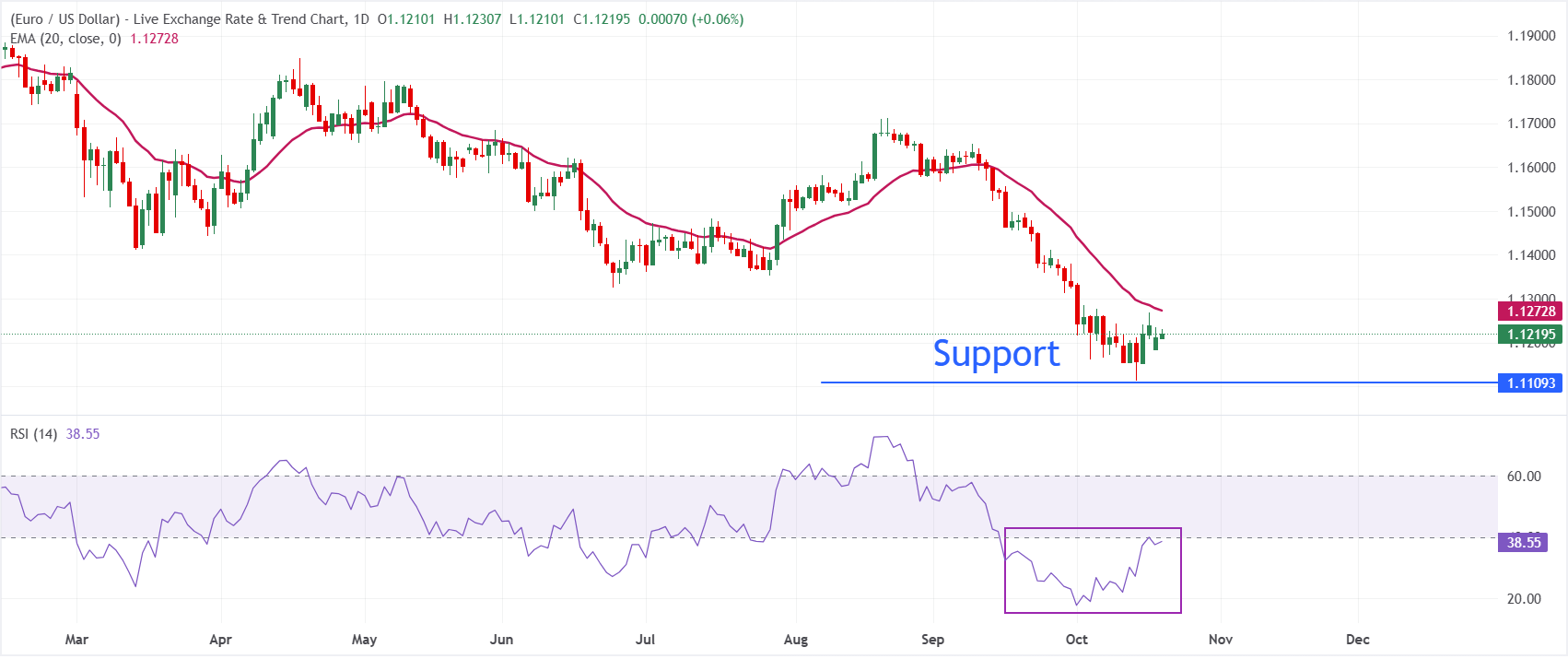
In the daily chart, EUR/USD trades at 1.1219, keeping a bearish near-term tone as it remains below the 20-period exponential moving average (EMA) at 1.1273. The pair’s inability to reclaim this short-term EMA suggests that rallies are being capped by overhead supply, while the Relative Strength Index (14) at 38.5 stays below the neutral 50 line, hinting at lingering downside pressure rather than a decisive recovery.
On the topside, immediate resistance is located at the 20-period EMA at 1.1273, which needs to be cleared to ease the current bearish bias and open the way for a more sustained rebound. Until that level is reclaimed, price action is likely to remain vulnerable to renewed selling on approaches to the EMA, with the lack of nearby technical supports on the chart reinforcing the risk of further slippage if sellers regain control.
(The technical analysis of this story was written with the help of an AI tool. Know more.)
US Dollar FAQs
The US Dollar (USD) is the official currency of the United States of America, and the ‘de facto’ currency of a significant number of other countries where it is found in circulation alongside local notes. It is the most heavily traded currency in the world, accounting for over 88% of all global foreign exchange turnover, or an average of $6.6 trillion in transactions per day, according to data from 2022. Following the second world war, the USD took over from the British Pound as the world’s reserve currency. For most of its history, the US Dollar was backed by Gold, until the Bretton Woods Agreement in 1971 when the Gold Standard went away.
The most important single factor impacting on the value of the US Dollar is monetary policy, which is shaped by the Federal Reserve (Fed). The Fed has two mandates: to achieve price stability (control inflation) and foster full employment. Its primary tool to achieve these two goals is by adjusting interest rates. When prices are rising too quickly and inflation is above the Fed’s 2% target, the Fed will raise rates, which helps the USD value. When inflation falls below 2% or the Unemployment Rate is too high, the Fed may lower interest rates, which weighs on the Greenback.
In extreme situations, the Federal Reserve can also print more Dollars and enact quantitative easing (QE). QE is the process by which the Fed substantially increases the flow of credit in a stuck financial system. It is a non-standard policy measure used when credit has dried up because banks will not lend to each other (out of the fear of counterparty default). It is a last resort when simply lowering interest rates is unlikely to achieve the necessary result. It was the Fed’s weapon of choice to combat the credit crunch that occurred during the Great Financial Crisis in 2008. It involves the Fed printing more Dollars and using them to buy US government bonds predominantly from financial institutions. QE usually leads to a weaker US Dollar.
Quantitative tightening (QT) is the reverse process whereby the Federal Reserve stops buying bonds from financial institutions and does not reinvest the principal from the bonds it holds maturing in new purchases. It is usually positive for the US Dollar.
Recommended Articles


