


Euro gives away gains amid geopolitical uncertainty, rising Oil prices
- EUR/USD drifts to session lows near 1.1630 from Monday's highs above 1.1660.
- The Euro struggles with oil prices above the key $100 level.
- Frail hopes of progress in the US-Iran peace plan are keeping the Euro from falling further.
The Euro (EUR) resumes its bearish trend against the US Dollar (USD) on Tuesday, retreating to levels near 1.1630 at the time of writing, from Monday’s highs right above 1.1660. The uncertainty around the US-Iran conflict and concerns about the inflationary impact of high Oil prices are keeping the Euro on its back foot.
US President Donald Trump affirmed on Monday that an attack on Iran was postponed as, he said, “serious negotiations” are taking place. Markets, however, remain skeptical, as the parties seem far apart on key issues, such as nuclear power.
Oil prices remain more than 30% above pre-war levels. The Brent Crude barrel is above $107.00, and the US benchmark West Texas Intermediate (WTI) is near $103.00, fuelling concerns about long-lasting inflationary pressures that will weigh heavily on the crude-importing Eurozone economies and act as a headwind to a significant Euro recovery.
Technical analysis: The Euro maintains its bearish trend intact
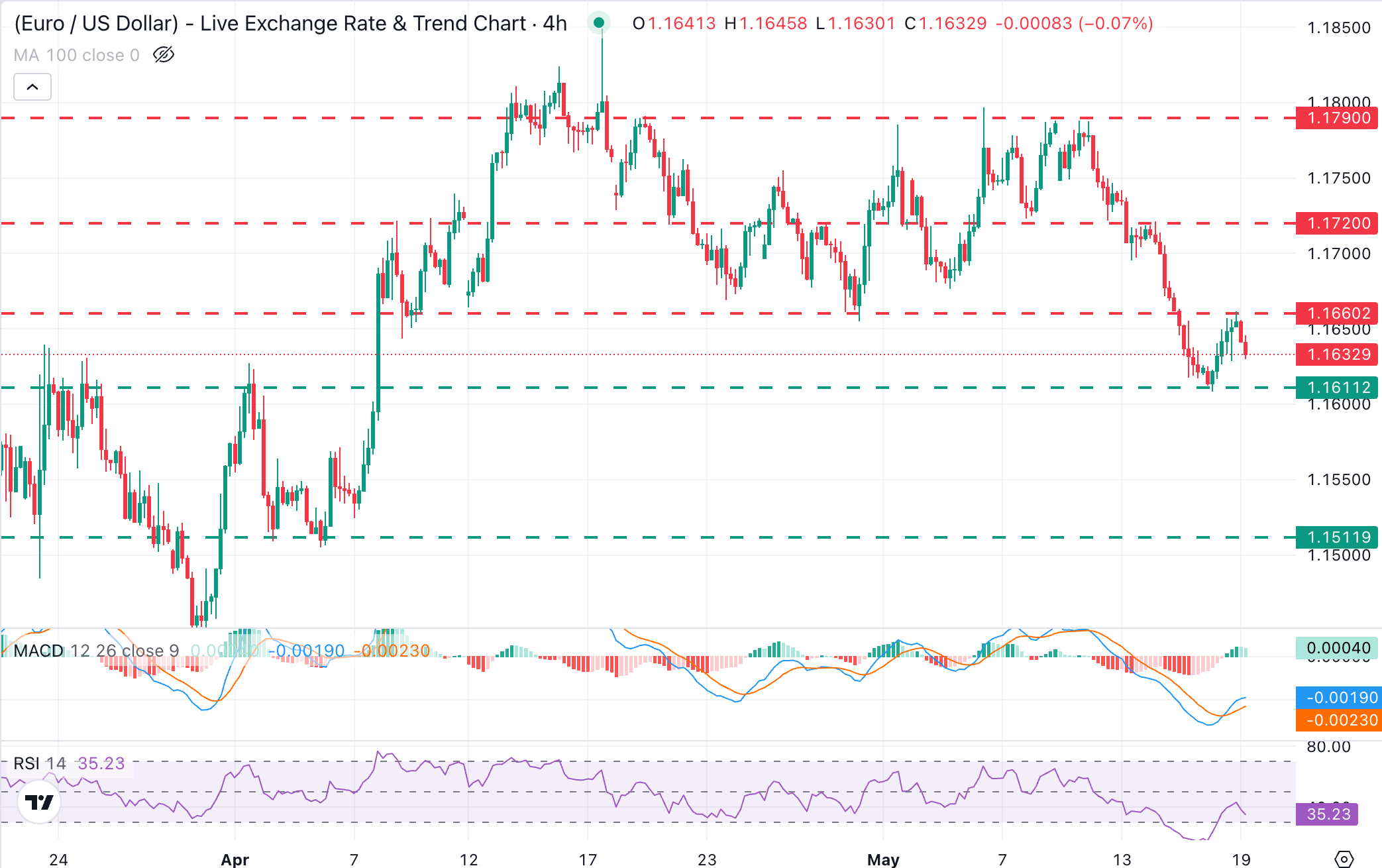
EUR/USD holds a bearish tone with price action capped below the bottom of the last four weeks' trading range, at the 1.1660-1.1675 area. The 4-hour Moving Average Convergence Divergence (MACD) histogram has turned slightly positive, hinting at waning downside pressure, but the Relative Strength Index (RSI) near 36 still points to a weak recovery and favors sellers on rebounds.
On the downside, Monday's low at 1.1610 remains at a short distance. A clear break of that level would expose the deeper floor at April's bottom in the 1.1510-1.1525 area.
Bulls, on the other hand, would have to break the mentioned resistance area ahead of 1.1675 to ease negative pressure and shift the focus towards the May 14 high, at 1.1720, and the May 7, 8, and 11 highs, in the 1.1790 area.
(The technical analysis of this story was written with the help of an AI tool.)
Euro FAQs
The Euro is the currency for the 20 European Union countries that belong to the Eurozone. It is the second most heavily traded currency in the world behind the US Dollar. In 2022, it accounted for 31% of all foreign exchange transactions, with an average daily turnover of over $2.2 trillion a day. EUR/USD is the most heavily traded currency pair in the world, accounting for an estimated 30% off all transactions, followed by EUR/JPY (4%), EUR/GBP (3%) and EUR/AUD (2%).
The European Central Bank (ECB) in Frankfurt, Germany, is the reserve bank for the Eurozone. The ECB sets interest rates and manages monetary policy. The ECB’s primary mandate is to maintain price stability, which means either controlling inflation or stimulating growth. Its primary tool is the raising or lowering of interest rates. Relatively high interest rates – or the expectation of higher rates – will usually benefit the Euro and vice versa. The ECB Governing Council makes monetary policy decisions at meetings held eight times a year. Decisions are made by heads of the Eurozone national banks and six permanent members, including the President of the ECB, Christine Lagarde.
Eurozone inflation data, measured by the Harmonized Index of Consumer Prices (HICP), is an important econometric for the Euro. If inflation rises more than expected, especially if above the ECB’s 2% target, it obliges the ECB to raise interest rates to bring it back under control. Relatively high interest rates compared to its counterparts will usually benefit the Euro, as it makes the region more attractive as a place for global investors to park their money.
Data releases gauge the health of the economy and can impact on the Euro. Indicators such as GDP, Manufacturing and Services PMIs, employment, and consumer sentiment surveys can all influence the direction of the single currency. A strong economy is good for the Euro. Not only does it attract more foreign investment but it may encourage the ECB to put up interest rates, which will directly strengthen the Euro. Otherwise, if economic data is weak, the Euro is likely to fall. Economic data for the four largest economies in the euro area (Germany, France, Italy and Spain) are especially significant, as they account for 75% of the Eurozone’s economy.
Another significant data release for the Euro is the Trade Balance. This indicator measures the difference between what a country earns from its exports and what it spends on imports over a given period. If a country produces highly sought after exports then its currency will gain in value purely from the extra demand created from foreign buyers seeking to purchase these goods. Therefore, a positive net Trade Balance strengthens a currency and vice versa for a negative balance.
Recommended Articles


