


Japanese Yen strengthens on BoJ rate hike bets despite political uncertainty
- The Japanese Yen continues with its relative outperformance despite political uncertainty.
- The incoming macro data from Japan reaffirmed BoJ rate hike bets and underpin the JPY.
- Dovish Fed expectations weigh on the USD and further exert pressure on the USD/JPY pair.
The Japanese Yen (JPY) trades with a positive bias against its American counterpart during the Asian session on Tuesday, though the uptick lacks bullish conviction amid mixed fundamental cues. US President Donald Trump signed an executive order last Thursday to lower the Japanese auto import tariff, and fueled optimism. Furthermore, an upward revision of Japan's Q2 GDP growth figures, along with a rise in household spending and positive real wages, backs the case for an imminent interest rate hike by the Bank of Japan (BoJ). This marks a significant divergence in comparison to rising bets for a more aggressive policy easing by the US Federal Reserve (Fed), which contributes to the JPY's relative outperformance against the bearish US Dollar (USD).
Meanwhile, Japan's Prime Minister Shigeru Ishiba announced his resignation over the weekend. This adds a layer of uncertainty, which could temporarily hinder the BoJ from normalising policy and hold back the JPY bulls from placing aggressive bets. Apart from this, the upbeat market mood turns out to be another factor that contributes to capping the upside for the JPY. The USD, on the other hand, touched a fresh low since July 28 amid dovish Fed expectations. This, in turn, suggests that the path of least resistance for the USD/JPY pair is to the downside. Traders, however, might opt to wait for the release of the US inflation figures – the Producer Price Index (PPI) and the Consumer Price Index (CPI) on Wednesday and Thursday, respectively.
Japanese Yen bulls have the upper hand as BoJ rate hike bets overshadow domestic political turmoil
- Japan’s tariff negotiator Ryosei Akazawa said in an X post on Tuesday that US tariffs on Japanese goods, including cars and auto parts, are set to be lowered by September 16. US President Donald Trump's signing of an executive order last Thursday formalized the U.S.-Japan trade deal and cleared uncertainties.
- The Cabinet Office reported on Monday that Japan's economy expanded at an annualised 2.2% rate in the April-June period from the previous quarter, much faster than the initial reading of 1.0% growth. On a quarterly basis, GDP increased by 0.5% compared to a median forecast and the initial estimate of a 0.3% rise.
- This comes after data released on Friday showed that real wages in Japan turned positive for the first time in seven months. This, along with a further rise in household spending, keeps hopes alive for an imminent interest rate hike by the Bank of Japan (BoJ) and continues to offer some support to the Japanese Yen.
- Japan's Prime Minister Shigeru Ishiba announced over the weekend that he will step down as President of the ruling Liberal Democratic Party (LDP). This adds a layer of uncertainty, which could temporarily hinder the BoJ from normalising policy and hold back the JPY bulls from positioning for any meaningful upside.
- Meanwhile, the US Dollar continues with its struggle to attract any meaningful buyers and touches a fresh low since July 28 during the Asian session on Tuesday amid bets for a more aggressive policy easing by the Federal Reserve. In fact, traders are pricing in a small possibility of a jumbo interest rate cut later this month.
- Moreover, the US central bank could lower borrowing costs three times by the year-end. The expectations were boosted by the US employment details released on Friday, which provided further evidence of a softening US labor market. This marks a significant divergence in comparison to hawkish BoJ and favors the JPY bulls.
- The US Bureau of Labor Statistics will publish the preliminary estimate of the annual revision of Nonfarm Payrolls later today, which might drive the USD and the USD/JPY pair. The focus will then shift to the US Producer Price Index (PPI) and the Consumer Price Index (CPI), due on Wednesday and Thursday, respectively.
USD/JPY seems vulnerable to slide further; 146.80-146.70 support holds the key for bullish traders
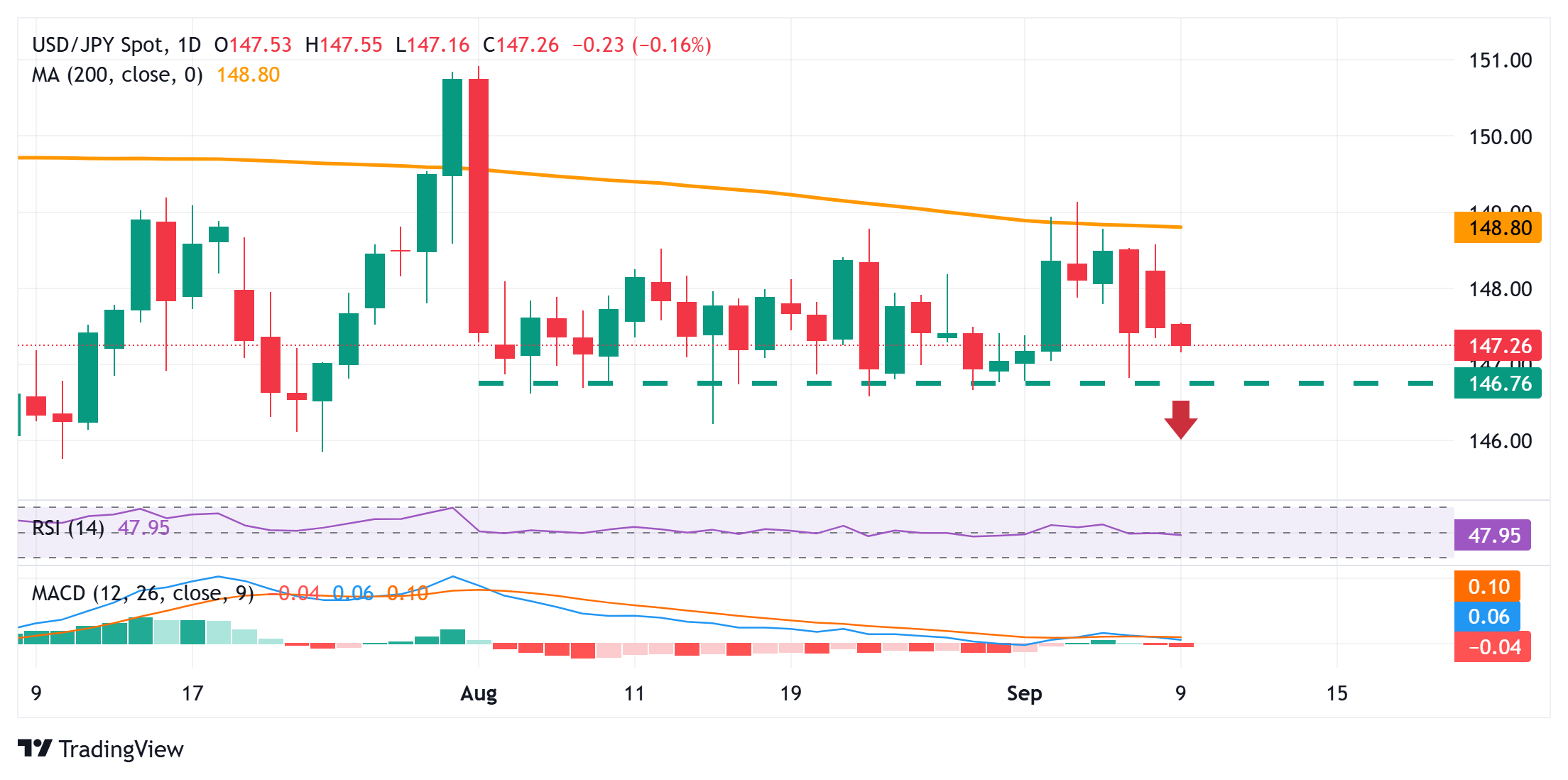
The overnight failure ahead of the very important 200-day SMA barrier and a subsequent slide below the 148.00 mark favor the USD/JPY bears. Moreover, oscillators on the daily chart have again started gaining negative traction and suggest that the path of least resistance for spot prices is to the downside. Hence, some follow-through selling below the 147.00 mark, leading to a subsequent break through the 146.80-146.70 horizontal support, will reaffirm the negative bias and expose the August swing low, around the 146.20 region, before the pair eventually drops to the 146.00 mark.
On the flip side, the Asian session high, around the 147.50-147.55 area, now seems to act as an immediate hurdle. A sustained strength beyond might trigger a short-covering move and allow the USD/JPY pair to reclaim the 148.00 mark. The momentum could extend further, though it runs the risk of fizzling out rather quickly near the 200-day SMA barrier, around the 148.75 zone. This is closely followed by the 149.00 round figure and the 149.20 area, or a one-month high touched last week, which, if cleared, might shift the near-term bias in favor of bulls. Spot prices might then climb to the 150.00 psychological mark and then aim to challenge the August monthly swing high, around the 151.00 neighborhood.
Bank of Japan FAQs
The Bank of Japan (BoJ) is the Japanese central bank, which sets monetary policy in the country. Its mandate is to issue banknotes and carry out currency and monetary control to ensure price stability, which means an inflation target of around 2%.
The Bank of Japan embarked in an ultra-loose monetary policy in 2013 in order to stimulate the economy and fuel inflation amid a low-inflationary environment. The bank’s policy is based on Quantitative and Qualitative Easing (QQE), or printing notes to buy assets such as government or corporate bonds to provide liquidity. In 2016, the bank doubled down on its strategy and further loosened policy by first introducing negative interest rates and then directly controlling the yield of its 10-year government bonds. In March 2024, the BoJ lifted interest rates, effectively retreating from the ultra-loose monetary policy stance.
The Bank’s massive stimulus caused the Yen to depreciate against its main currency peers. This process exacerbated in 2022 and 2023 due to an increasing policy divergence between the Bank of Japan and other main central banks, which opted to increase interest rates sharply to fight decades-high levels of inflation. The BoJ’s policy led to a widening differential with other currencies, dragging down the value of the Yen. This trend partly reversed in 2024, when the BoJ decided to abandon its ultra-loose policy stance.
A weaker Yen and the spike in global energy prices led to an increase in Japanese inflation, which exceeded the BoJ’s 2% target. The prospect of rising salaries in the country – a key element fuelling inflation – also contributed to the move.
Recommended Articles


