


USD/MXN (USDMXN) Volatility Intensified on Sep 28: Factors to Watch
USD/MXN (USDMXN) is up 0.51% at Sep 28 03:15(ET), now at $17.77725, with a 7-day up of 3.27%.
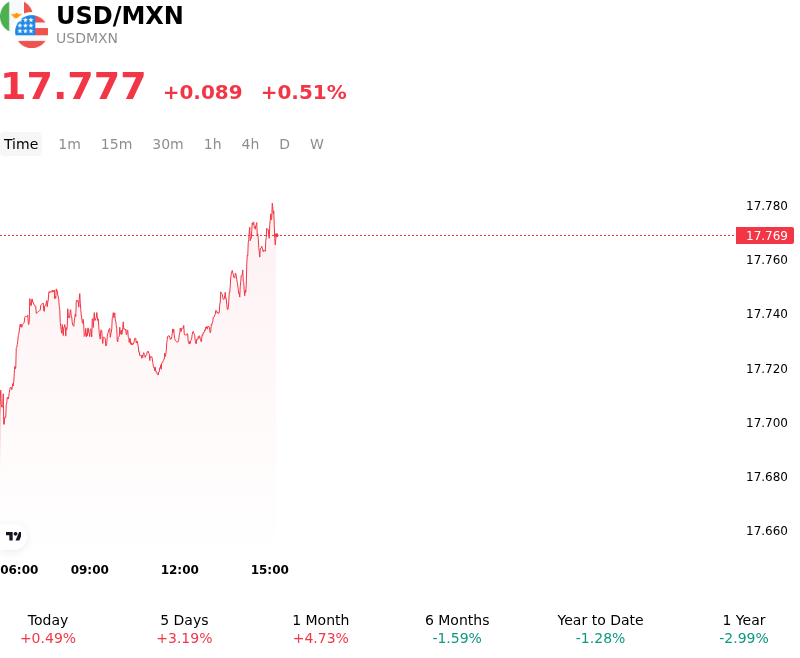
What is driving USD/MXN (USDMXN)’s stock price up today?
The advance in USDMXN is primarily driven by the ongoing recalibration of relative monetary policy expectations and interest-rate differentials between the United States and Mexico. Following the Federal Reserve's recent policy tightening and its signal that U.S. borrowing costs could remain elevated, Banco de México chose to keep its benchmark interest rate unchanged at 6.50%. Crucially, Banxico explicitly noted that domestic monetary policy will not react mechanically to Federal Reserve rate decisions, highlighting distinct domestic macroeconomic conditions and persistent slack within the Mexican economy.
This deliberate policy decoupling has accelerated the narrowing of the U.S.-Mexico interest-rate differential, diminishing the attractiveness of the Mexican peso's carry trade. As U.S. Treasury yields press higher on expectations of persistent Fed policy tightness, the diminished yield spread reduces the risk-adjusted premium required by foreign investors to hold MXN-denominated debt. Institutional investors have consequently trimmed long-peso carry positions, channeling liquidity back into the U.S. dollar.
Underlying macroeconomic data in Mexico has reinforced Banxico's inclination to stand ground despite the narrowing spread. Although headline consumer inflation experienced a slight non-core acceleration, core inflation has continued its steady deceleration toward target, providing the central bank sufficient flexibility to avoid defensive rate hikes. Coupled with a broader shift toward risk aversion in emerging market FX and firm U.S. economic momentum, the rally in USDMXN appears supported by a broader macro trend of narrowing rate buffers rather than a short-lived technical impulse.
Technical Analysis of USD/MXN (USDMXN)
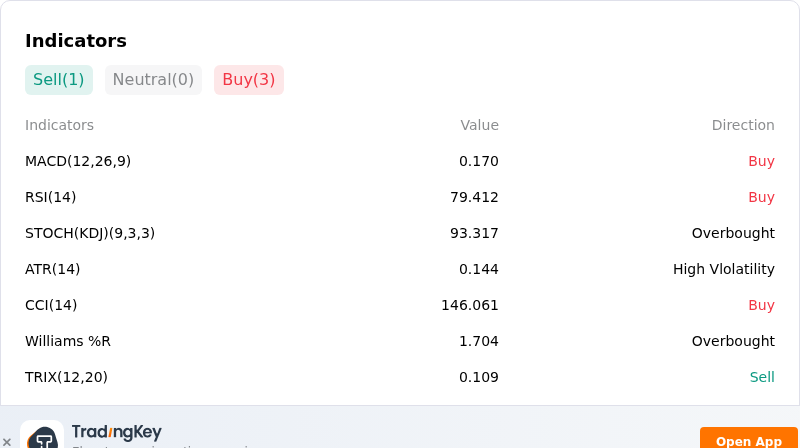
Technically, USD/MXN (USDMXN) shows a MACD (12,26,9) value of 0.170, indicating a buy signal. The RSI at 79.412 suggests buy condition and the Williams %R at 1.704 suggests overbought condition. Please monitor closely.
More details about USD/MXN (USDMXN)
Recent Events and Risks:
- Narrowing U.S.-Mexico Interest Rate Differential: The compression of the U.S.-Mexico benchmark rate spread to 250 basis points—its narrowest margin since 2015—following Federal Reserve rate tightening and Banxico maintaining its 6.50% policy rate has significantly eroded the peso's carry cushion, exposing USD/MXN to sustained upside volatility.
- Banxico Policy Independence and Domestic Macro Softness: Banco de México's explicit guidance that it will not mechanically follow Fed rate hikes, combined with weaker Mexican retail sales and softer core inflation data, limits Banxico's ability to defend the peso, leaving MXN vulnerable to hawkish U.S. monetary repricing.
- Vulnerability to Carry Trade Unwinding: Heavy speculative net-long positioning in the Mexican peso creates market structure risk, where any sudden deterioration in global risk sentiment or sharp spike in U.S. Treasury yields could trigger stop-loss liquidations and a fast unwind of long-MXN carry trades.
- U.S. Data Outperformance and Treasury Yield Pressure: Better-than-expected U.S. PMI activity data and elevated U.S. 10-year yields above 5.00% have boosted the broad U.S. Dollar Index above 101.00, pushing USD/MXN through key technical resistance levels toward 17.70.
Recommended Articles


