


USD/MXN (USDMXN) Moved Sharply on Sep 24: Are Central Bank Expectations Shifting?
USD/MXN (USDMXN) is up 0.56% at Sep 24 10:55(ET), now at $17.61831, with a 7-day up of 2.65%.
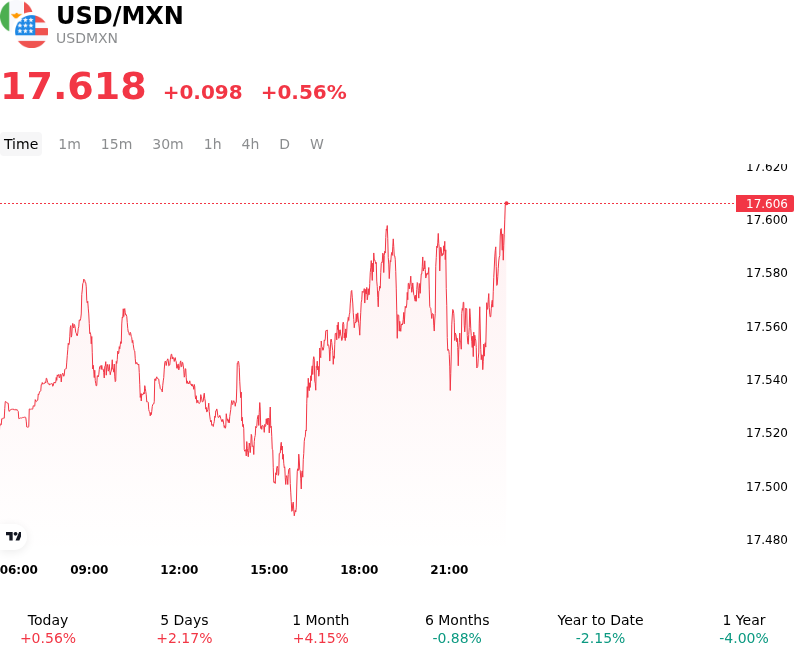
What is driving USD/MXN (USDMXN)’s stock price up today?
The upward movement in USDMXN was primarily driven by a broader resurgence in the US dollar, coupled with positioning adjustments ahead of the Bank of Mexico’s monetary policy decision. Resilient US macroeconomic indicators and hawkish commentary from Federal Reserve officials led market participants to reprice expectations toward tighter US monetary policy and sustained higher interest rates. This drove US Treasury yields higher and provided broad-based support for the greenback across foreign exchange markets.
In contrast, the Mexican peso faced downside pressure as the narrowing interest rate differential between the Federal Reserve and Banco de México reduced the relative attractiveness of the peso’s carry trade. While Banxico maintained its policy rate at elevated levels to anchor inflation expectations, market expectations that the central bank remains on an extended policy pause limited fresh capital inflows into peso-denominated debt. Consequently, as US yields adjusted higher, the compressed yield spread encouraged institutional investors to trim overweight peso exposure.
Technical developments and market positioning further amplified the currency pair's advance. The breakthrough above key moving averages and technical resistance levels triggered short-covering in the dollar and forced an unwinding of stretched long-peso speculative positions. This liquidity-driven momentum exacerbated the peso's decline, particularly as market participants adjusted portfolios to account for potential external macro volatility and a less supportive yield buffer.
From a global macro perspective, the move reflects a fundamental repricing of central bank policy paths and relative yield dynamics rather than an idiosyncratic shock to Mexico's domestic fundamentals. Over the medium term, USDMXN sensitivity will remain closely tied to Federal Reserve policy guidance, shifts in US economic growth expectations, and the evolution of the Banxico-Fed interest rate differential. Potential upside risks for USDMXN include persistent hawkishness from the Fed or a broader risk-off turn in global markets, while any re-expansion of the yield spread or sustained risk appetite could restore stability to the peso.
Technical Analysis of USD/MXN (USDMXN)
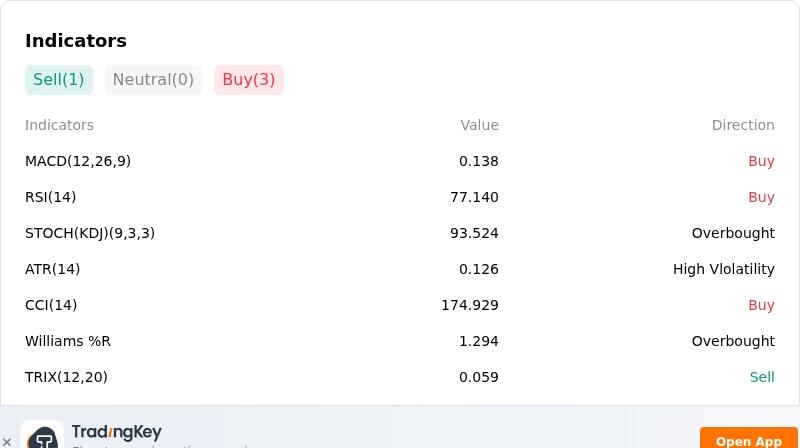
Technically, USD/MXN (USDMXN) shows a MACD (12,26,9) value of 0.138, indicating a buy signal. The RSI at 77.140 suggests buy condition and the Williams %R at 1.294 suggests overbought condition. Please monitor closely.
More details about USD/MXN (USDMXN)
Recent Events and Risks:
- Hawkish Federal Reserve and Narrowing Rate Spread: Recent hawkish commentary from Federal Reserve officials alongside rising U.S. yield expectations has squeezed the U.S.-Mexico interest rate differential to its narrowest margin in years, eroding the relative yield advantage that previously anchored the Mexican peso and fueling intraday upside momentum in USD/MXN.
- Unwinding of MXN Carry Trade Positions: The compression in bond yield spreads, combined with heightened global interest rate volatility, is prompting institutional traders to pare back leveraged peso carry trade exposure, increasing the risk of sudden liquidity shocks and sharp upward spikes in the currency pair.
- Domestic Macro Softness vs. Banxico Policy Limits: Softening domestic economic data in Mexico, including missed retail sales forecasts and decelerating growth indicators, restricts the Bank of Mexico’s scope for further monetary tightening, leaving the peso vulnerable if U.S. monetary policy remains restrictive for longer.
- Broad U.S. Dollar Strength and Emerging Market Capital Outflows: Resilient U.S. economic activity and firming Treasury yields continue to spur risk-off flows away from high-beta emerging market assets toward the greenback, worsening capital outflow risks for the Mexican peso during market stress.
Recommended Articles


