

Jupiter Price Forecast: JUP positions for a trend reversal as network activity picks up

Source Fxstreet
  • Jupiter is up 6% on Wednesday, crossing above its 200-day EMA at $0.2192.
  • Network data shows a spike in monthly revenue and fees in June to a three-month high.
  • Retail demand supports the recovery in JUP, with Open Interest up 11% over the last 24 hours, reflecting a positional buildup.

Jupiter (JUP) edges higher by 6% at press time on Wednesday, testing the 200-day Exponential Moving Average (EMA) breakout at $0.2192. A fresh spark in monthly revenue and fees, reaching a three-month high, reflects renewed user demand on the network, backed by a near-term rise in retail confidence as Open Interest jumps 11% in 24 hours. 

The technical outlook for Jupiter is mixed, with a short-term recovery poised to test the breakout of the overhead resistance zone near $0.2400.

Jupiter’s network activity and retail support pick up

Jupiter, a Solana-based Decentralized Exchange (DEX), regains network demand after three months of steady decline. DeFiLlama data show that user fees and revenue have surged to 261,909 SOL and 76,257 SOL, respectively, despite broader market risk-off sentiment. The fresh surge reaffirms Jupiter’s dominance in the DeFi industry, which could boost demand for its JUP token. 
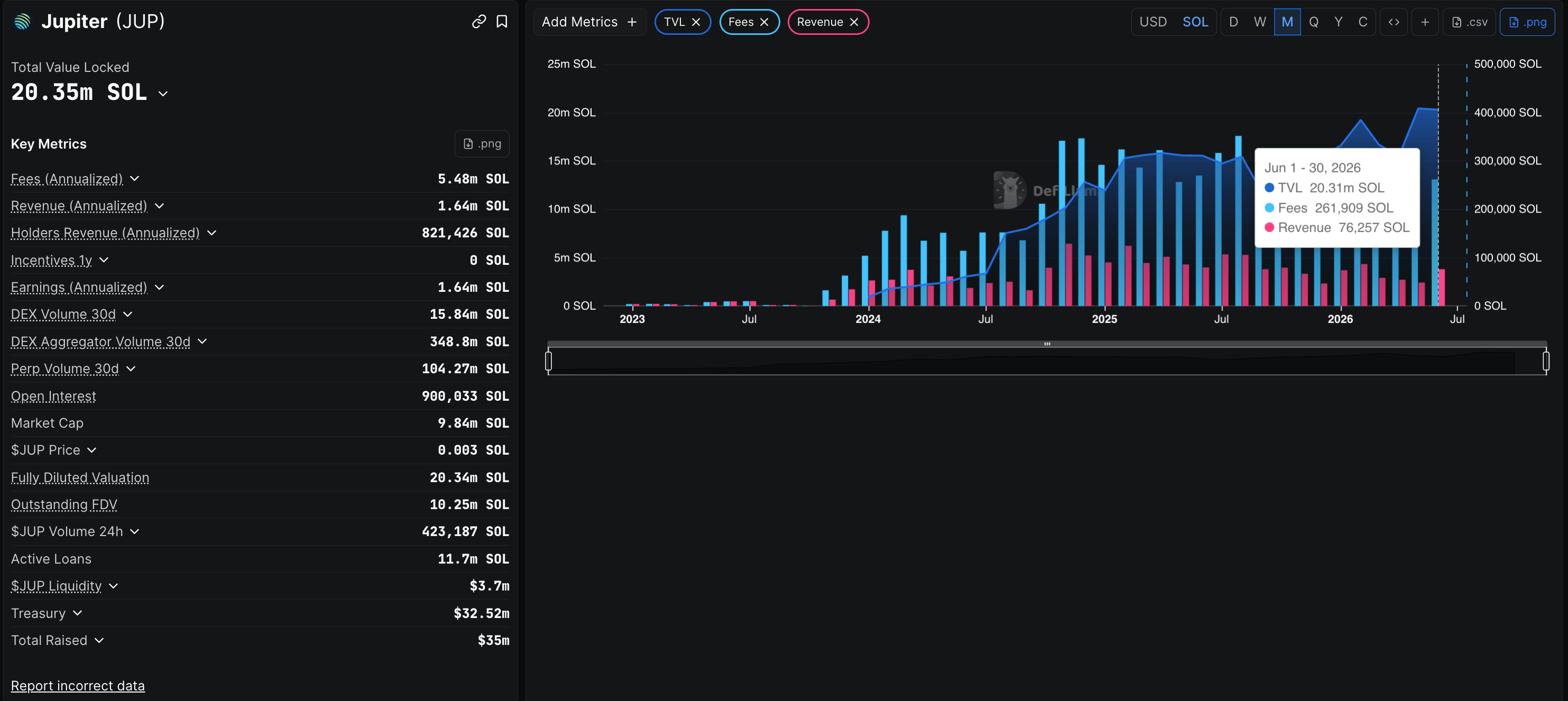
Jupiter network data. Source: DeFiLlama

On the derivatives front, CoinGlass data show JUP Open Interest (OI) rising 11% over 24 hours to $58.71 million, suggesting a surge in leverage-driven positional setups. In addition, the funding rates of 0.0021% reflect near-term bullish sentiment among traders, who are willing to take long positions at a premium. 
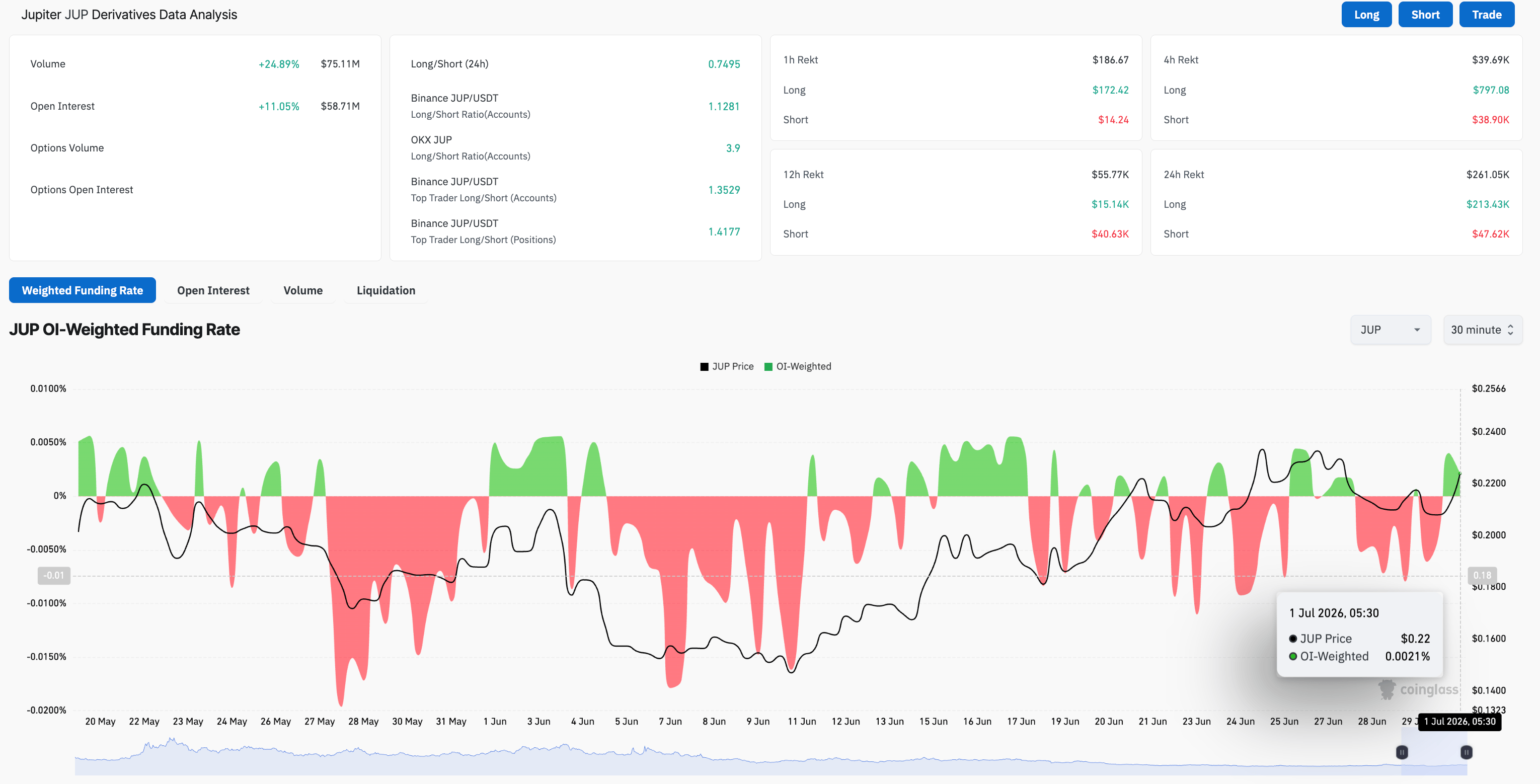
JUP derivatives data. Source: CoinGlass

Technical outlook: Will JUP price break above its prevailing downtrend trendline?

Jupiter shows a bullish recovery attempt, heading to challenge a declining resistance trendline near $0.2325. At the time of writing, JUP is roughly 6% on Wednesday, with intraday gains crossing above the 200-day EMA at $0.2192.

From a technical perspective, the DeFi token is heading toward a confluence of resistance at the declining trendline and the 78.6% Fibonacci retracement level at $0.2372, measured from the upswing from $0.1350 to $0.2766. A decisive close above this zone could confirm a more decisive bullish extension, targeting the previous swing high near $0.2766, followed by the 127.2% Fibonacci extension level at $0.3361.

The Relative Strength Index (RSI) at around 59 on the daily chart remains above the midline, as buyers retain control. At the same time, the Moving Average Convergence Divergence (MACD) is close to its signal line, while the histograms contract, suggesting easing upside momentum.

Chart Analysis JUP/USDT (Binance)
JUP/USDT daily price chart.

On the downside, initial support aligns with the 50-day EMA at $0.1971, near the 50% retracement at $0.1932, followed by the 23.6% retracement at $0.1599.

(The technical analysis of this story was written with the help of an AI tool.)

Disclaimer: For information purposes only. Past performance is not indicative of future results.
placeholder
Bitcoin CME gaps at $35,000, $27,000 and $21,000, which one gets filled first?Prioritize filling the $27,000 gap and even try higher.
Author  FXStreet
Aug 22, 2023
Prioritize filling the $27,000 gap and even try higher.
placeholder
Pinduoduo Earnings Incoming: Morgan Stanley Sees Long-Term Profit Potential​Insights – On November 21, Chinese e-commerce giant Pinduoduo (PDD) will release its Q3 2024 earnings.
Author  Mitrade
Nov 20, 2024
​Insights – On November 21, Chinese e-commerce giant Pinduoduo (PDD) will release its Q3 2024 earnings.
placeholder
Bitcoin briefly loses 2025 gains as crypto plunges over the weekend.Bitcoin experienced a sharp decline this weekend, briefly erasing its 2025 gains and dipping below its year-opening value of $93,507. The cryptocurrency fell to a low of $93,029 on Sunday, representing a 25% drop from its all-time high in October. Although it has rebounded slightly to around $94,209, the pressures on the market remain significant. The downturn occurred despite the reopening of the U.S. government on Thursday, which many had hoped would provide essential support for crypto markets. This year initially appeared promising for cryptocurrencies, particularly after the inauguration of President Donald Trump, who has established the most pro-crypto administration thus far. However, ongoing political tensions—including Trump's tariff strategies and the recent government shutdown, lasting a historic 43 days—have contributed to several rapid price pullbacks for Bitcoin throughout the year. Market dynamics are also being influenced by Bitcoin whales—investors holding large amounts of Bitcoin—who have been offloading portions of their assets, consequently stalling price rallies even as positive regulatory developments emerge. Despite these sell-offs, analysts from Glassnode argue that this behavior aligns with typical patterns seen among long-term investors during the concluding stages of bull markets, suggesting it is not indicative of a mass exodus. Notably, Bitcoin is not alone in its struggles, as Ethereum and Solana have also recorded declines of 7.95% and 28.3%, respectively, since the start of the year, while numerous altcoins have faced even steeper losses. Looking ahead, questions linger regarding the viability of the four-year cycle thesis, particularly given the increasing institutional support and regulatory frameworks now in place in the crypto landscape. Matt Hougan, chief investment officer at Bitwise, remains optimistic, suggesting a potential Bitcoin resurgence in 2026 driven by the “debasement trade” thesis and a broader trend toward increased adoption of stablecoins, tokenization, and decentralized finance. Hougan emphasized the soundness of the underlying fundamentals, pointing to a positive outlook for the sector in the longer term.
Author  Mitrade
Nov 17, 2025
Bitcoin experienced a sharp decline this weekend, briefly erasing its 2025 gains and dipping below its year-opening value of $93,507. The cryptocurrency fell to a low of $93,029 on Sunday, representing a 25% drop from its all-time high in October. Although it has rebounded slightly to around $94,209, the pressures on the market remain significant. The downturn occurred despite the reopening of the U.S. government on Thursday, which many had hoped would provide essential support for crypto markets. This year initially appeared promising for cryptocurrencies, particularly after the inauguration of President Donald Trump, who has established the most pro-crypto administration thus far. However, ongoing political tensions—including Trump's tariff strategies and the recent government shutdown, lasting a historic 43 days—have contributed to several rapid price pullbacks for Bitcoin throughout the year. Market dynamics are also being influenced by Bitcoin whales—investors holding large amounts of Bitcoin—who have been offloading portions of their assets, consequently stalling price rallies even as positive regulatory developments emerge. Despite these sell-offs, analysts from Glassnode argue that this behavior aligns with typical patterns seen among long-term investors during the concluding stages of bull markets, suggesting it is not indicative of a mass exodus. Notably, Bitcoin is not alone in its struggles, as Ethereum and Solana have also recorded declines of 7.95% and 28.3%, respectively, since the start of the year, while numerous altcoins have faced even steeper losses. Looking ahead, questions linger regarding the viability of the four-year cycle thesis, particularly given the increasing institutional support and regulatory frameworks now in place in the crypto landscape. Matt Hougan, chief investment officer at Bitwise, remains optimistic, suggesting a potential Bitcoin resurgence in 2026 driven by the “debasement trade” thesis and a broader trend toward increased adoption of stablecoins, tokenization, and decentralized finance. Hougan emphasized the soundness of the underlying fundamentals, pointing to a positive outlook for the sector in the longer term.
placeholder
Markets in 2026: Will gold, Bitcoin, and the U.S. dollar make history again? — These are how leading institutions thinkAfter a turbulent 2025, what lies ahead for commodities, forex, and cryptocurrency markets in 2026?
Author  Insights
Dec 25, 2025
After a turbulent 2025, what lies ahead for commodities, forex, and cryptocurrency markets in 2026?
placeholder
Gold Price Forecast: Does Gold Falling Below $4,000 Mean the Bull Market Is Over? Will It Still Rise in the Second Half of 2026?Heading into the second half of 2026, the gold market has transitioned from a strong-performing asset at the start of the year into one pulling back from its highs. Recently, gold prices
Author  TradingKey
Jun 29, Mon
Heading into the second half of 2026, the gold market has transitioned from a strong-performing asset at the start of the year into one pulling back from its highs. Recently, gold prices
Related Instrument
goTop
quote