


South Korea’s June Exports Break Record. AI Chip Shipments Surge 200% as Key Driver, Lifted by Samsung and SK Hynix.
TradingKey - Driven by the ongoing boom in global AI infrastructure investment, South Korea's export trade achieved a historic breakthrough in June, with multiple core indicators setting new record highs.
According to preliminary data released by the Ministry of Trade, Industry and Energy of South Korea on July 1, South Korea's exports in June surged by 70.9% year-on-year to $102.25 billion. This not only marks the first time monthly exports have surpassed the $100 billion threshold but also represents the fastest growth rate since October 1978, accelerating further from the revised 53.4% increase in May. This performance far exceeded market expectations; the median forecast of nine economists surveyed by The Wall Street Journal was 57.3%.
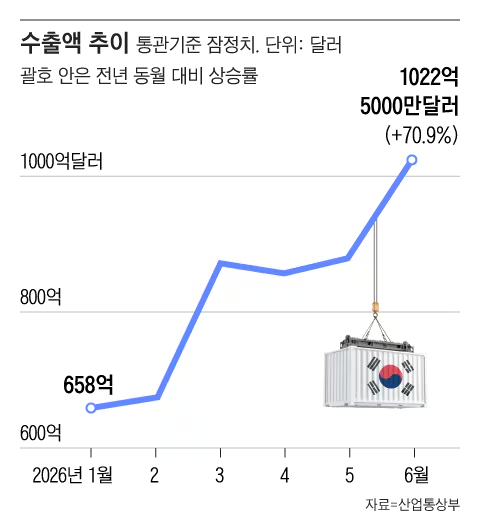
South Korea's export trend chart for the first half of 2026; Source: South Korea's Ministry of Trade, Industry and Energy
With this, South Korea has become the fourth country in the world to achieve a monthly export volume exceeding $100 billion, following China, the United States, and Germany.
The trade surplus for the month reached $36.15 billion, surpassing the $30 billion mark for the first time and significantly improving from the revised $27.04 billion in May. Cumulative exports in the first half of the year reached $496.7 billion, up 48.4% year-on-year. The cumulative trade surplus stood at $138.3 billion, an increase of $110.9 billion compared to the same period last year, with both indicators setting historical highs for the same period.
Ahn Duk-geun, South Korea's Minister of Trade, Industry and Energy, stated: "Despite challenges such as US tariffs, the Middle East conflict, and the spread of protectionism, our country's export performance in the first half of the year reached a historic high, thanks to strong growth in semiconductor exports driven by AI investments, as well as the balanced development of key and promising industries."
Semiconductors have become the absolute driving force behind the export boom.
Among all export categories, semiconductors delivered the most outstanding performance, serving as the core engine driving overall export growth.
In June, South Korea's semiconductor exports reached $44.82 billion, surging 199.5% year-on-year. This not only set a new monthly record but also marked the first time the country's monthly semiconductor exports surpassed the $40 billion threshold.
Among these, single-month exports of High Bandwidth Memory (HBM) reached $12.681 billion, up 171% year-on-year, while exports of NAND flash memory and SSDs surged by 388% and 355% year-on-year, respectively.
According to an analysis by South Korea's Ministry of Trade, Industry and Energy, the ongoing expansion of global AI infrastructure is the primary driver behind the robust growth in semiconductor exports. As tech giants accelerate their buildout of artificial intelligence and data centers, demand for high-performance memory chips is experiencing explosive growth, with HBM chips, which are essential for AI servers, in particularly short supply.
Samsung Electronics and SK Hynix collectively control over 80% of the global HBM market. With their order books completely filled, the two companies serve as powerful catalysts for South Korea's semiconductor export growth.
Major markets across the board see robust growth, with both the Chinese and US markets surpassing $20 billion
By export destination, seven of South Korea's nine major export regions recorded growth, with exports to its two main trading partners—China and the United States—both surpassing $20 billion for the first time.
Exports to China, led by semiconductors, surged 92.1% year-on-year to $20.03 billion, while exports to the U.S. rose 78.6% year-on-year to $20.02 billion on the back of strong performances in semiconductors, computers, and cosmetics. Additionally, exports to ASEAN reached $18.3 billion, setting a record monthly high.
Economic K-Shaped Divergence Intensifies as Non-Tech Sectors Face Significant Pressure
Despite the stellar overall export data, the June trade figures also reveal a clear divergence within the South Korean economy. Exports of auto parts fell 2.4% year-on-year, while finished vehicle exports grew by only 5.8%, a growth rate far below that of tech products such as semiconductors. Exports to the Middle East dropped by 8.4% year-on-year, as ongoing tensions in the region pose obstacles to supply chains and logistics.
The Ministry of Trade pointed out that non-tech industries still face high raw material costs, supply constraints, and logistical challenges stemming from the situation in the Middle East, resulting in a highly uneven distribution of economic returns.
This K-shaped growth pattern means that the economic prosperity driven by the AI boom is primarily concentrated in the tech sector, while traditional industries have failed to fully benefit and are even facing pressure.
Strong exports signal economic recovery; Bank of Korea contemplates rate hike
The robust performance of South Korea's exports has provided strong support for the country's economic growth, as well as fundamental backing for the Bank of Korea's increasingly hawkish policy stance.
Bank of Korea Governor Rhee Chang-yong stated that the boom in the semiconductor sector is driving broader growth in consumption, investment, and wages, intensifying inflation pressure risks. Economists expect that the Bank of Korea may raise interest rates by 25 basis points at its rate decision on July 16 to counter potential inflationary pressures.
Several international institutions have recently upgraded their economic growth forecasts for South Korea. Banks such as ING and Citi believe that government-led AI investment initiatives will drive capital expenditure expansion. While exports continue to act as the primary engine of growth, they will lay the foundation for stronger private consumption, government spending, and corporate investment. The risks of an energy-driven inflation crisis tend to be receding, which, coupled with sustained robust demand for AI-related products, is supporting the overall outlook for the South Korean economy.
Recommended Articles


