

Brent (UKOIL) Volatility Intensified on Jun 22: What to Watch

Source Tradingkey

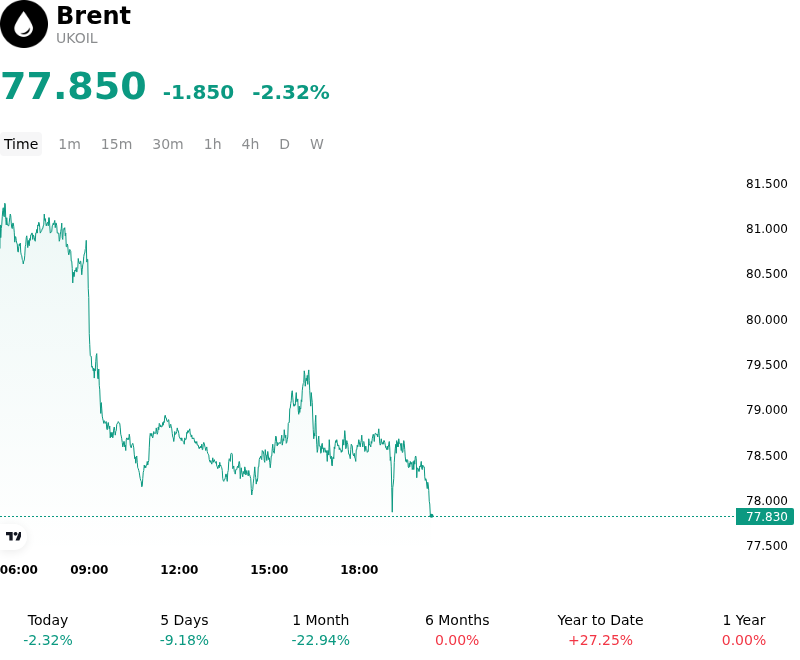
Brent (UKOIL) is down 2.32% at Jun 22 08:25(ET), now at $77.85, with a 7-day down of 5.58%.
SummaryOverview

What is driving Brent (UKOIL)’s stock price down today?

The primary catalyst driving the sharp decline in Brent crude (UKOIL) is the substantial unwinding of the geopolitical risk premium following positive diplomatic developments in Switzerland. The conclusion of bilateral talks between the United States and Iran has led to reports that Tehran secured sanctions waivers for its oil and petrochemical exports, dramatically easing fears of prolonged supply tightness. Simultaneously, regional tensions cooled further as Iran's military joint command signaled a halt to offensive operations against Israel, reducing the immediate threat of a wider conflict that could endanger critical energy infrastructure. These developments have cleared the way for a swift normalization of shipping routes through the Strait of Hormuz, which typically facilitates approximately one-fifth of global oil transit.

With diplomatic avenues progressing, physical oil markets are bracing for a rapid influx of previously restricted supplies. State-level statements indicate that millions of barrels of Iranian crude have already begun clearing naval blockades, raising expectations that up to 1.5 million barrels per day could soon return to international markets. Furthermore, neighboring Middle Eastern producers are actively moving to capture market share. The United Arab Emirates, Kuwait, and Iraq have expanded their offers to global buyers, with Iraq announcing plans to gradually restore its crude production to more than 4 million barrels per day. The prospect of these collective volumes entering the market has shifted the near-term supply-demand outlook from a deficit to a looming global surplus.

Compounding the supply-side pressure are deteriorating global demand expectations. Major energy organizations, including the International Energy Agency and OPEC, recently downgraded their demand growth projections for the year, citing persistent macroeconomic headwinds and high fuel prices that have already triggered demand contractions across major consuming sectors. This downshift in consumption is reinforced by hawkish signals from major central banks. The Federal Reserve's indicated bias toward maintaining elevated interest rates to combat inflation has stoked institutional concerns over slowing industrial activity and global economic growth. This combination of an accelerating supply recovery and cooling demand has prompted systemic long liquidation and a fundamental repricing of Brent futures.

Technical Analysis of Brent (UKOIL)

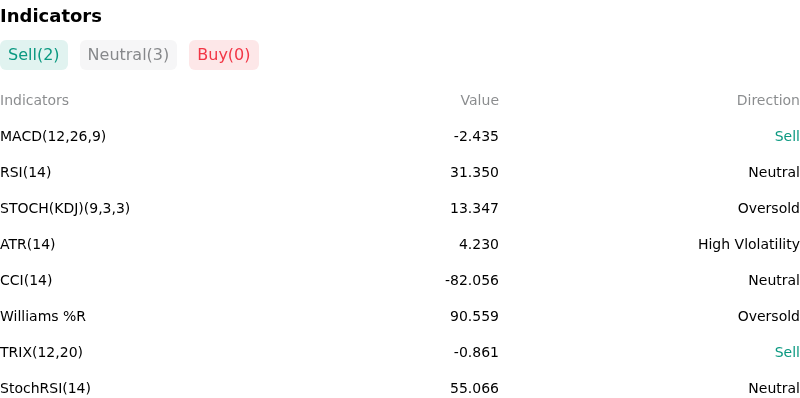
Technically, Brent (UKOIL) shows a MACD (12,26,9) value of -2.435, indicating a sell signal. The RSI at 31.350 suggests neutral condition and the Williams %R at 90.559 suggests oversold condition. Please monitor closely.
IndicatorAnalysis

More details about Brent (UKOIL)

Recent Events and Risks:

  • U.S.-Iran Diplomatic Progress and Export Waivers: High-level negotiations in Switzerland concluded with Tehran securing waivers for its oil and petrochemical exports. This progress on a 60-day roadmap toward a final agreement has significantly defused the geopolitical risk premium, pushing Brent crude futures below the psychological $80 per barrel support level.
  • Reopening of the Strait of Hormuz Chokepoint: The easing of Middle East tensions and the formal halt of military operations between regional powers have allowed the Strait of Hormuz to safely reopen. The return of commercial transit has facilitated the release of previously stranded cargoes, with over 25 million barrels of Iranian oil already clearing the blockade line, adding immediate physical supply to the market.
  • Increased Regional Producer Supply: Key OPEC producers—including the United Arab Emirates, Kuwait, and Iraq—have increased physical export offers to customers. Notably, Iraq’s Ministry of Oil announced plans to gradually restore its crude production to a range of 4.2 million to 4.3 million barrels per day, amplifying downside pressure via expected near-term output gains.
  • Severe Downgrades to Global Demand Forecasts: In its latest June Oil Market Report, the International Energy Agency (IEA) slashed its 2026 global demand growth forecast by 700,000 barrels per day, expecting an overall year-over-year contraction of 1.1 million barrels per day. This is compounded by Goldman Sachs warning of accelerating demand destruction across Western Europe and China, threatening a swift transition into market surplus.
Disclaimer: For information purposes only. Past performance is not indicative of future results.
placeholder
Bitcoin CME gaps at $35,000, $27,000 and $21,000, which one gets filled first?Prioritize filling the $27,000 gap and even try higher.
Author  FXStreet
Aug 22, 2023
Prioritize filling the $27,000 gap and even try higher.
placeholder
Pinduoduo Earnings Incoming: Morgan Stanley Sees Long-Term Profit Potential​Insights – On November 21, Chinese e-commerce giant Pinduoduo (PDD) will release its Q3 2024 earnings.
Author  Mitrade
Nov 20, 2024
​Insights – On November 21, Chinese e-commerce giant Pinduoduo (PDD) will release its Q3 2024 earnings.
placeholder
Elon Musk’s xAI and Neuralink Launch New Funding Rounds​Billionaire Elon Musk recently raised funds for his two high-profile tech companies, xAI and Neuralink.
Author  Insights
Jun 03, 2025
​Billionaire Elon Musk recently raised funds for his two high-profile tech companies, xAI and Neuralink.
placeholder
Bitcoin ETF Inflows For 2025 Now Outpace 2024, Data ShowsUS Bitcoin spot exchange-traded funds (ETFs) have seen more inflows this year so far compared to the same point in 2024, according to data.
Author  Bitcoinist
Jul 16, 2025
US Bitcoin spot exchange-traded funds (ETFs) have seen more inflows this year so far compared to the same point in 2024, according to data.
placeholder
Bitcoin briefly loses 2025 gains as crypto plunges over the weekend.Bitcoin experienced a sharp decline this weekend, briefly erasing its 2025 gains and dipping below its year-opening value of $93,507. The cryptocurrency fell to a low of $93,029 on Sunday, representing a 25% drop from its all-time high in October. Although it has rebounded slightly to around $94,209, the pressures on the market remain significant. The downturn occurred despite the reopening of the U.S. government on Thursday, which many had hoped would provide essential support for crypto markets. This year initially appeared promising for cryptocurrencies, particularly after the inauguration of President Donald Trump, who has established the most pro-crypto administration thus far. However, ongoing political tensions—including Trump's tariff strategies and the recent government shutdown, lasting a historic 43 days—have contributed to several rapid price pullbacks for Bitcoin throughout the year. Market dynamics are also being influenced by Bitcoin whales—investors holding large amounts of Bitcoin—who have been offloading portions of their assets, consequently stalling price rallies even as positive regulatory developments emerge. Despite these sell-offs, analysts from Glassnode argue that this behavior aligns with typical patterns seen among long-term investors during the concluding stages of bull markets, suggesting it is not indicative of a mass exodus. Notably, Bitcoin is not alone in its struggles, as Ethereum and Solana have also recorded declines of 7.95% and 28.3%, respectively, since the start of the year, while numerous altcoins have faced even steeper losses. Looking ahead, questions linger regarding the viability of the four-year cycle thesis, particularly given the increasing institutional support and regulatory frameworks now in place in the crypto landscape. Matt Hougan, chief investment officer at Bitwise, remains optimistic, suggesting a potential Bitcoin resurgence in 2026 driven by the “debasement trade” thesis and a broader trend toward increased adoption of stablecoins, tokenization, and decentralized finance. Hougan emphasized the soundness of the underlying fundamentals, pointing to a positive outlook for the sector in the longer term.
Author  Mitrade
Nov 17, 2025
Bitcoin experienced a sharp decline this weekend, briefly erasing its 2025 gains and dipping below its year-opening value of $93,507. The cryptocurrency fell to a low of $93,029 on Sunday, representing a 25% drop from its all-time high in October. Although it has rebounded slightly to around $94,209, the pressures on the market remain significant. The downturn occurred despite the reopening of the U.S. government on Thursday, which many had hoped would provide essential support for crypto markets. This year initially appeared promising for cryptocurrencies, particularly after the inauguration of President Donald Trump, who has established the most pro-crypto administration thus far. However, ongoing political tensions—including Trump's tariff strategies and the recent government shutdown, lasting a historic 43 days—have contributed to several rapid price pullbacks for Bitcoin throughout the year. Market dynamics are also being influenced by Bitcoin whales—investors holding large amounts of Bitcoin—who have been offloading portions of their assets, consequently stalling price rallies even as positive regulatory developments emerge. Despite these sell-offs, analysts from Glassnode argue that this behavior aligns with typical patterns seen among long-term investors during the concluding stages of bull markets, suggesting it is not indicative of a mass exodus. Notably, Bitcoin is not alone in its struggles, as Ethereum and Solana have also recorded declines of 7.95% and 28.3%, respectively, since the start of the year, while numerous altcoins have faced even steeper losses. Looking ahead, questions linger regarding the viability of the four-year cycle thesis, particularly given the increasing institutional support and regulatory frameworks now in place in the crypto landscape. Matt Hougan, chief investment officer at Bitwise, remains optimistic, suggesting a potential Bitcoin resurgence in 2026 driven by the “debasement trade” thesis and a broader trend toward increased adoption of stablecoins, tokenization, and decentralized finance. Hougan emphasized the soundness of the underlying fundamentals, pointing to a positive outlook for the sector in the longer term.
goTop
quote