




SpaceX Shares Have Fallen 38% From Their Peak. Here’s How Traders Can Respond
SpaceX was meant to be one of the defining market debuts of 2026. Instead, only weeks after its Nasdaq listing, the stock has become one of Wall Street’s sharpest reversals.
This week, shares dropped to just above their US$135 IPO price after erasing the explosive gains that made the company one of Wall Street’s biggest stories.
The stock surged from its Nasdaq debut price on 12 June of US$150 to a post-listing high of US$225.64. It has since plunged nearly 38% from that peak, as investors reassessed the company’s valuation, its AI ambitions, and the prospect of more shares coming to market.
SpaceX’s listing initially propelled the company into the ranks of the world’s largest listed businesses. Its early surge briefly pushed its market value above Amazon’s and Microsoft’s, while lifting Elon Musk’s estimated wealth to US$1.45 trillion. The reversal has been severe enough to drop that figure by more than US$500 billion in recent weeks.
SpaceX is now only just above its IPO price of US$135, leaving investors who bought during the first wave of post-listing enthusiasm nursing sharp losses.
But for Australian traders, the more immediate story is the scale of the price action: SpaceX has moved from one of the market’s hottest new listings to one of its most volatile. Mitrades Contracts for Difference (CFDs) allow traders to take a position on that volatility without owning the underlying shares. They can go long if they expect SpaceX to recover, or short if they expect the sell-off to continue—giving them a way to respond in either direction.
Why SpaceX shares have been so volatile
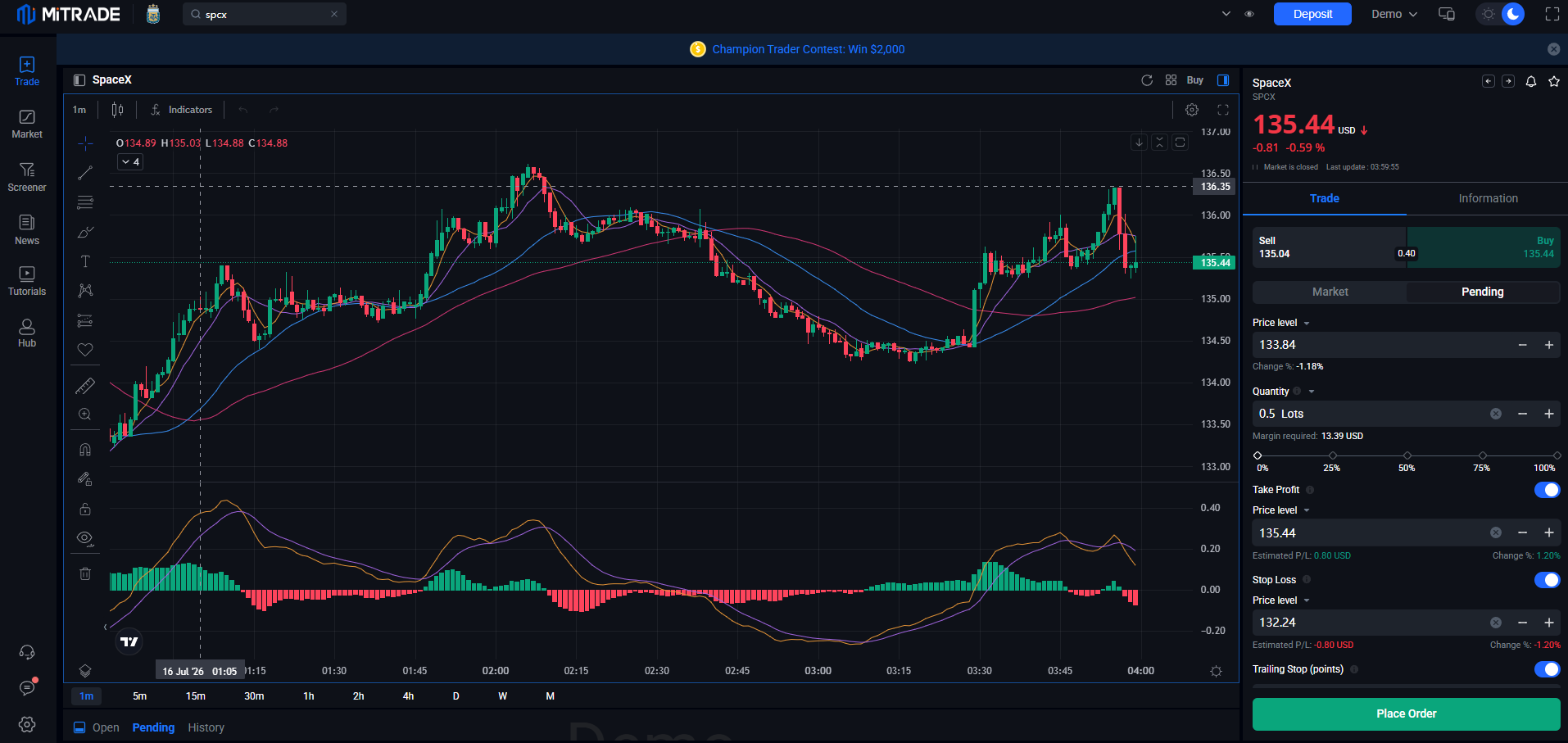
SpaceX Stock Price Today
SpaceX’s post-listing rally left the shares trading at a demanding valuation. As momentum faded, investors began weighing a cluster of concerns—from its US$60 billion Cursor deal to a potential increase in tradeable shares and fresh scrutiny of Musk’s wider funding plans.
The Cursor acquisition has become the central point of debate. Supporters see the AI coding platform’s technology, developer base, and data as a valuable addition to SpaceX’s AI ambitions. Others are focused on the new shares issued to fund the deal and whether the company can generate returns that justify the cost.
SpaceX’s post-listing reversal shows how quickly sentiment can change around one of Wall Street’s most closely watched new stocks. With CFDs, Australian traders can take a position on share-price movements without purchasing the underlying shares outright—going long if they expect a recovery or short if they expect further weakness.
“SpaceX’s next major catalyst is already approaching. Be ready to trade the next move. ”
SpaceX is no longer just a space story
SpaceX’s appeal has always extended beyond rockets and satellite launches. Starlink has created a global satellite-internet business, while new computing agreements have positioned the company closer to the AI infrastructure trade that has dominated US markets.
Recent reports point to deals that would give partners access to SpaceX-linked computing capacity, including arrangements with Google and AI startup Reflection AI.
That gives traders several reasons to watch the stock:
Starlink subscriber growth and international expansion
New satellite launches and network capacity
AI computing agreements and data-centre demand
Revenue from government, defence, and commercial contracts
The company’s first quarterly results as a listed business
Broader movements in AI, semiconductor, and high-growth technology stocks
A launch update is only one part of the story now. New AI spending plans, a weak chip-sector session, or evidence that the Cursor deal is adding revenue rather than dilution could all move SpaceX shares sharply.
Trading a fast-moving US listing from Australia
SpaceX’s 38% fall from its post-listing high did not happen over a year of disappointing results. It unfolded within weeks, as the market shifted from IPO excitement to concerns about valuation, dilution, and future share supply.
The moves happen when most Australian traders are asleep. That makes timing a practical challenge: earnings, AI announcements, and broader technology sell-offs can all move the stock well before the ASX opens. Australian traders face several other hurdles:
Overnight catalysts: SpaceX’s next earnings report, a new Starlink or AI deal, or a major shift in tech sentiment can trigger a sharp move during the local night.
Capital requirements: Buying shares outright requires the full purchase amount in US dollars, even when the price is above US$100 per share.
Currency conversion: International share purchases usually require exchanging Australian dollars into US dollars before placing a trade.
One-way exposure: Physical share ownership only benefits when the price rises. That offers little flexibility when a stock is falling as quickly as SpaceX has.
Rapid reversals: The shares moved from US$225.64 at their post-listing high to below US$150 within weeks, leaving little time to reassess a position.
Those challenges make the trading structure just as important as the market view. Australian traders need a way to follow SpaceX’s price movements without committing the full value of a US share purchase or being limited to a rising market.
How Mitrade helps traders respond to US share moves
Mitrade gives Australian traders a way to access price movements in major international shares through CFDs.
Rather than waiting for Australian markets to open or committing the full value of an overseas share purchase, traders can monitor SpaceX and other US stocks through one platform and decide whether they see an opportunity in a rise or fall.
Key features include:
Long and short trading: Take a view on whether a stock may rise or fall.
Leverage: Retail share CFDs can offer up to 5:1 leverage, subject to ASIC rules. This means less capital is required upfront than the full value of the underlying position.
Stop-loss and take-profit orders: Set risk controls before entering a position or adjust them as market conditions change.
AUD account funding: Fund an account in Australian dollars without first arranging a separate international brokerage account.
Commission-free trading: Mitrade charges no commission on CFD trades, with costs built into the spread.
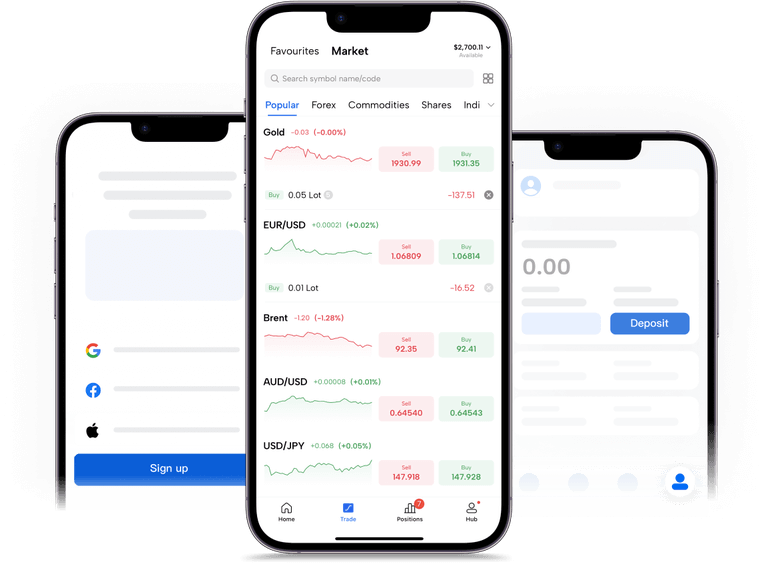
Mobile access: Monitor positions or adjust risk settings when US markets are moving overnight.
Demo account: Practice trading volatile US shares with virtual funds before using real capital.
Leverage can amplify gains, but it can also amplify losses. That makes risk controls particularly important when trading a stock that can move by several percentage points in a single session.
“SpaceX’s next major catalyst is already approaching. Be ready to trade the next move. ”
What could drive SpaceX’s next move?
The next major test is expected to be SpaceX’s first earnings report as a listed company later this month. Investors will be looking for more details on revenue growth, Starlink performance, AI-related spending, and the company’s outlook.
Other developments could also move the share price:
Lock-up expiry: More shares becoming available to trade may increase selling pressure, but could also improve liquidity.
AI partnerships: New computing or data-centre agreements could strengthen the growth case.
Cursor integration: The market will want evidence that the acquisition creates value rather than simply adding costs and dilution.
Technology-sector sentiment: Further weakness in AI and semiconductor shares could weigh on SpaceX, while a broader rebound may support it.
Analyst reassessments: A stock that has fallen nearly 38% from its peak is likely to attract both bargain hunters and fresh valuation concerns.
The first stage of the SpaceX story was an extraordinary IPO rally. The next phase may be defined by whether the company can turn its enormous ambitions into results that justify its valuation.
Be ready for the next SpaceX move
The SpaceX sell-off has shown that major US share opportunities do not only come from buying the next rally. Volatility can create potential trading setups in either direction, provided traders have a clear view, defined risk, and the ability to act when the market moves.
With Mitrade, Australian traders can access leading US shares through CFDs, trade rising or falling markets, and manage positions with built-in risk controls.
Start trading US share CFDs in three simple steps
Open an account: Register through the Mitrade homepage, or use the fast sign-up process with existing Google or Facebook credentials.
Fund the account: Deposit initial margin using secure Australian payment methods, including POLi or Visa/Mastercard.
Trade CFDs: Choose SpaceX or another US share or index, analyse the market, set risk parameters, and decide whether to take a long or short position.
SpaceX has shown how quickly US-market sentiment can turn. Open your Mitrade account today and be ready to trade the volatility.


1. Why has SpaceX stock fallen since its Nasdaq debut?
SpaceX shares rose sharply after listing before falling nearly 38% from their peak. The decline has reflected a combination of valuation concerns, a broader technology sell-off, investor reaction to its Cursor acquisition, and uncertainty around future share supply.
2. Can Australian traders trade SpaceX shares through CFDs?
Australian traders can access SpaceX price movements through share CFDs on platforms that offer the instrument. CFDs allow traders to take a long or short position without owning the underlying shares.
3. Can CFDs be used when SpaceX shares are falling?
Yes. A CFD allows a trader to go short if they believe the share price may fall, as well as go long if they expect it to rise. Losses can exceed expectations when leverage is used, so risk management is important.
4. What should traders watch next?
SpaceX’s first earnings report as a listed company, developments around its AI strategy, the lock-up expiry, and broader sentiment toward AI and high-growth technology shares are likely to be key catalysts.
Disclaimer: The content presented above, whether from a third party or not, is considered as general advice only. CFD trading involves significant risk of loss. Past performance does not guarantee future results. This article serves informational purposes only and does not constitute financial advice. Consider your risk tolerance before trading.


