




Market Index Explained: What It Is & How ASX Indices Work (Australia 2026 Guide)

If you’ve been in the financial markets for a minute, you’ve probably heard investors talking about portfolio diversification across the thousands of companies listed on global exchanges. This is because asset prices change every second based on news, reports, market changes, and investor sentiment. This is where the concept of investing in a market index comes in. It allows you to invest in a group of stocks instead of tracking one at a time.
This is why investors, analysts, and traders use indices to measure market trends, compare performance, and identify opportunities across diverse sectors and economies. However, in Australia, investing in indices begins with the market index ASX system. At the same time, global indices such as the S&P 500, NASDAQ Composite, and Dow Jones Industrial Average (Dow Jones) open up your portfolio to global markets. Now, let’s get into the details of how a market index works and your options for trading indices in Australia in 2026.
What Is a Market Index?
A market index is a benchmark that tracks the performance of a group of stocks in one place. Instead of focusing on a single company's stock, an index shows the overall movement of a selected market sector or segment. These groups can be organised by market size, geography, industry, or investment bucket. For example:
The S&P 500 is all about the top 500 US companies on the stock market
The NASDAQ Composite focuses on top tech companies in the US and beyond
The S&P/ASX 200 follows the largest 200 companies in Australia
The Dow Jones Industrial Average (Dow Jones) tracks the performance of the top 30 companies in the US
However, it’s important to note that a market index is not a company or investment product. Instead, it is a benchmark used to gauge overall market performance and investor sentiment. If the index price rises, it typically means the value of the companies within it is increasing. If it dips, it usually reflects a broader market decline within the sector being tracked.
The simplicity of tracking indices for market analysis is a significant feature because instead of monitoring hundreds of stocks individually, you can use indices to save time and determine the broader market pulse.
For example, Aussie investors who track the market index ASX option will find a composition of the local economy, which is heavily represented by companies in the banking, mining, and energy sectors.
How Does a Market Index Work?
A market index works by combining the prices or market values of selected companies into a single measurement. However, not all indices are calculated the same way.
Some are price-weighted, while others are market-cap weighted. In a price-weighted index, companies with higher share prices influence the index’s movement more. The most popular example is the Dow Jones.
However, most modern indices are market-cap weighted. This means companies with higher valuations have a greater impact on the index’s value because of their strong market capitalisation. For example, within the S&P/ASX 200, major banks and mining firms influence index movements more heavily than smaller companies.
Notably, these positions are not permanent, as indices are regularly reviewed and adjusted in response to prevailing market conditions. Index providers can add or remove companies from their assets based on changes in the following metrics:
Market capitalisation
Liquidity
Sector representation
Exchange rules
By doing so, the index continues to reflect the latest market conditions per represented segment.
Top Stock Market Indices to Watch
Stock market indices are abundant, but only a few stand out globally. These limited options are called “blue chips” because of their large market share, global influence, and high investor interest.
That is why millions of retail traders, institutional investors, and financial enthusiasts follow them to get insight into global economic conditions and market performance. Here are the top names:
1. S&P 500 Index
The S&P 500 is arguably the biggest stock market index in the world. It tracks the 500 most influential publicly listed companies in the United States. These big players exist in multiple industries, including technology, healthcare, finance, fast-moving consumer goods (FMCGs), and energy. Some major companies within the index include:
Apple Inc. (AAPL)
Microsoft (MSFT)
NVIDIA (NVDA)
Tesla (TSLA)
Berkshire Hathaway Inc. (BRK.B)
Eli Lilly and Co (LLY).
The index is market-cap weighted, which means that its biggest influencers are entities with larger market values. Because of this, performance from major tech companies can significantly impact the index.
This is why, as an investor, you should consider the S&P 500 a long-term benchmark for market diversification since it combines growth, diversification, and exposure to leading global businesses.
2. NASDAQ Composite
The NASDAQ Composite is heavily associated with tech and innovation-focused companies. The index includes thousands of companies listed on the NASDAQ exchange, but is dominated by the big players in the global tech industry. These include:
Apple Inc
Meta Platforms
Tesla
Nvidia
Because of this concentration, the NASDAQ often outperforms during periods of strong growth in technology and artificial intelligence. However, it can also be more volatile than broader indices (such as the S&P 500) due to its reaction to macroeconomic conditions, including rising interest rates or concerns about growth stocks.
In other words, the NASDAQ represents exposure to future-focused industries such as AI, cloud computing, semiconductors, and digital platforms. As an investor, it’s an index to watch if you’re keen on the long-term value of such companies’ stocks over short-term risk.
3. Dow Jones Industrial Average
The Dow Jones Industrial Average (Dow Jones) is one of the oldest and most recognised stock indices globally.
Unlike the S&P 500 or NASDAQ, the Dow tracks only 30 major US companies. These are generally large, established businesses across the tech, finance, manufacturing, healthcare, energy, and consumer goods industries.
As such, you’ll find companies like:
Coca-Cola
Goldman Sachs
McDonald’s
Visa
JPMorgan Chase
One key difference is that the Dow Jones is price-weighted rather than market-cap weighted. This means companies with higher share prices have more influence over the index, regardless of their market values.
This is why, despite being less diversified than the S&P 500, the Dow remains a top index followed by investors as a quick snapshot of the overall US market sentiment.
4. FTSE 100
The Financial Times Stock Exchange (FTSE) also has the FTSE 100 index, which is the most popular stock market index in the United Kingdom. The London Stock Exchange Group owns this index, and it tracks the UK’s 100 blue-chip publicly listed companies.
The index includes multinational businesses across industries such as banking, energy, telecommunications, healthcare, and consumer goods. Some big names within the index include:
Airtel Africa PLC (AAF)
Barclays PLC (BARC)
HSBC Holdings (HSBA)
British American Tobacco (BATS)
Shell PLC (SHEL)
Because many FTSE 100 companies are multinationals with international revenues, the index is influenced not only by the UK economy but also by global economic conditions and currency movements.
5. Nikkei 225
The Nikkei 225 is Japan’s most followed stock market index and one of the most important economic benchmarks in Asia. It tracks 225 major Japanese companies listed on the Tokyo Stock Exchange.
The index includes globally recognised companies, especially those with Asian dominance, such as:
Toyota (7203)
Tokyo Electron Ltd (8035)
Sony Group Corp (6758)
Mitsubishi Corp (8058)
SoftBank Group Corp (9984)
Like the Dow Jones, the Nikkei is price-weighted. This means higher-priced stocks have a larger impact on index movements. The index’s major influences include manufacturing trends, technology exports, and currency movements, particularly the strength or weakness of the Japanese yen.
If you’re looking for exposure to Japan’s advanced industrial and technology sectors, as well as the broader Asian economic conditions from Australia, the Nikkei 225 is the index to follow.
“Trade Indices with an ASIC-regulated broker. Fast AUD funding via PayID. ”
Key Stock Market Indices in Australia
Australia is one of the world’s economically strong nations, making it home to several companies that make up indices that you can use to track local market performance and the broader economy. Here are the most prominent indices to watch as an Aussie:
1. S&P/ASX 200
The ASX 200 is the biggest stock market index on the ASX that investors monitor. It tracks the top 200 companies listed on the Australian Securities Exchange (ASX) and is the primary benchmark for the Australian market for millions of investors.
The index is heavily weighted towards banks, mining companies, and energy firms. Its top brands include:
BHP Group Ltd (BHP)
Commonwealth Bank of Australia (CBA)
Rio Tinto Ltd (RIO)
National Australia Bank Ltd (NAB)
CSL Limited (CSL)
2. All Ordinaries
The All Ordinaries Index (XAO) tracks 500 of the largest Australian companies on the ASX. This means you can get a broader overview of the market than using the ASX 200.
3. S&P/ASX 50
The ASX 50 focuses on the 50 largest companies on the ASX. Because it concentrates on large-cap firms, you can consider it a good way to determine the corporate heavyweights in Australia.
4. S&P/ASX Small Ordinaries
The S&P/ASX Small Ordinaries (XSO) index tracks small-cap ASX-listed companies. As such, it often experiences stronger volatility than large-cap indices but may be a good investment if the company stocks with stronger growth potential surge during favourable market conditions.
“Trade Indices with an ASIC-regulated broker. Fast AUD funding via PayID. ”
Why Do Australian Investors Care About Market Indices?
Simplified Analysis
Market indices are popular among Aussie investors and traders because they provide a simple way to view the broader market performance without complicated charting tools or rigorous market analysis.
Instead of analysing hundreds of stocks individually, you can save time and energy by using indices to track economic trends and sector performance.
Quick Portfolio Check
Indices also act as a portfolio health check. For example, if your portfolio consistently underperforms the S&P/ASX 200, it means that you need to adjust your investment strategy to match the current market realities.
Easy Diversification
Another major feature of a market index is its easy diversification. Because they contain multiple companies, the performance of one stock has less impact on the overall instrument. That means you can avoid the higher risk of owning shares of a single company, whether you’re a short-term trader or a long-term investor.
How to Trade Indices in Australia
There are three major ways to trade stock indices in Australia:
Trading Shares on the ASX
You can gain exposure to a market index by buying stocks of companies that heavily influence its price movement on the ASX. However, this approach does not offer full diversification and requires stock-specific analysis.
Investing in Index Funds
Index funds and ETFs are also common ways to invest in indices. These funds track the performance of a specific market index, such as the S&P/ASX 200 and the S&P 500.
Trading Indices with CFDs
Another popular way to gain exposure to a market index is through CFDs (Contracts for Difference). With CFDs, you can speculate on price movements of indices without directly owning the underlying assets.
In other words, instead of purchasing shares individually, you can take positions based on whether you believe an index will rise or fall.
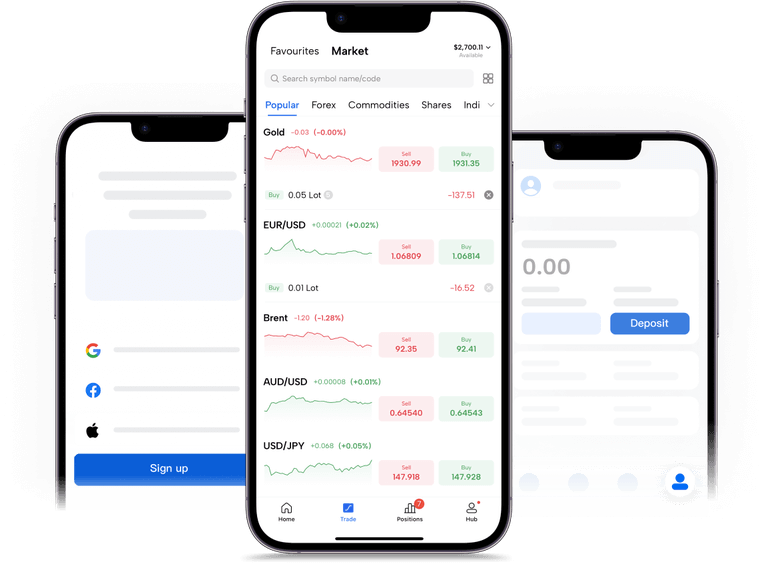
This flexibility to potentially make profits whether the market is up or down is why CFD trading is popular among Aussies. Moreover, you can access global markets outside of Australia in one place when trading CFDs on Mitrade.
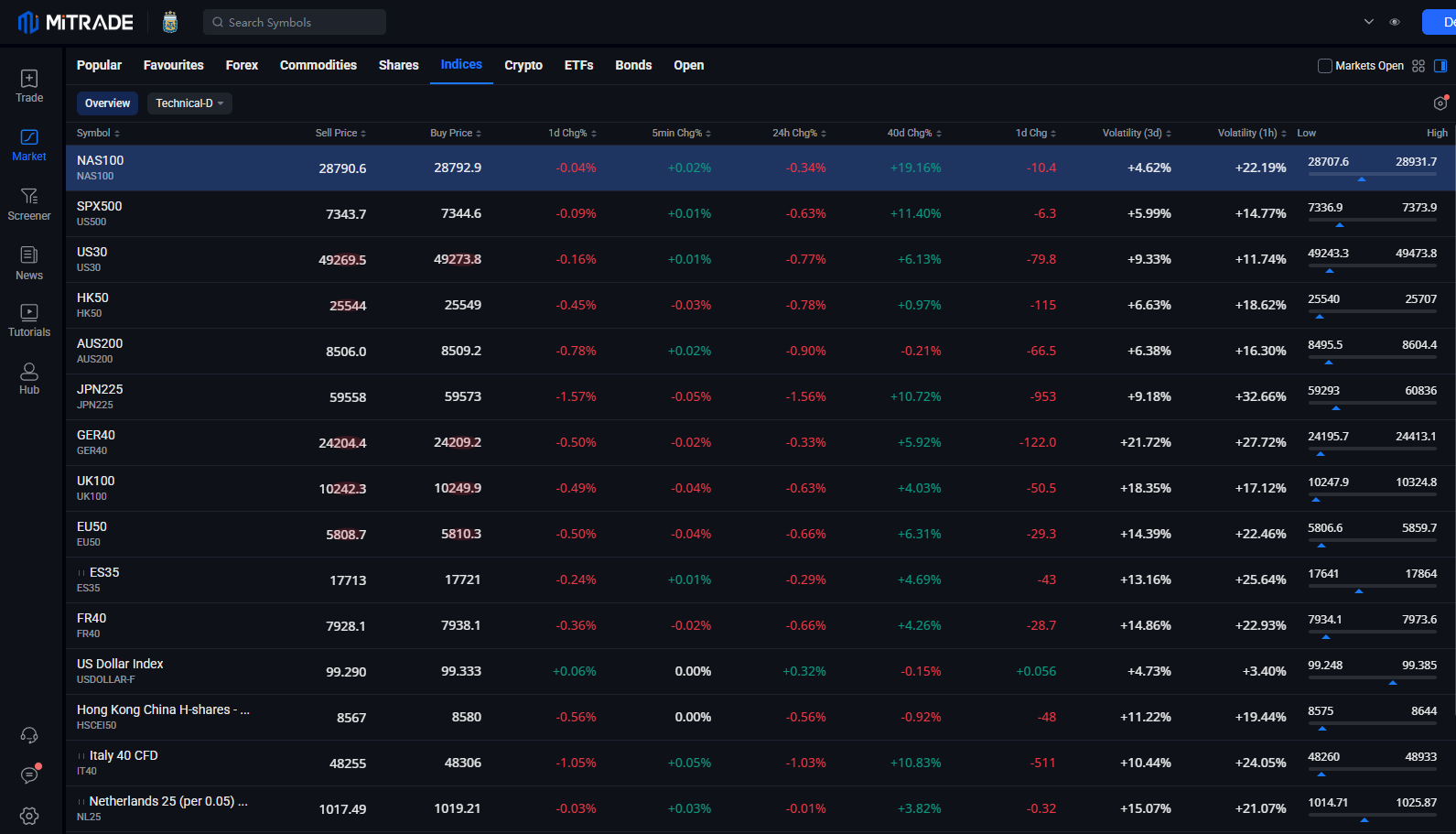
How to Trade Market Indices on Mitrade
Create a Mitrade account and complete identity verification
Deposit funds using any of the supported payment options
Explore the supported index CFDs and choose your preferred one
Analyse the market and decide what position to take
Open a position (go long or short) based on your projection


1. What is a market index?
A market index measures the performance of a group of stocks within a market or sector.
2. What is the main market index ASX investors follow?
The S&P/ASX 200 is the primary benchmark index in Australia.
3. Can Australians trade global market indices?
Yes, Australians can access global indices through ETFs, international brokers, and CFD trading platforms like Mitrade.
Disclaimer: The content presented above, whether from a third party or not, is considered as general advice only. CFD trading involves significant risk of loss. Past performance does not guarantee future results. This article serves informational purposes only and does not constitute financial advice. Consider your risk tolerance before trading.


