




How to Invest in AI Stocks from Australia in 2026: The Three-Layer Approach

Nvidia (NVDA) slid nearly 12% in June 2026. Microsoft (MSFT) dropped 17% in the same month. Broadcom (AVGO) fell 20%. And yet every analyst worth listening to is still calling AI the defining investment theme of the decade.
That gap between short-term volatility and long-term conviction is exactly what makes AI stocks so difficult to trade and so important to understand properly. The investors who get hurt are the ones treating AI as a single trade when it is actually three separate opportunities, each operating at a different pace, carrying a different risk profile, and accessible through a different part of the market.
This guide breaks the AI investment landscape into its three real layers for 2026: the compute layer that powers the buildout, the infrastructure layer that houses it, and the application layer that turns it into revenue. It covers which stocks give Australian investors exposure at each level, how to access US-listed names that are not on the ASX, and which ETFs suit investors who want diversified AI exposure without picking individual stocks.
Why the AI Trade in 2026 Is Not One Trade
AI stocks are shares of companies that develop, manufacture, or significantly benefit from artificial intelligence, ranging from chip makers and data centre operators to cloud platforms and software businesses embedding AI into products that generate revenue today.
The mistake most retail investors make is treating AI as a single sector. They buy Nvidia, hold it through post-earnings volatility, and wonder why their AI thesis is not playing out the way the headlines suggest. The reality is that AI spending flows through a supply chain with three distinct layers, and each layer moves at a different speed and responds to different catalysts.
The compute layer is where the chips are made. The infrastructure layer is where the physical data centres, power systems, and connectivity assets are built to run those chips at scale. The application layer is where software companies embed AI into real products that users pay for today. Owning across all three layers is the most important idea in AI investing in 2026, because nobody yet knows which layer captures the largest share of AI's eventual profit pool.
Layer 1: The Compute Layer
This is where the AI buildout starts and where the most obvious money has already been made.
Nvidia (NVDA)
Nvidia delivered $81.6 billion in quarterly revenue in May 2026, up 85% year over year, with data centre sales of $75.2 billion growing 92% and data centre networking revenue exploding 199% year over year. Management guided the following quarter at $91 billion. Microsoft, Amazon, Alphabet, and Meta collectively signalled AI infrastructure spending of approximately $725 billion in 2026, and almost all of that spending flows through Nvidia's chip architecture.
The stock slid ~13% in June 2026 alongside the broader tech pullback, which analysts including Morningstar's team called a significant discount to its $280 fair value estimate, making the current pullback one of the more compelling entry points of the year.
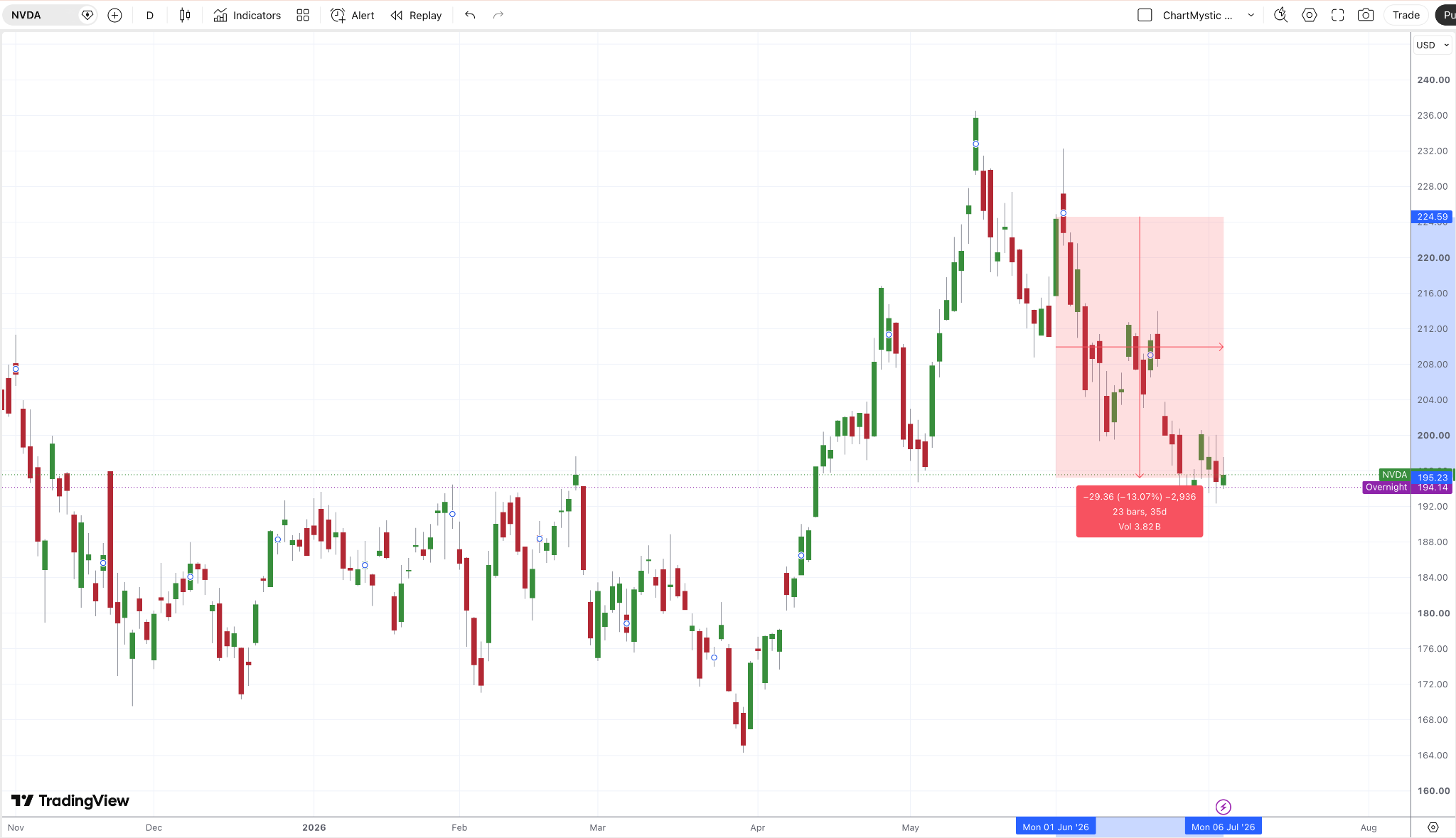
Source:NVDA TradingView Daily Chart
“Trade Nvidia Stock with an ASIC-regulated broker. Fast AUD funding via PayID. ”
Layer 2: The Infrastructure Layer
This is where the physical backbone of AI gets built, and it is the layer most Australian investors are completely ignoring despite the fact that the ASX gives direct access to two of its best representatives.
NextDC (NXT.AX)
NextDC is Australia's leading data centre operator with 16 functioning centres and more under development across Oceania. In December 2025, NextDC signed a memorandum of understanding with OpenAI to develop a sovereign AI hyperscale campus and GPU supercluster at its Sydney S7 site. In April 2026, the company launched a $1 billion hybrid securities offer backed by a $1 billion commitment from La Caisse, lifting pro-forma liquidity to around $5.2 billion as it scales to meet contracted demand through fiscal year 2029. Every AI model trained in Australia runs on infrastructure that companies like NextDC provide. The stock gives Australian investors direct ASX exposure to the AI infrastructure boom without touching a US stock or converting a single dollar of AUD.
Goodman Group (GMG.AX)
Goodman is a different kind of AI infrastructure play. It owns, develops, and manages the industrial real estate that data centres sit inside, and it is one of the most underappreciated AI beneficiaries on the entire ASX. As demand for cloud computing and AI-powered services scales, companies including Amazon, Microsoft, and Google need massive, energy-ready facilities to run their technology.
Goodman has been actively repositioning its global industrial portfolio to meet this demand, including through large-scale data centre developments backed by institutional capital. The strategy gives Goodman exposure to the AI boom without relying on the success of any single technology platform, which is exactly the kind of structural diversification most AI investors are missing.
“Trade ASX Stocks with an ASIC-regulated broker. Fast AUD funding via PayID. ”
Layer 3: The Application Layer
This is where AI stops being an infrastructure story and starts generating real revenue from real customers paying real money today.
WiseTech Global (WTC.AX)
WiseTech develops IT solutions for logistics companies across the globe and has embedded AI into its core CargoWise platform, which connects importers, exporters, customs brokers, freight forwarders, and carriers across over 180 countries. AI is not a future strategy for WiseTech. It is already reducing manual processing time, improving customs compliance accuracy, and enabling the kind of real-time global supply chain visibility that logistics companies are paying premium subscription fees to access.
For Australian investors, WiseTech is one of the clearest examples of a domestic company generating compounding revenue from AI that is already embedded in mission-critical enterprise workflows.
Microsoft (MSFT)
Microsoft dropped 17% in June 2026 alongside the broader tech pullback, but the underlying AI revenue picture remains intact. Azure cloud revenue continues to grow at double-digit rates and Copilot, Microsoft's AI assistant embedded across its entire Office 365 suite, is now generating revenue at a meaningful scale across its 300 million commercial users.
Microsoft also holds a significant stake in OpenAI and runs its models on Azure infrastructure, creating a structural link between the world's most watched AI research organisation and Microsoft's cloud billing. The June pullback is the same setup that has preceded each of Microsoft's three strongest recovery periods since the AI trade began in 2023.
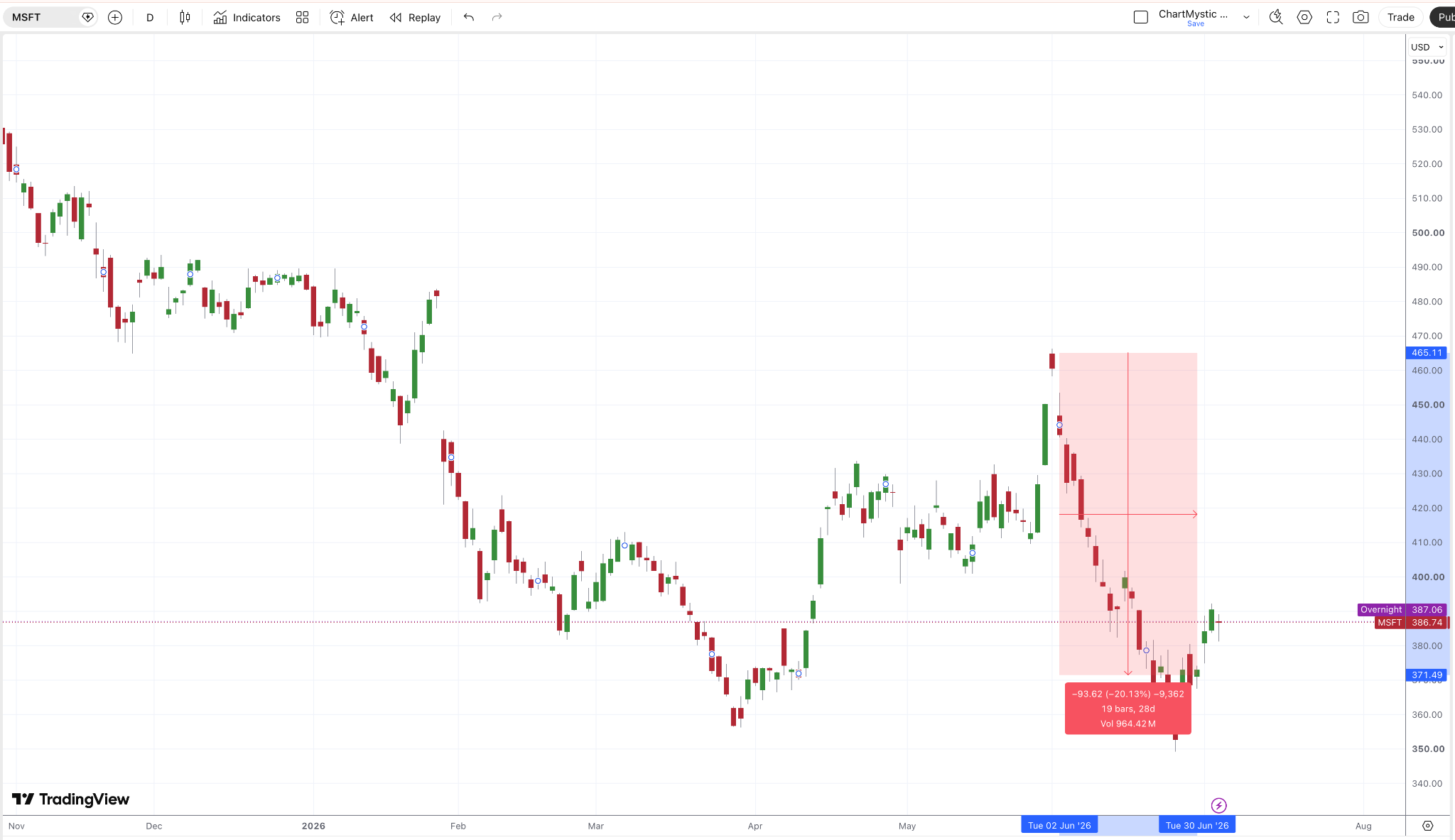
Source: MSFT TradingView Daily Chart
Alphabet (GOOG)
Alphabet pairs its Gemini model family with its own custom TPU chips, Google Cloud infrastructure, and the cash machine of search all under one roof. That vertical integration, where the model, the chip, and the cloud are all owned by the same company, is genuinely rare among the hyperscalers and gives Alphabet a structural cost advantage that compounds over time.
Google Cloud grew 28% year over year in the most recent quarter. AI-driven improvements to search are monetising quickly through advertising revenue that funds the entire AI buildout. The unique risk is that AI-driven shifts in how people search could pressure the very business funding everything else, which makes Alphabet one of the most important companies to understand deeply before taking a position.
“Trade AI Stocks with an ASIC-regulated broker. Fast AUD funding via PayID. ”
AI ETFs: Diversified Exposure Without Picking Individual Stocks
For Australian investors who want exposure to the AI theme without the concentration risk of individual stocks, three ASX-listed ETFs offer different angles on the same megatrend.
The BetaShares Global Robotics and Artificial Intelligence ETF listed as RBTZ on the ASX is sector and geography-agnostic, focusing purely on the robotics and AI theme with key holdings including Nvidia, Intuitive Surgical, and Keyence Corporation. The BetaShares NASDAQ 100 ETF listed as NDQ captures the global leaders driving AI development including Microsoft, Apple, Amazon, and Alphabet.
The BetaShares Asia Technology Tigers ETF listed as ASIA adds a third dimension by providing exposure to major Asian technology companies including Alibaba and Baidu, which are building out their own AI ecosystems for hundreds of millions of users across markets that the US-focused ETFs underrepresent entirely.
Three Ways to Invest in AI Stocks from Australia
Australian investors have three practical routes to the AI trade depending on their goals, time horizon, and risk tolerance.
Direct ASX share ownership gives you exposure to the infrastructure layer through NextDC (NXT.AX), Goodman Group (GMG.AX), and WiseTech Global (WTC.AX) without currency conversion or international account setup. These are CHESS-sponsored holdings with the full dividend and franking credit entitlements of Australian shares.
AI-focused ETFs listed on the ASX like RBTZ and NDQ give diversified exposure across all three AI layers through a single instrument with low management fees and no need to select individual stocks. These suit buy-and-hold investors who want structural AI exposure without the volatility of single stock concentration.
CFD trading through Mitrade gives active traders access to both ASX and US AI stocks from a single ASIC-regulated account, with the ability to go long or short on any instrument. Mitrade offers Nvidia (NVDA), Microsoft (MSFT), Alphabet (GOOG), NextDC (NXT.AX), Goodman Group (GMG.AX), and WiseTech Global (WTC.AX) as CFDs with zero commission and no currency conversion required on US names. When Nvidia slides 12% in a month, Mitrade traders can go short and profit from the drawdown rather than absorbing the loss and waiting for the recovery.
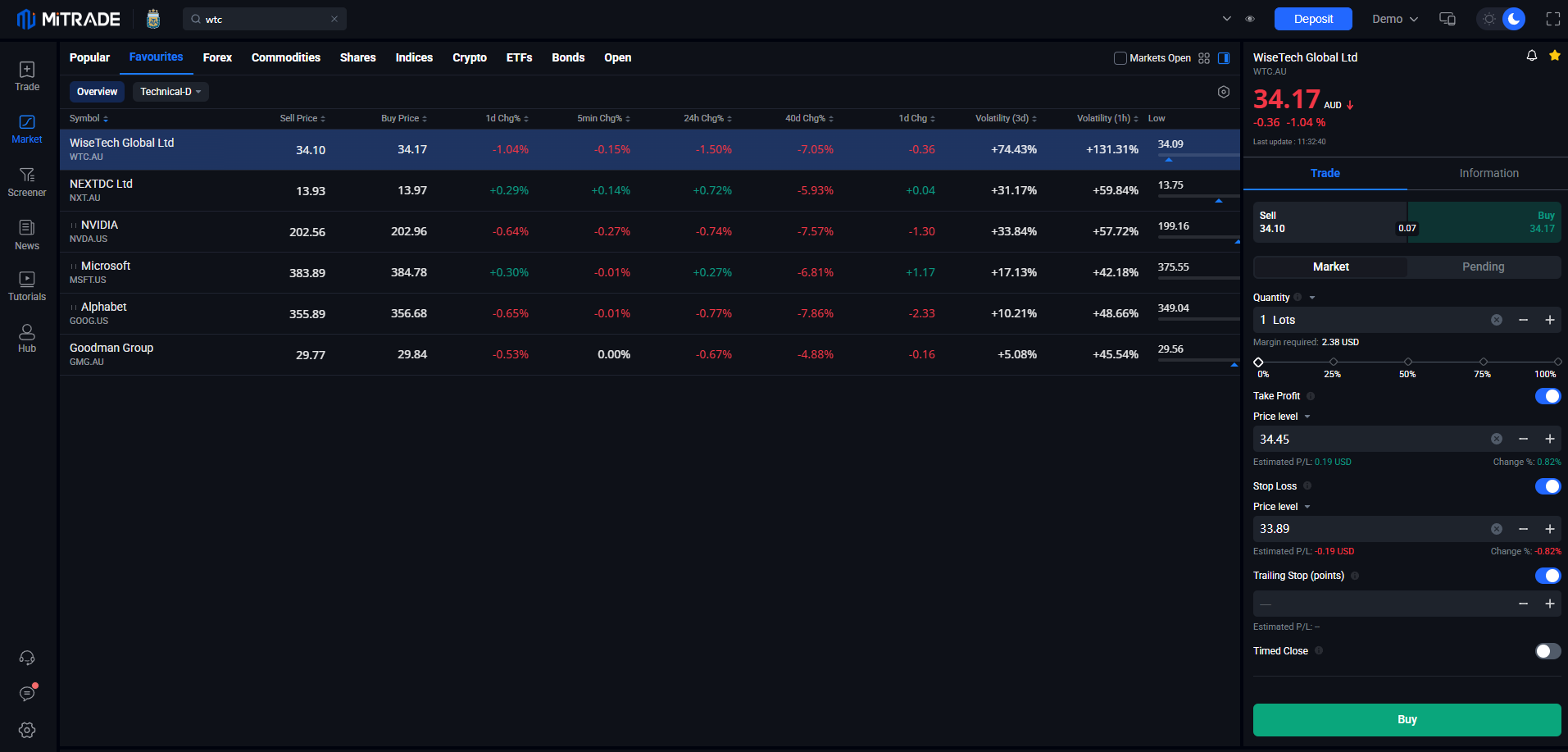
Source: Mitrade Platform
Pros of Trading AI Stocks as CFDs on Mitrade
You can go short on individual AI stocks when post-earnings selloffs hit, sector rotation pulls money out of tech, or macro risk-off events compress valuations across the board. Long-only investors have no tool for this and can only wait.
You can access US AI names like Nvidia, Microsoft, and Alphabet from an AUD-funded ASIC-regulated Australian account without opening a US brokerage account, completing a W-8BEN tax form, or converting currency on every trade.
You can access ASX AI names like NextDC, Goodman Group, and WiseTech Global as CFDs from the same account, which means your entire three-layer AI portfolio sits inside a single platform with a single login and a single set of risk management tools.
You can react immediately to AI earnings results during Australian business hours through the after-hours trading window, which is when Nvidia, Microsoft, and Alphabet all release their quarterly numbers. A stop-loss order placed before the event caps your downside if the result moves against your position.
You can practise the full three-layer approach on a free demo account loaded with $50,000 in virtual funds before risking real capital on one of the most volatile investment themes in global markets.


1. What are AI stocks and why are Australian investors buying them?
AI stocks are shares of companies that develop, manufacture, or significantly benefit from artificial intelligence. Australian investors are buying them because AI is the fastest-growing technology theme in global markets, with the AI market projected to grow from $196 billion in 2024 to over $1.8 trillion by 2030. The ASX gives direct access to AI infrastructure plays like NextDC and Goodman Group, while US markets give access to the compute and application leaders like Nvidia, Microsoft, and Alphabet.
2. What ASX stocks give exposure to the AI trade in 2026?
The three strongest ASX AI plays in 2026 are NextDC (NXT.AX) for data centre infrastructure, Goodman Group (GMG.AX) for the industrial real estate that data centres occupy, and WiseTech Global (WTC.AX) for AI embedded in enterprise logistics software. Appen and BrainChip Holdings are smaller, higher-risk pure-play ASX AI names for investors comfortable with micro-cap volatility.
3. Is Nvidia still a good AI stock to buy in 2026?
Nvidia slid 12% in June 2026 alongside a broader tech pullback, which Morningstar analysts described as a significant discount to their $280 fair value estimate. The underlying business delivered $81.6 billion in revenue in its most recent quarter, up 85% year over year, with management guiding the following quarter at $91 billion. Morningstar rates the stock as 31% undervalued at current prices relative to their fair value estimate, making the June drawdown one of the more compelling entry points of 2026 for investors with a medium-term horizon.
4. What is the difference between buying AI stocks directly and through CFDs?
Buying AI stocks directly gives you legal ownership, dividends, and no financing fees but limits you to going long and requires currency conversion for US names. CFD trading gives you price exposure to the same stocks without ownership, allows you to go short, requires no currency conversion for US names, and involves faster account setup. CFDs suit active traders. Direct ownership suits long-term investors who want dividends and compounding from the underlying business.
5. What AI ETFs are available on the ASX?
Three ASX-listed ETFs offer diversified AI exposure. The BetaShares Global Robotics and Artificial Intelligence ETF listed as RBTZ focuses purely on the AI and robotics theme with holdings including Nvidia and Intuitive Surgical. The BetaShares NASDAQ 100 ETF listed as NDQ captures the global AI leaders including Microsoft, Apple, and Alphabet. The BetaShares Asia Technology Tigers ETF listed as ASIA adds exposure to Asian AI companies including Alibaba and Baidu that US-focused ETFs miss entirely.
6. Can Australian traders access AI stocks on Mitrade?
Yes. Mitrade offers AI stocks across all three layers of the trade under ASIC regulation with licence AFSL 398528. Australian traders can access Nvidia (NVDA), Microsoft (MSFT), Alphabet (GOOG), NextDC (NXT.AX), Goodman Group (GMG.AX), and WiseTech Global (WTC.AX) as CFDs with zero commission and no US brokerage account required. A free demo account with $50,000 in virtual funds is available before going live.
Disclaimer: The content presented above, whether from a third party or not, is considered as general advice only. CFD trading involves significant risk of loss. Past performance does not guarantee future results. This article serves informational purposes only and does not constitute financial advice. Consider your risk tolerance before trading.


