




Best Low Spread Forex Brokers in Australia (2026): Compare Spreads, Fees & Trading Platforms

The Australian forex market is one of the most competitive in the world, giving traders access to dozens of regulated brokers offering tight spreads, fast execution, and advanced trading platforms. However, the broker with the lowest advertised spread isn't always the cheapest once commissions, slippage, and overnight financing costs are taken into account.
For active traders—especially scalpers, day traders, and high-frequency CFD traders—even a difference of 0.2 pips on EUR/USD can have a significant impact on long-term profitability. That's why choosing a genuinely low spread forex broker is one of the most important decisions you'll make.
Quick Summary: Best Low Spread Forex Brokers in Australia (2026)
Mitrade(From 0.0–0.3 pips )– Best overall for low spreads and zero commission
Pepperstone(From 0.0 pips (Razor) – Best for scalping and fast execution
IC Markets(From 0.0 pips (Raw Spread) – Best ECN broker
FP Markets(From 0.0 pips) – Best RAW Spread account
Eightcap(From 0.0 pips) – Best for algorithmic trading
CMC Markets(From 0.5 pips)– Best commission-free standard account
IG Markets(From 0.6 pips) – Best for multi-asset CFD trading
What Is a Low Spread Forex Broker?
A low spread forex broker is a broker that offers tight bid-ask spreads on currency pairs, helping traders reduce the cost of entering and exiting positions. Since the spread is one of the primary trading costs in Forex CFDs, choosing a broker with consistently low spreads can significantly improve long-term trading performance—particularly for active traders.
The spread is simply the difference between the buy (Ask) price and the sell (Bid) price of a currency pair. For example, if EUR/USD is quoted at 1.18000 / 1.18002, the spread is 0.2 pips. Every trade begins with this small cost, meaning the market must move beyond the spread before a position becomes profitable.
Why Do Low Spreads Matter?
Lower spreads reduce transaction costs, allowing traders to retain more of their profits over time.
For example:
If you execute 100 trades per month, the difference between a 0.2-pip spread and a 1.2-pip spread could amount to hundreds or even thousands of dollars in annual trading costs.
This is why professional traders often pay close attention to spreads, especially when trading frequently.
Low Spread Doesn't Always Mean Lower Costs
Many beginners focus only on the advertised minimum spread, but the true cost of trading includes more than just the spread.
When comparing forex brokers, consider:
Average spreads, not just the minimum advertised spread
Commission fees charged on RAW or ECN accounts
Swap (overnight financing) fees for positions held overnight
Execution quality and slippage, particularly during volatile markets
Market liquidity, which affects how much spreads widen during major economic news
For example, a broker offering 0.0-pip spreads with a US$7 round-turn commission may actually be more expensive than another broker offering a consistent 0.5-pip spread with zero commission.
“Trade Forex with an ASIC-regulated broker. Fast AUD funding via PayID. ”
Low Spread Forex Brokers Australia (2026) Comparison
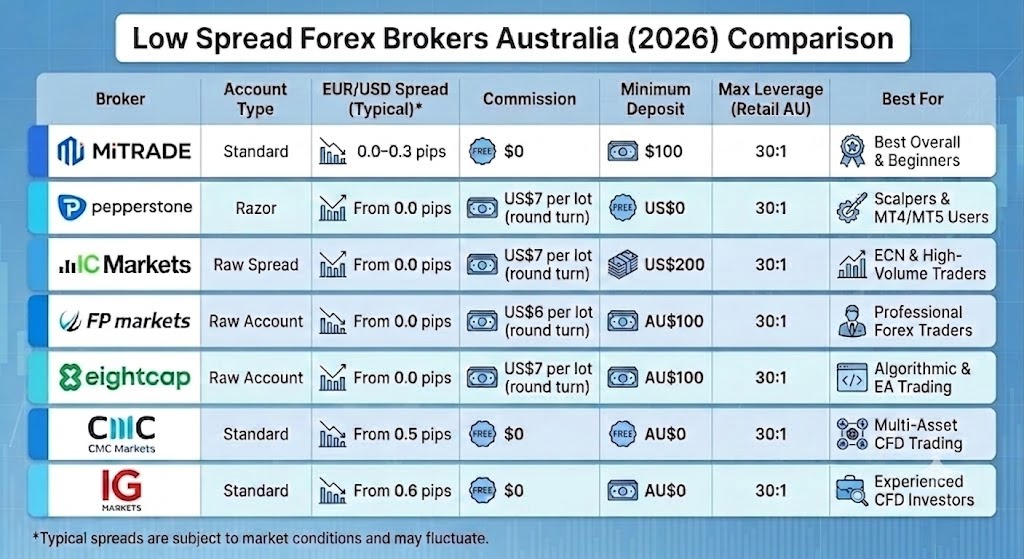
*Note: Spreads shown are typical or minimum advertised values for EUR/USD and may vary depending on market volatility, liquidity, and trading session. Australian retail clients are generally subject to a maximum leverage of 30:1 for major Forex pairs under ASIC regulations. Professional clients who qualify may access higher leverage.
Best Low Spread Forex Brokers in Australia (2026)
1. Mitrade
For most Australian retail traders, Mitrade offers one of the best combinations of tight spreads, zero commission, and an easy-to-use trading platform. Unlike many ECN brokers that advertise ultra-low spreads but charge a commission on every trade, Mitrade keeps pricing simple by incorporating trading costs into the spread, allowing traders to know exactly what they're paying upfront.
This pricing model is particularly attractive for beginners, swing traders, and active CFD traders who want to avoid calculating separate commission fees while still benefiting from competitive spreads on major currency pairs.
Why We Recommend Mitrade
Pros
✅ Tight spreads from 0.4 pips on major Forex pairs
✅ Zero commission on Forex CFD trades
✅ ASIC-regulated broker for Australian clients
✅ Trade over 60+ Forex pairs, Gold, Indices, Commodities, Shares and Crypto CFDs from one account
✅ User-friendly proprietary trading platform for desktop and mobile
✅ Fast account opening with a low minimum deposit
✅ Free demo account with virtual funds
✅ Built-in risk management tools including Stop Loss, Take Profit and Guaranteed Stop Loss on selected markets
Cons
Limited support for third-party platforms such as MT4 or MT5
Designed primarily for CFD trading rather than direct ownership of underlying assets
Trading Costs
One of Mitrade's biggest advantages is its transparent pricing model. Instead of charging a separate commission for each transaction, trading costs are included within the spread.
For example:
For many retail traders, this can result in a lower overall trading cost than RAW Spread accounts that advertise 0.0-pip spreads but charge a commission of around US$6–US$7 per standard lot.
If your priority is to minimise trading costs without dealing with complicated fee structures, Mitrade stands out as one of the best low spread Forex brokers in Australia in 2026. Its combination of tight spreads, zero commissions, ASIC regulation, and a streamlined trading platform makes it particularly well suited to beginner and intermediate Forex CFD traders, while still offering competitive pricing for active traders.
“Trade Forex with an ASIC-regulated broker. Fast AUD funding via PayID. ”
2. Pepperstone
Pepperstone is one of Australia's most recognised Forex brokers and a popular choice among scalpers and experienced traders. Its Razor Account offers institutional-grade pricing with spreads from 0.0 pips on major currency pairs, making it ideal for traders who execute a high volume of short-term trades.
Combined with ultra-fast execution, deep liquidity, and support for MT4, MT5, cTrader and TradingView, Pepperstone is well suited to active Forex CFD traders who prioritise speed and precision.
Why We Recommend Pepperstone
Pros
✅ Razor Account spreads from 0.0 pips
✅ Excellent execution speed with low latency
✅ Supports MT4, MT5, cTrader and TradingView
✅ ASIC-regulated Australian broker
✅ Suitable for scalping, day trading and algorithmic trading
✅ No minimum deposit requirement
Cons
Commission applies to Razor accounts
Standard account spreads are wider than Razor accounts
Trading Costs
Pepperstone's Razor Account combines raw spreads with a fixed commission.
Although commissions increase the total trading cost, Pepperstone remains one of Australia's best choices for scalpers thanks to its execution quality and consistently tight spreads.
Pepperstone is one of the best low spread Forex brokers for experienced traders who value fast execution and institutional pricing. If you regularly scalp the market or use Expert Advisors, Pepperstone's Razor Account is an excellent option.
3. IC Markets
IC Markets has built its reputation around providing a true ECN-style trading environment. The broker aggregates liquidity from leading banks and financial institutions, allowing traders to access some of the tightest spreads available in the retail Forex market.
Its Raw Spread Account is particularly popular among professional traders, automated strategy users, and high-volume traders.
Why We Recommend IC Markets
Pros
✅ RAW spreads from 0.0 pips
✅ Deep institutional liquidity
✅ Excellent execution speed
✅ MT4, MT5 and cTrader available
✅ Supports algorithmic trading and VPS
✅ ASIC-regulated
Cons
Commission charged on Raw Spread accounts
Slightly higher minimum deposit than some competitors
Trading Costs
IC Markets delivers consistently low spreads during active market hours, making it one of the leading ECN brokers worldwide.
If you're looking for an institutional-style ECN trading experience, IC Markets remains one of Australia's strongest choices thanks to its excellent liquidity, tight spreads and reliable execution.
4. FP Markets
FP Markets has been serving Australian traders for nearly two decades and is widely recognised for its competitive RAW pricing and broad range of CFD products.
Its RAW Account combines low spreads with relatively competitive commissions, making it attractive for active Forex traders.
Why We Recommend FP Markets
Pros
✅ RAW spreads from 0.0 pips
✅ Competitive commission structure
✅ MT4 and MT5 support
✅ ASIC-regulated
✅ Over 10,000 tradable instruments
Cons
Commission required on RAW accounts
Proprietary platform less developed than competitors
Trading Costs
FP Markets offers one of the most competitive RAW Spread accounts in Australia and remains a strong choice for experienced traders looking to minimise transaction costs.
5. Eightcap
Eightcap has become increasingly popular among traders using automated strategies and Expert Advisors. With RAW spreads, fast execution, and extensive MT4 and MT5 support, it provides an excellent environment for algorithmic Forex trading.
Why We Recommend Eightcap
Pros
✅ RAW spreads from 0.0 pips
✅ Excellent MT4 and MT5 integration
✅ Supports automated trading
✅ ASIC-regulated
✅ Competitive commissions
Cons
Fewer research tools than larger brokers
Product range smaller than IG or CMC Markets
Trading Costs
Eightcap is an excellent choice for traders who rely on automated strategies and want consistently low spreads with reliable execution on MetaTrader platforms.
6. CMC Markets
CMC Markets stands out by offering competitive spreads without charging commissions on its Standard account. Combined with its award-winning Next Generation platform and extensive CFD product range, it is a solid choice for traders seeking simplicity.
Why We Recommend CMC Markets
Pros
✅ No commission on standard Forex trading
✅ Powerful proprietary trading platform
✅ Excellent charting and market analysis
✅ Large CFD product selection
✅ ASIC-regulated
Cons
Spreads slightly wider than RAW accounts
Less suitable for high-frequency scalping
Trading Costs
CMC Markets is ideal for traders who prefer transparent, commission-free pricing and a premium trading platform without sacrificing competitive spreads.
7. IG Markets
IG Markets is one of the world's largest CFD brokers, offering access to thousands of markets alongside competitive Forex spreads. While its spreads may not be the absolute lowest, its strong regulation, advanced research tools, and broad market coverage make it a popular choice among long-term CFD traders.
Why We Recommend IG Markets
Pros
✅ Commission-free Forex trading
✅ Excellent market research and education
✅ Over 17,000 global markets
✅ ASIC-regulated
✅ Advanced trading platform
Cons
Spreads slightly higher than ECN brokers
Not designed specifically for scalping
Trading Costs
IG Markets is best suited to traders looking for a well-rounded CFD broker with competitive Forex pricing, outstanding research tools, and access to a wide range of global markets beyond currencies.
Why Spreads Matter More Than Commissions
When comparing Forex brokers, many traders focus on whether a broker charges commissions. While commissions certainly affect your overall trading costs, the spread often has a much greater impact—especially if you trade frequently.
Every Forex CFD trade starts with the spread. Before your position can become profitable, the market must first move enough to cover the difference between the bid and ask prices. The wider the spread, the more the market needs to move in your favour before you begin making a profit.
Spread vs Commission: Which Costs More?
Consider the following example of trading one standard lot (100,000 units) of EUR/USD.
Although Broker B advertises a 0.0-pip spread, the commission increases the total cost to approximately US$7 per standard lot. Meanwhile, Broker A, with a 0.2-pip spread and zero commission, may actually offer the lowest overall trading cost.
This is why experienced traders evaluate the all-in cost rather than focusing solely on the lowest advertised spread.
Our Recommendation
Rather than searching for the broker with the lowest advertised spread, compare the total trading cost, including:
Average spreads (not minimum spreads)
Commission fees
Overnight financing (swap) charges
Execution quality and slippage
Platform reliability
For most Australian retail traders, brokers that combine tight spreads with zero commissions, such as Mitrade, can offer better value than RAW Spread accounts that charge additional commissions on every trade.
How to Start Trading Forex CFDs with Low Spreads
Getting started with Forex CFD trading is straightforward, but choosing a broker with competitive pricing can help reduce costs from your very first trade. Follow these simple steps to begin trading with low spreads.
Step 1: Choose a Regulated Low Spread Broker: Select an ASIC-regulated broker that offers competitive spreads, transparent pricing, and reliable execution.
Step 2: Open and Verify Your Account: Register online by providing your email address and personal details. You'll then complete a quick identity verification process, which is required under Australian financial regulations.
Step 3: Fund Your Trading Account: Deposit funds using your preferred payment method. Start with an amount that matches your trading plan and risk tolerance.
Step 4: Practise on a Demo Account: Before risking real capital, spend time using a demo account.
Step 5: Start Trading Major Currency Pairs: Begin with the most liquid currency pairs, which generally offer the tightest spreads, such as:
EUR/USD
GBP/USD
AUD/USD
USD/JPY
USD/CHF
Major pairs typically experience lower trading costs and better liquidity than exotic currency pairs.
👉 Ready to Trade Forex with Lower Costs?
If you're looking for a broker that combines tight spreads, zero commissions, ASIC regulation, and an intuitive trading platform, Mitrade is one of the strongest choices for Australian Forex CFD traders in 2026.
Whether you're just starting out or you're an active trader looking to reduce transaction costs, Mitrade's transparent pricing model helps you keep more of your potential profits by avoiding separate commission charges on every Forex CFD trade.


1. What is a low spread forex broker?
A low spread forex broker offers tight bid-ask spreads on currency pairs, helping traders reduce their transaction costs. Lower spreads mean the market needs to move less before a trade becomes profitable, making these brokers particularly attractive for active traders, scalpers, and day traders.
2. Is a 0.0-pip spread always cheaper?
Not necessarily. Many brokers offering 0.0-pip RAW spreads charge commissions of around US$6–US$7 per standard lot. In some cases, a broker offering a 0.2-pip spread with zero commission can actually be more cost-effective, especially for retail traders.
3. What is the difference between RAW spreads and Standard spreads?
A RAW Spread Account provides direct market pricing with extremely tight spreads but usually charges a commission per trade. A Standard Account generally has slightly wider spreads, but commissions are included in the spread, making pricing simpler and easier to understand.
4. Are low spread brokers suitable for beginners?
Yes. Low spread brokers can help beginners reduce trading costs from the start. However, beginners should also consider factors such as platform usability, educational resources, customer support, and transparent pricing. Brokers like Mitrade are popular because they combine low spreads with commission-free trading and an easy-to-use platform.
5. Which currency pairs usually have the lowest spreads?
Major currency pairs typically have the lowest spreads because they are the most actively traded. These include:
EUR/USD
GBP/USD
USD/JPY
AUD/USD
USD/CHF
Exotic and emerging market currency pairs generally have wider spreads due to lower liquidity.
Disclaimer: The content presented above, whether from a third party or not, is considered as general advice only. CFD trading involves significant risk of loss. Past performance does not guarantee future results. This article serves informational purposes only and does not constitute financial advice. Consider your risk tolerance before trading.


