




Dow Jones Forecast 2026: Record High, Then a 1,151-Point Drop in Two Days. Here Is What Is Actually Going On

The Dow Jones Industrial Average (DJI) hit an all-time high of 51,370 last week. Then it dropped 619 points on Tuesday and another 532 points on Wednesday. It now sits at 50,776 as of June 4, 2026 and the question traders are asking is the one they always ask after a sharp two-day reversal from a record high: was that the top?
Nobody knows. But the reasons behind the selloff are not random. Fresh US-Iran strikes, Broadcom missing earnings, and inflation data hitting a near four-year high all landed within 48 hours. These are not noise. They are the exact risks that were sitting underneath this rally the entire time it was running.
This guide covers what the Dow actually is, the 2026 rally that most commentary gets wrong, the risks now actively pulling it lower, and where analysts see it heading through year end.
What Is the Dow Jones and Why Do Traders Follow It?
The Dow Jones Industrial Average is a price-weighted index of 30 large blue-chip US companies and it is the oldest and most recognised stock market benchmark on the planet.
Unlike the S&P 500 which weights companies by market capitalization, the Dow weights them by share price. A company trading at $500 per share moves the index more than one at $100 regardless of how large the business actually is. Financial services make up the largest sector weighting at 27%, followed by technology at 17.4% and industrials at 17.1%.
The 30 components include Goldman Sachs (GS), JPMorgan (JPM), Microsoft (MSFT), Caterpillar (CAT), and Boeing (BA). Traders follow it because it reacts immediately to earnings, Fed decisions, geopolitical events, and economic data, and when it moves sharply the rest of the market almost always follows within hours.
How the Dow Got to 51,370
The round number makes a great headline. The journey getting there is more interesting.
The Dow closed at 50,115 on February 6, 2026, jumping 1,206 points in a single session. It was the first time in the index's 130-year history it had ever closed above five digits and a comma. The index needed 76 years to climb its first 1,000 points and just 21 months to climb its last 10,000, the strongest run between any two 10,000-point milestones in the Dow's entire history.
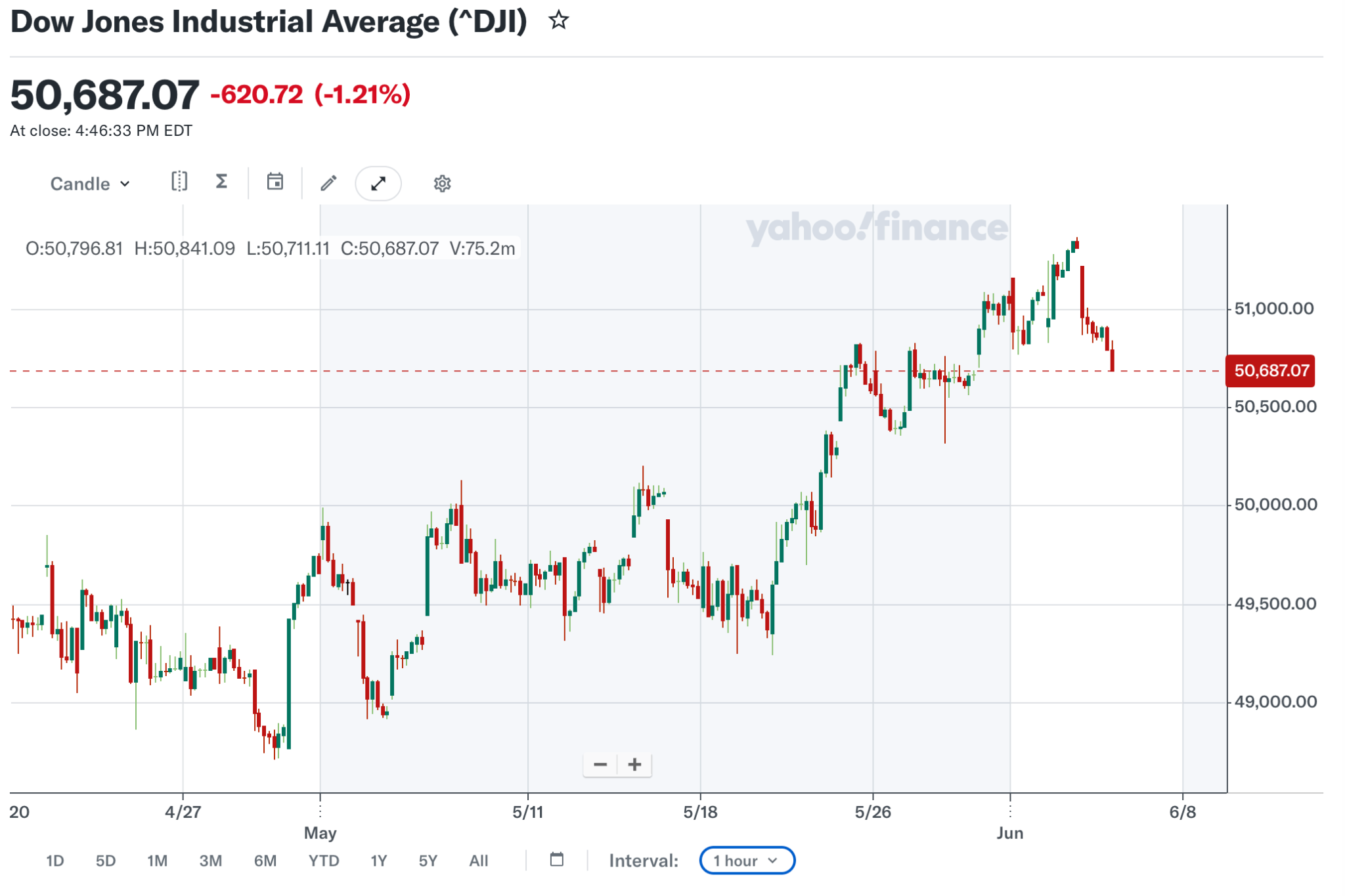
Source: DJI Yahoo Finance Hourly Chart
The Dow briefly tumbled below 37,000 in April 2025 during the early tariff scare, then reclaimed 45,000 by August and ran through 46,000, 47,000, and 48,000 in quick succession. It reclaimed 50,000 on May 14 as US-China trade tensions eased and financial sector earnings came in strong. It pushed through 51,000 and set an all-time high of 51,370 before Tuesday and Wednesday's combined 1,151-point selloff brought it back to 50,776 where it closed on June 4.
“Trade Dow Jones with an ASIC-regulated broker. Fast AUD funding via PayID. ”
What Is Actually Driving the 2026 Dow Rally
This is where the 2026 market story gets genuinely interesting, and where most commentary gets it wrong.
Since late December 2025, a clear sector rotation has taken hold in US equity markets with the Dow outperforming the AI-heavy Nasdaq significantly. Energy is the best performing S&P 500 sector in 2026, up 21.5% year to date. Technology is the worst performing major sector, down 3%. Materials have added 17.6%. The stocks that look boring are the ones doing the work this year.
When money moves from growth to value and from tech to industrials and energy, it is usually telling you something about where rates and inflation are headed. Financials make up around 28% of the DJI and strong earnings from Goldman Sachs (GS) and JPMorgan (JPM) have acted as directional triggers for the index across multiple sessions. Banks perform well in high-rate environments and with the Fed holding rates elevated through the first half of 2026, the financial sector tailwind has been structural rather than cyclical.
Why the Dow Just Dropped 1,151 Points in Two Days
Three things hit simultaneously and none of them were surprises to anyone who had been watching the risks underneath this rally.
Iran launched fresh missile strikes on Kuwait and Bahrain on June 3, targeting infrastructure and resulting in at least one confirmed fatality. The strikes reignited conflict fears, sent oil higher, pushed yields up across the curve, and killed hopes for a near-term ceasefire that markets had partially priced in.
Broadcom (AVGO) then reported fiscal second-quarter revenue below expectations after Wednesday's close, sinking nearly 14% in after-hours trading. The weakness spread immediately with AMD down 2.9%, Arm Holdings down 4.3%, and Palantir down 1.5%.
A strong ADP report and an ISM Services price gauge hitting a near four-year high pushed Fed rate cut expectations further into 2027, hitting rate-sensitive Dow components directly. IBM fell 7%, Honeywell dropped 5%, and Salesforce lost nearly 5%.
These three catalysts did not create new risks. They activated risks that were sitting underneath the rally the entire time. Caterpillar (CAT) and Boeing (BA), two of the Dow's most important price-weighted components, need stable energy costs and global infrastructure spending to hold their current valuations.
Neither condition is guaranteed while the Strait of Hormuz remains contested and oil stays above $100.
Dow Jones Forecast 2026: Three Scenarios From Here
The Dow sits at 50,776 as of June 4, 2026, with 51,370 as the recent record high and 49,000 as the nearest significant support. Here are your three most realistic scenarios for the rest of the year.
Case 1 - The bull case requires a genuine Middle East ceasefire that brings Brent crude back toward $75 to $80, a Fed that signals rate cuts before year end, and continued strong earnings from financials and energy in the next quarter. Analysts generally predict the DJI will trade in the $52,617 to $58,497 range by year end 2026, with more optimistic forecasts allowing above $63,564 if conditions align fully.
Case 2 - The base case keeps the Dow oscillating between 49,000 and 53,000 through the summer as Middle East uncertainty persists, the Fed holds steady, and the current selloff resolves into consolidation rather than a trend reversal. This is a range-trading environment that suits short-term CFD traders far better than long-term investors.
Case 3 - The bear case involves material escalation of the Iran conflict, oil pushing above $120, and a Fed forced to hold through 2027 in response to reaccelerating inflation. A break below 49,000 support on strong volume would signal the bear case is materialising faster than the base case, with 44,000 as the next meaningful support zone below.
“Trade Dow Jones with an ASIC-regulated broker. Fast AUD funding via PayID. ”
How Australian Traders Access the Dow Jones
The DJI does not trade on the ASX, but Australian traders have practical ways to get exposure. Here are your three most direct options.
Trading the DJI as a CFD
A few Australian brokers offer Dow Jones as an index CFD instrument. You go long if you expect the index to recover toward 52,000 and short if you expect the selloff to continue toward 49,000, without needing a US brokerage account or converting AUD to USD.
ASX-Listed ETFs
Several ASX-listed ETFs give indirect Dow exposure for longer-term investors. The iShares Core S&P 500 ETF listed as IVV on the ASX gives broad US market exposure that closely tracks the same macro forces driving the Dow. The BetaShares NASDAQ 100 ETF listed as NDQ captures the tech side of the US market. These suit buy-and-hold investors comfortable with ASX settlement timelines rather than real-time CFD execution.
International Platforms With US Market Access
Direct access to Dow futures or DJI component stocks is available through platforms with US market connectivity. The AUD/USD exchange rate adds a second variable alongside the index movement itself, with currency conversion fees applying on both entry and exit.
Pros of Trading the Dow Jones as a CFD
You can go short on the DJI when the risk-off environment takes hold, exactly the position that would have captured 1,151 points of downside across Tuesday and Wednesday this week. Holding ETFs only lets you benefit from rising markets.
You can react to Dow-moving events in real time without the settlement delays of ASX-listed products. When Iran strikes overnight and Dow futures move immediately, a CFD position on Mitrade lets Australian traders act before the local market even opens.
You can manage your exact risk on every trade by placing a stop loss and take profit directly on the order screen before confirming your position. Mitrade shows you the dollar value of your risk at each price level so you always know your worst-case outcome before a trade goes live.
You can gain meaningful exposure to the full DJI price move with a smaller capital outlay than buying individual Dow component stocks outright in USD, many of which trade between $100 and $400 per share.


1. What is the Dow Jones Industrial Average and how is it different from the S&P 500?
The Dow Jones Industrial Average tracks 30 large US blue-chip companies and weights them by share price, meaning higher-priced stocks move the index more than lower-priced ones regardless of company size. The S&P 500 tracks 500 companies weighted by market capitalisation. The Dow is more concentrated and reacts more sharply to individual high-priced component moves like Goldman Sachs (GS) and Caterpillar (CAT).
2. Why did the Dow drop over 1,150 points in two days after hitting a record high?
Three things hit simultaneously. Iran launched fresh missile strikes on Kuwait and Bahrain on June 3, reigniting Middle East conflict fears and pushing oil and yields higher. Broadcom (AVGO) missed revenue estimates after hours and triggered a broad tech selloff. A strong ADP report and near four-year high in the ISM Services price gauge pushed Fed rate cut expectations further into 2027.
3. What is the Dow Jones forecast for year end 2026?
Analysts generally predict the DJI will trade in the $52,617 to $58,497 range by year end 2026. The bull case targeting 55,000 to 58,000 requires a Middle East ceasefire and Fed rate cut signals in the second half. The base case keeps the index between 49,000 and 53,000 through the summer. The bear case puts 42,000 to 44,000 in scope if the Iran conflict escalates and inflation reaccelerates.
4. What is driving the Dow's outperformance of the Nasdaq in 2026?
A sector rotation from technology into energy, industrials, and financials is the primary driver. Energy is up 21.5% year to date as the best performing S&P 500 sector. Technology is down 3% as the worst. The Dow's heavier weighting toward industrials and financials has made it the relative outperformer as institutional money repositions for a higher-for-longer rate environment.
5. How does the Dow Jones affect Australian markets?
The Dow is the strongest overnight signal for the ASX 200 open. When the Dow drops sharply, risk-off sentiment spills into ASX-listed stocks particularly in resources and financials. A strong Dow close tends to support AUD/USD through improved global risk appetite, which feeds into Australian export dynamics and RBA rate expectations.
Disclaimer: The content presented above, whether from a third party or not, is considered as general advice only. CFD trading involves significant risk of loss. Past performance does not guarantee future results. This article serves informational purposes only and does not constitute financial advice. Consider your risk tolerance before trading.


