




US Stock Market Outlook 2026: Key Risks, Drivers and Investment Strategies

The US stock market has held up better than most people expected in 2026.
The S&P 500 is up about 4.17% year-to-date as of late April, and it recently crossed 7,100 for the first time ever.
But the gains are masking a lot of noise underneath. Geopolitical tension, sticky inflation, and trade policy uncertainty are the biggest US stock market decline reasons right now. Each one has the potential to shift market direction fast.
In this post, you'll get a clear look at what's driving the current climate. You'll also learn what the bull and bear cases look like and concrete steps you can take to manage your position from here.
Overview of the US Stock Market in 2025–2026
2025 was a year the US stock market won't forget. The S&P 500 closed the year up 16.39%, hitting 39 record closing highs along the way.
But those gains didn't come easy. April 2025 brought Liberation Day, a sweeping tariff announcement that triggered the largest global market sell-off since the COVID-19 pandemic crash in 2020.
The index nearly fell 19% from its peak before a tariff pause sparked a sharp recovery. A record-long government shutdown added more uncertainty.
Through it all, the AI investment boom kept the market moving. The “Magnificent 7,” which includes Apple, Microsoft, Nvidia, Amazon, Alphabet, Meta, and Tesla, accounted for 55% of the index's three-year total return.
Investors entered 2026 feeling relatively confident. Earnings were growing, borrowing costs had eased after multiple Fed interest rate cuts, and the AI spending cycle showed no signs of slowing.
Then new disruptions arrived.
In January, the Supreme Court struck down broad tariffs imposed under emergency powers, and the administration responded with a fresh 15% import duty. Shortly after, the US-Iran conflict sent oil prices surging and rattled global markets.
The S&P 500 came close to a 10% decline from its January 2026 high. It recovered, crossing 7,100 for the first time ever by late April.
But the risks that drove that pullback haven't gone away, and that's exactly what the next section covers.
“Trade US Stocks with an ASIC-regulated broker. Fast AUD funding via PayID. ”
Why Is the US Stock Market Declining? Key Risks in 2026
Understanding the US stock market decline reasons in 2026 starts with knowing what's actually changed. The market hasn't collapsed, but several forces are pulling against it.
Geopolitical Tension
The biggest short-term disruptor has been the US-Iran conflict. About one-fifth of the world's oil passes through the Strait of Hormuz, according to U.S. Bank. Any disruption there pushes energy prices higher, which feeds inflation and weighs on growth.
Oil has been hovering near $100–$101 per barrel as of late April 2026, keeping markets on edge.
Tariff and Trade Policy Uncertainty
Trade policy remains a live risk. The Supreme Court struck down broad emergency-powers tariffs on January 20, 2026. But the administration responded the same day with a 15% import duty under a different legal authority.
That kind of unpredictability is hard for markets to price in. In 2025, tariff shock alone nearly sent the US stock market into bear market territory, with an intra-year decline of 19%.
Inflation and Fed Policy
The Fed's current rate sits at 3.75% as of April ending. Inflation has been steady but hasn't been fully beaten, and an oil price shock adds upward pressure.
That limits how much the Fed can cut rates, which is one of the market's key supports right now.
Valuation Concerns
Analysts are predicting earnings growth of 18.6% for the full year 2026, according to FactSet. That's a strong number, but it means the market is priced for a lot to go right.
If earnings disappoint, prices could fall further than the headline numbers suggest.
Concentration Risk
The Magnificent 7 still account for a disproportionate share of index returns. A stumble in any of these names can pull the broader index lower quickly.
Key Drivers That Could Support the Market
The US stock market has real supports underneath it, even with the risks in play. None of them are guaranteed to hold, but each one matters. The main drivers include:
Earnings growth: Q1 2026 results have come in strong so far. UnitedHealth beat Wall Street estimates on April 22, and GE Vernova surged 12% after a strong quarter, according to CNBC. The bigger test comes on later in April, when Microsoft, Alphabet, Amazon, and Meta all report. If Big Tech delivers, it could give the broader market a meaningful lift.
The AI investment cycle: AI-related capital expenditure drove roughly half of US GDP growth in the first half of 2025, according to J.P. Morgan. That spending hasn't slowed. Amazon recently committed up to $25 billion in Anthropic, a sign that major players are still betting heavily on AI infrastructure.
The Fed's easing bias: Rate cuts in 2024 and 2025 have already reduced borrowing costs. Policymakers have signaled flexibility if growth slows, according to U.S. Bank. Lower rates support stock valuations, especially in growth-heavy sectors.
Fiscal support: The One Big Beautiful Bill Act delivers around $150 billion in individual tax refunds and $190 billion in corporate tax incentives, according to S&P Dow Jones Indices. That's direct spending power flowing into the economy.
Broader market participation: Smaller-company stocks have risen more than 60% since last April's lows, per U.S. Bank. When gains spread across the market rather than concentrating in a few names, it's generally a healthier sign.
US Stock Market Forecast 2026 (Bull vs Bear Scenarios)
No one can call the market with certainty. But knowing what the bull and bear cases look like helps you respond to new information rather than react to it.
The Bull Case
In the bull case, earnings come through as expected.
Big Tech delivers during the late April reporting period, the Iran ceasefire holds, and oil pulls back from current levels. The Fed cuts rates once or twice more in the second half of 2026.
Under those conditions, the S&P 500 consensus target of 8,001 looks achievable, implying around 16.9% upside from end-2025 levels.
As of late March 2026, Morningstar calculated the US stock market was trading at a 12% discount to fair value. If risks are clear, there's room to run.
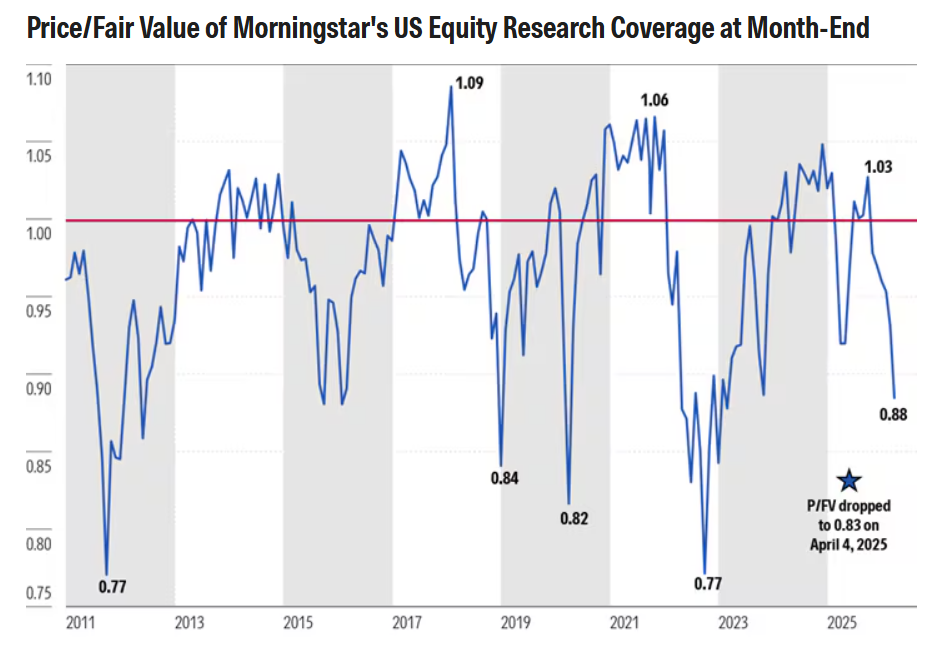
Image via Morningstar
The Bear Case
In the bear case, the US stock market decline reasons that have built up through 2026 start to compound.
The Iran conflict escalates, Strait of Hormuz disruptions persist, and oil stays above $100. Earnings disappoint, particularly in tech, and valuation multiples compress. The Fed holds rates higher for longer as inflation stays sticky.
Add midterm election uncertainty in November, and short-term volatility could stay elevated. In a growth-scare scenario, RBC Capital Markets has flagged a possible 14–20% peak-to-trough decline.
Ultimately, the honest answer is that both paths are live. What matters more than predicting which one plays out is knowing which indicators to watch and having a plan for either outcome.
“Trade US Stocks with an ASIC-regulated broker. Fast AUD funding via PayID. ”
How a US Stock Market Decline Affects Australia's Market
When the US stock market moves sharply, the ASX tends to follow. The clearest recent example came in April 2025, when Trump's sweeping tariff announcement sent the ASX down 10% within days.
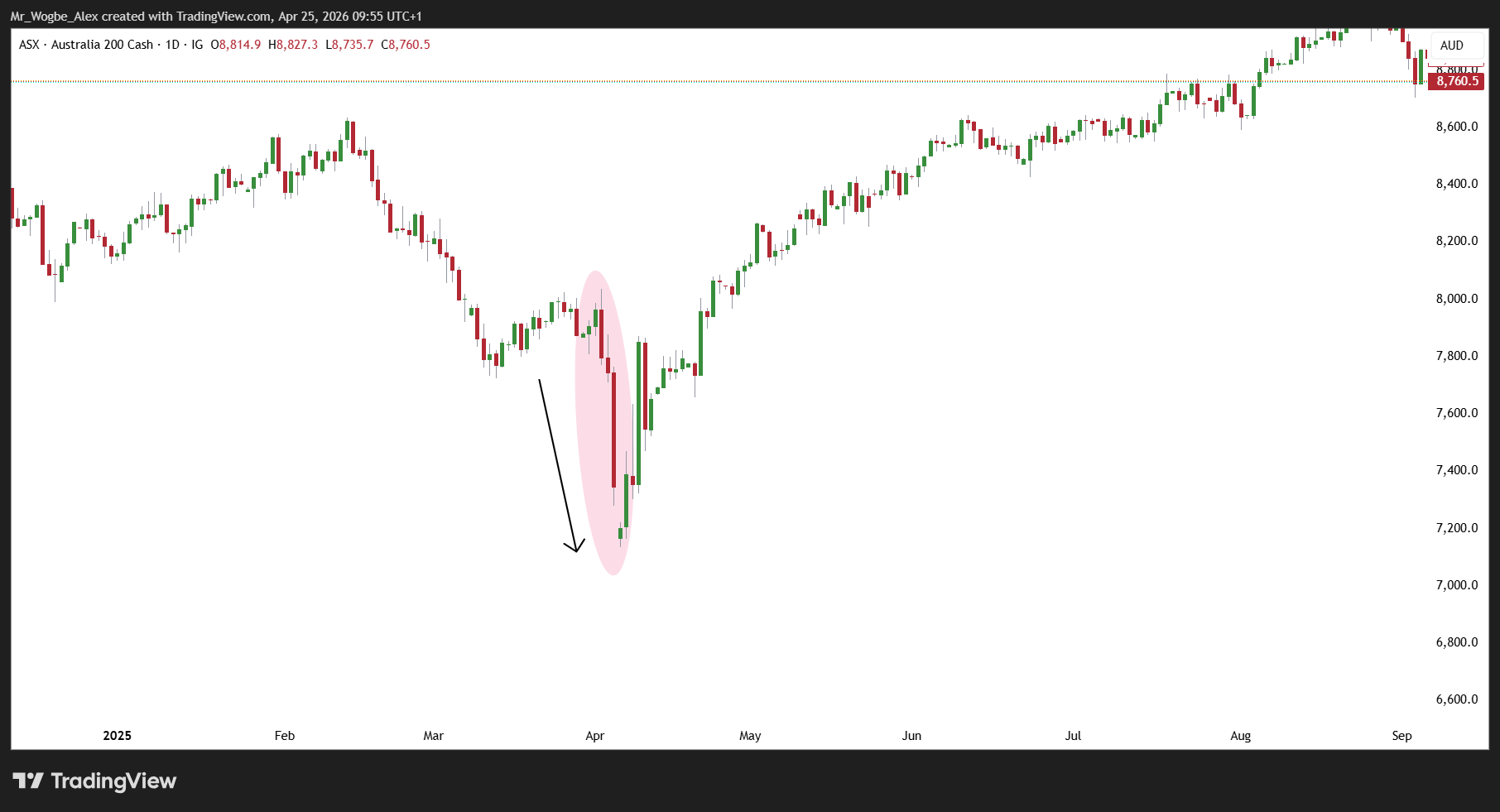
It happened again in April 2026. When US stock futures tumbled on reports that Iran ceasefire talks had collapsed, the ASX 200 fell 44 points, or 0.5%, in the same session. It recovered the following day after Wall Street rallied.
The consistent pattern here is that what happens on Wall Street rarely stays on Wall Street.
The connection runs through two main channels.
The first is commodity prices. Australia's economy is heavily tied to iron ore, oil, and gold. When US stocks fall and global growth fears rise, commodity demand tends to drop, which hits mining stocks like BHP directly.
The second is currency. A falling US market often weakens the Australian dollar, which amplifies the effect on import costs and inflation.
The Reserve Bank of Australia has flagged stagflation risks if energy shocks persist, noting limited capacity to address supply-driven inflation.
For context, the ASX 200 gained around 5.5% in 2025, well behind the S&P 500's 16.39%, partly reflecting these structural differences, according to CommSec.
What Happens to Global Assets When US Stocks Fall?
A drop in the US stock market tends to shift investor behavior across asset classes. Here's where it tends to go and what that means for each asset class:
Bonds: Investors typically move into US Treasuries during a sell-off, pushing bond prices up and yields down. This happened during the April 2025 Liberation Day crash, though the bond market reversed quickly as fiscal concerns took hold. The safe haven function isn't always clean.
Gold: Gold hit record highs during the 2025 tariff shock and has stayed elevated. Gold-related ASX stocks doubled over 2025, making it one of the more reliable hedges this cycle.
Oil:Oil prices spiked near $100–$101 per barrel during the Iran conflict. The energy sector rose 34% in early 2026, but oil volatility cuts both ways.
US Dollar: The dollar weakened after Liberation Day in 2025. A falling dollar can support emerging market assets, but it also signals reduced confidence in US assets broadly.
Crypto: Crypto-related equities gained when risk appetite improved in late April 2026. It tends to move with sentiment rather than acting as a reliable hedge.
How Investors Should Respond to a Market Decline
Understanding the US stock market decline reasons covered in this post is only half the work. The other half is having a plan so you're responding to the market, not reacting to it:
Review your portfolio allocation: Check your current split between equities, bonds, commodities, and cash. If it no longer matches your risk tolerance or time horizon, that's worth addressing.
Resist the urge to time the market: The S&P 500 has historically closed higher in more than two-thirds of years. Investors who panic-sold during the 2025 Liberation Day crash missed the recovery.
Use volatility to rebalance: Morningstar flagged consumer cyclicals and financials as attractively valued after their Q1 2026 declines. Volatile markets often create opportunities to buy undervalued sectors at better prices.
Watch the right indicators: Oil prices, Strait of Hormuz developments, Big Tech earnings, Fed signals, and November midterm developments are the key variables for the rest of 2026.
Be deliberate about diversification: Gold and energy have acted as real hedges this cycle. Bonds have been less reliable, so think through your hedge based on the specific risks in play.
As we move through 2026, the US stock market presents a mix of opportunity and uncertainty. Persistent inflation pressures, interest rate shifts, and geopolitical tensions remain key risks—but they are balanced by strong corporate earnings, AI-driven innovation, and resilient consumer demand. For investors, this is not a market to avoid, but one to approach with strategy and discipline.
👉 Ready to invest in the US market?
Take the first step today with Mitrade.


1. What are the main US stock market decline reasons in 2026?
The biggest US stock market decline reasons are the US-Iran conflict, tariff uncertainty, sticky inflation, stretched valuations, and heavy concentration in a handful of large tech stocks.
2. Is the US stock market going to crash in 2026?
A full crash isn't the base case. Analysts still expect solid earnings growth, but a 14–20% peak-to-trough decline is possible if key risks compound at the same time.
3. How does a US stock market fall affect the ASX?
The ASX tends to follow Wall Street closely. A sharp US sell-off typically hits Australian mining stocks, weakens the Australian dollar, and weighs on broader market sentiment.
4. What assets do well when US stocks decline?
Gold and energy have been the strongest hedges this cycle. US Treasuries can offer short-term protection too, though they're not always reliable when fiscal concerns are in play.
5. Can I trade US stock market moves on Mitrade?
Yes. Mitrade lets you trade US indices like the S&P 500 and Nasdaq as CFDs (contracts for difference). You can go long or short, so you can act on both rising and falling markets.
Disclaimer: The content presented above, whether from a third party or not, is considered as general advice only. CFD trading involves significant risk of loss. Past performance does not guarantee future results. This article serves informational purposes only and does not constitute financial advice. Consider your risk tolerance before trading.


