




Oil Price Forecast: WTI Surges Above $79 After US-Iran Conflict Escalates — Can Crude Oil Hit $85 Next?

Oil prices extended their sharp rally on 14 July, with WTI crude climbing above $79 per barrel and Brent crude nearing $85, after posting their biggest single-day gains in years during the previous trading session. Renewed military escalation between the United States and Iran, combined with growing concerns over oil shipments through the Strait of Hormuz, has triggered another wave of buying across the energy market.
The latest surge has pushed crude oil to its highest level in more than a month, while volatility across global financial markets has increased significantly. Investors are now closely watching whether supply disruptions could intensify and drive oil prices even higher. If geopolitical tensions continue to escalate, many analysts believe WTI could soon test the psychologically important $80–85 range, making crude oil one of the hottest markets to watch this week.
In this article, we'll explain why oil prices are rising, what factors could determine the next move for WTI and Brent, and whether traders should prepare for another leg higher.
Why Did Oil Prices Surge Today?
Oil prices rallied sharply after geopolitical risks in the Middle East intensified once again, raising concerns that global crude supplies could be disrupted.
The biggest catalyst was the renewed military confrontation between the United States and Iran. Fresh U.S. airstrikes and Iranian retaliatory attacks have heightened fears that the conflict could spread across the region. At the same time, reports of attacks on commercial vessels and increased military activity around the Strait of Hormuz—the world's most important oil shipping route—have significantly increased the geopolitical risk premium in crude oil markets. Around 20% of global oil consumption passes through this narrow waterway, meaning even the threat of disruption can send prices sharply higher.
Market sentiment was further boosted by concerns over tightening physical supply. Traders are increasingly pricing in the possibility of lower exports from the Gulf region should hostilities escalate, while expectations of falling U.S. crude inventories have also supported prices. Together, these factors helped push WTI above $79 and Brent close to $85, extending Monday's nearly 10% rally, the strongest daily advance since 2020.
Beyond immediate supply concerns, investors have also shifted toward traditional geopolitical hedge assets. Energy commodities typically outperform during periods of elevated geopolitical uncertainty, and speculative positioning in crude oil futures has risen as traders anticipate further price swings. With markets now focused on developments in the Middle East, volatility is expected to remain elevated throughout the week.
“Trade Crude Oil with an ASIC-regulated broker. Fast AUD funding via PayID. ”
WTI Technical Analysis: Can Oil Break $80?
WTI Price Today
WTI crude has staged a powerful bullish breakout after soaring nearly 10% in the previous session and extending gains above $79 on July 14. The rally has pushed prices above both the 50-day and 200-day moving averages, a bullish technical signal suggesting that market sentiment has shifted from neutral to positive.
From a technical perspective, $80.00 is now the key psychological resistance level. A decisive daily close above this barrier could open the door to the next upside targets around $82.50 and $85.00, especially if geopolitical tensions in the Middle East continue to escalate or supply disruptions emerge.
However, traders should also be prepared for heightened volatility. After such a rapid rally, short-term profit-taking could trigger a pullback toward the first support zone at $77.50–78.00, while stronger buying interest may emerge near $75.00, where previous resistance has turned into support.
Key WTI technical levels
Momentum indicators also remain supportive. The sharp increase in trading volume alongside the breakout suggests strong institutional participation rather than a short-lived speculative spike. As long as WTI remains above $77.50, the short-term trend is likely to remain bullish.
Oil Price Forecast for This Week
Oil prices are expected to remain highly volatile this week as traders continue to monitor developments surrounding the US-Iran conflict, the security of the Strait of Hormuz, and upcoming U.S. inventory data.
Bullish scenario
If military tensions escalate further or any disruption to shipping routes in the Gulf is confirmed, crude oil could extend its rally. A sustained move above $80 would likely attract additional momentum buying, increasing the probability of WTI testing $82–85 in the coming sessions. Falling U.S. crude inventories would provide another supportive catalyst.
Neutral scenario
If geopolitical headlines stabilize without further escalation, WTI may consolidate between $77 and $80 as traders digest the recent surge. Markets would then shift their focus to macroeconomic data, Federal Reserve expectations, and global demand indicators.
Bearish scenario
The main downside risk is a de-escalation in Middle East tensions or signs that oil exports remain largely unaffected. In addition, concerns about global oversupply and potential production increases from major producers could limit further gains. Under this scenario, WTI could retreat toward the $75–76 support zone before finding fresh buying interest.
Weekly Outlook
Overall, the short-term bias remains bullish, but price action is likely to stay headline-driven. Geopolitical developments will continue to dominate sentiment, making crude oil one of the most volatile assets in global markets this week.
WTI Weekly Forecast: $77.00–85.00
Bullish target: $82.50–85.00
Base case: $77.00–80.00
Bearish risk: $75.00–76.00
For active traders, the $80 level remains the most important resistance to watch. A confirmed breakout could signal the start of another bullish leg, while failure to hold above $77.50 may trigger a short-term correction before the next directional move.
Best Oil Stocks to Watch (ASX + US)
Rising crude oil prices often benefit upstream producers and integrated energy companies, making oil stocks an attractive way to gain exposure to the energy sector. If geopolitical tensions continue to support higher oil prices, the following companies are among the top names investors should watch.
“Trade Oil Stocks with an ASIC-regulated broker. Fast AUD funding via PayID. ”
How Australian Investors Can Trade Oil CFDs with Mitrade
Buying oil company shares is one way to benefit from rising crude prices, but many active traders prefer Oil CFDs because they provide direct exposure to WTI and Brent price movements without owning physical oil.
With Mitrade, Australian traders can speculate on both rising and falling oil markets through CFDs.
Why trade Oil CFDs with Mitrade?
Trade both WTI Crude Oil and Brent Crude
Go long or short depending on market direction
0 commission on CFD trading
Competitive spreads and fast execution
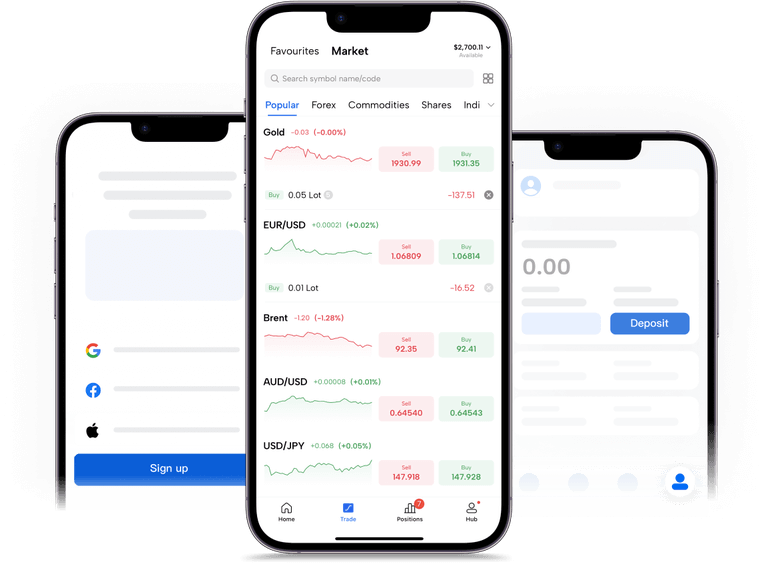
Trade on desktop or mobile anywhere
Risk management tools including Stop Loss and Take Profit
Free demo account with virtual funds for beginners
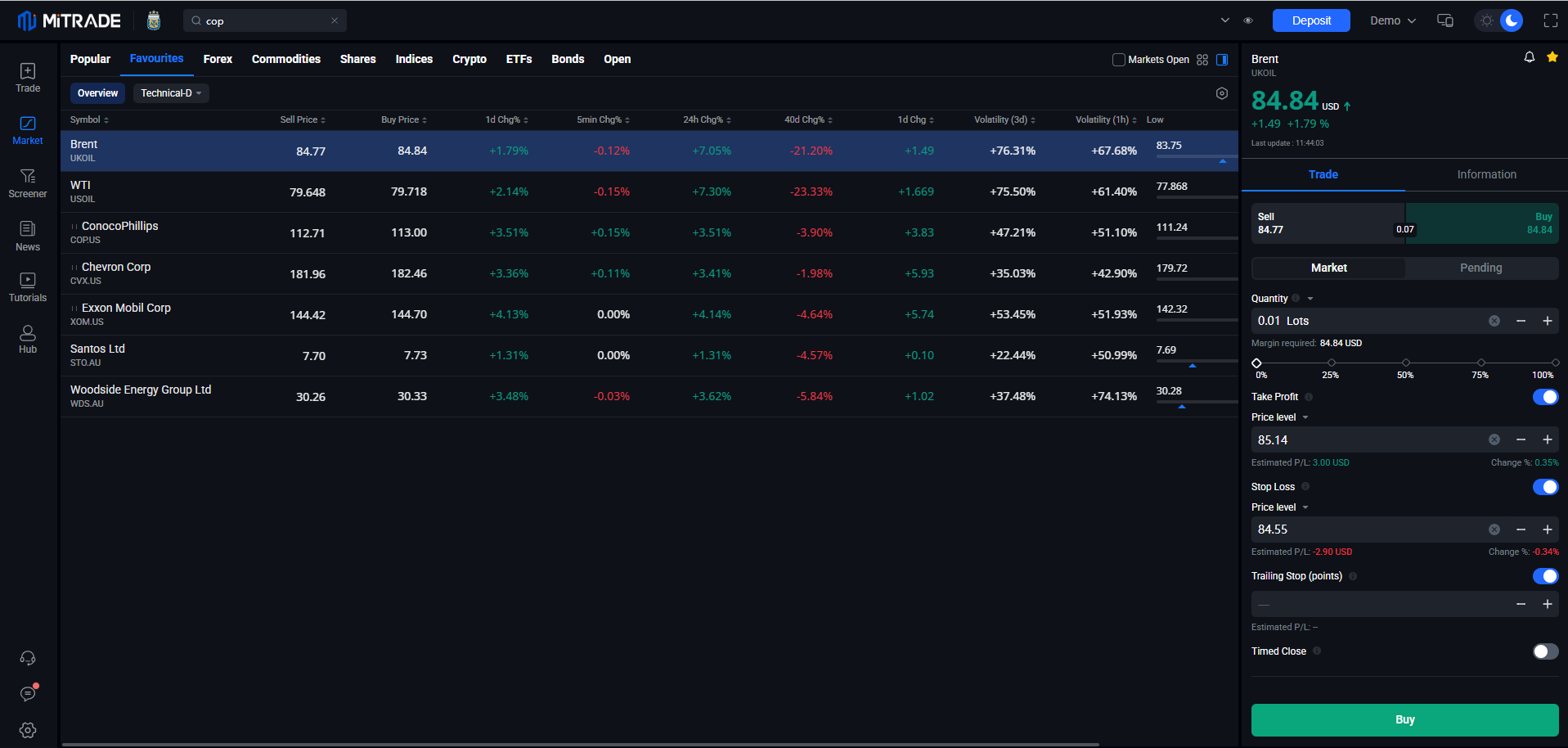
For example, if you believe escalating Middle East tensions will push WTI above $80 or even $85, you can open a Buy (Long) CFD position. Conversely, if geopolitical risks ease and oil prices retreat, you can potentially profit by opening a Sell (Short) position.
Because oil prices can react rapidly to geopolitical headlines, CFDs allow traders to respond quickly to changing market conditions while using leverage responsibly.


1. Why is the oil price rising today?
Oil prices have surged due to escalating US-Iran tensions, concerns over potential supply disruptions in the Strait of Hormuz, and increased geopolitical risk premiums in global energy markets.
2. Can WTI crude reach $85?
If geopolitical tensions continue to intensify and global oil supplies are disrupted, WTI could test the $82–85 range. However, prices remain highly sensitive to political developments and inventory data.
3. Is now a good time to invest in oil stocks?
Oil stocks often perform well during periods of rising crude prices, but investors should also consider company fundamentals, production costs, dividends, and broader market conditions before investing.
4. What's the difference between investing in oil stocks and trading Oil CFDs?
Buying oil stocks gives you ownership in an energy company, while trading Oil CFDs lets you speculate directly on crude oil price movements without owning the underlying asset. CFDs also allow traders to profit from both rising and falling markets.
5. Can Australians trade WTI and Brent oil?
Yes. Australian investors can trade both WTI Crude Oil and Brent Crude through regulated CFD brokers such as Mitrade, giving them access to global energy markets with flexible long and short trading opportunities.
Disclaimer: The content presented above, whether from a third party or not, is considered as general advice only. CFD trading involves significant risk of loss. Past performance does not guarantee future results. This article serves informational purposes only and does not constitute financial advice. Consider your risk tolerance before trading.


