


Nobody's Talking About It, But This Business Could Make Nvidia a $10 Trillion Company
Key Points
Nvidia shares have surged on the generative AI revolution.
A similar transformation seems to be brewing in robotics and automobiles.
Nvidia is a technological leader in both.
- 10 stocks we like better than Nvidia ›
Before ChatGPT launched, Nvidia (NASDAQ: NVDA) was worth $386 billion.
Today, largely because of the generative AI boom unleashed by ChatGPT, the company is worth more than ten times that, currently valued at nearly $5 trillion.
Where to invest $1,000 right now? Our analyst team just revealed what they believe are the 10 best stocks to buy right now, when you join Stock Advisor. See the stocks »
Now, there's another technological revolution unfolding that Nvidia is also leading, and it could be a significant long-term driver for the stock. I'm talking about the autonomous vehicle and robotics market, or, more broadly, what CEO Jensen Huang calls physical AI.
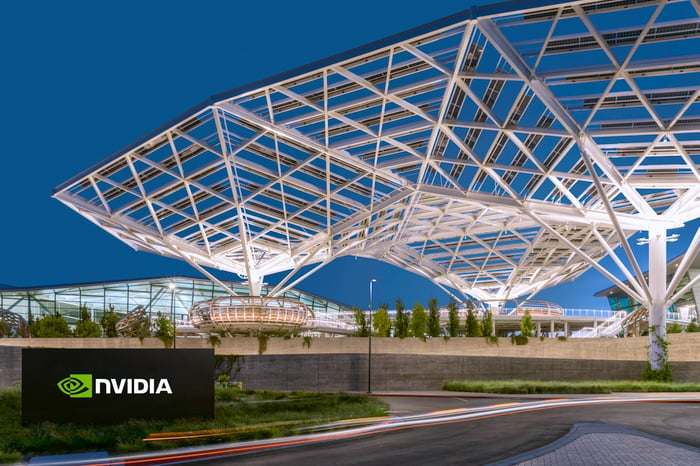
Image source: Nvidia.
Nvidia and physical AI
Nvidia is best known for its GPUs and the related components that power AI compute in the data center, but the company has also built a substantial advantage in physical AI components.
Its Jetson Thor supercomputer, for example, is widely considered the market leader for raw AI inference and robotics simulation. Nvidia sells Jetson Thor to a wide range of robotics companies, including Boston Dynamics, Amazon Robotics, Caterpillar, Deere, and others.
Those companies are using Jetson Thor for applications like computer vision to help operate robots and machines in Amazon's warehouses or agricultural fields for Deere.
Jetson Thor has also been adopted by tech companies like Meta and OpenAI, as well as healthcare companies like Medtronic.
While the robotics market is growing rapidly, the bigger prize here for Nvidia seems to be autonomous vehicles, an industry that could be approaching a tipping point. Alphabet's Waymo is now handling 500,000 weekly paid rides, more than doubling from a year ago, and it operates in 10 metro areas. Tesla's robotaxis are now available in seven cities, and other AV companies are expanding rapidly as well.
While Waymo and Tesla aren't direct AV partners of Nvidia, the chipmaker has signed up a number of key AV companies, including Uber, Toyota, Stellantis, Mercedes-Benz, and two Chinese EV makers, BYD and Geely.
Its most important automotive partnership is with Uber, as the ridesharing giant is working with Nvidia and OEMs like Stellantis to deliver at least 5,000 Level 4 autonomous vehicles for a robotaxi network. Nvidia's DRIVE AGX Hyperion AV platform will provide the brains for the AVs as it does for the other companies listed above.
What the numbers say
Nvidia's automotive business is still small, reporting just $2.3 billion in revenue in fiscal 2026, which was up 39% from the year before. In fiscal 2027, which started earlier this year, Nvidia restructured its reporting segments to combine the three non-data-center segments (Gaming and AI PC; Professional Visualization; Automotive and Robotics) into one, Edge Computing.
As a result, investors won't get the same level of transparency on the automotive business, but Nvidia is providing updates on it.
Though it's small now, the physical AI business is likely to deliver returns over a longer time horizon, as Jensen Huang recently said it's now generating $10 billion in annual run rate revenue, and he sees it growing to $100 billion within the next decade.
Why it could make Nvidia a $10 trillion company
Nvidia is already valued at $5 trillion, and it trades at a forward P/E of just 22, less than the S&P 500, even though analysts expect revenue to grow 82% this year.
That mismatch seems to owe to the historical cyclicality of the semiconductor sector and the risk of an AI bubble. Investors are hedging their bets that Nvidia's bumper profits will eventually decline, or at least that its growth will slow significantly.
The physical AI business provides an antidote to this. It's a totally separate vertical from data centers and generative AI, and should be less cyclical, as transportation is a constant need. Additionally, the company uses a recurring software-as-a-service model for part of its AV business, including the Drive AV stack.
That could give the physical AI business a significantly higher multiple than Nvidia's hardware business, as software typically trades at a higher valuation than hardware. If it reaches $100 billion in revenue, the physical AI business could earn a market value of $2 trillion or more, depending on its growth rate and profitability.
By making Nvidia more resilient to an AI downturn, the business should also help lift its valuation. Combine those benefits with the continued growth in the core data center segment, and it's not hard to see the company reaching $10 trillion in a few years.
Should you buy stock in Nvidia right now?
Before you buy stock in Nvidia, consider this:
The Motley Fool Stock Advisor analyst team just identified what they believe are the 10 best stocks for investors to buy now… and Nvidia wasn’t one of them. The 10 stocks that made the cut could produce monster returns in the coming years.
Consider when Netflix made this list on December 17, 2004... if you invested $1,000 at the time of our recommendation, you’d have $394,601!* Or when Nvidia made this list on April 15, 2005... if you invested $1,000 at the time of our recommendation, you’d have $1,197,093!*
Now, it’s worth noting Stock Advisor’s total average return is 895% — a market-crushing outperformance compared to 206% for the S&P 500. Don't miss the latest top 10 list, available with Stock Advisor, and join an investing community built by individual investors for individual investors.
See the 10 stocks »
*Stock Advisor returns as of July 31, 2026.
Jeremy Bowman has positions in Nvidia. The Motley Fool has positions in and recommends Nvidia. The Motley Fool has a disclosure policy.
Recommended Articles


