



Let’s imagine that you and I own a company. After years, our private business grows up and attracts more customers.Therefore we start thinking about opening new branches, launching new products, and reaching more markets. But all these plans require more funding than we currently have. Instead of counting on ourselves and the few personal investors, we feel that it's time to address everyone through shared ownership of the business.
🎯 Here is the role of the IPO (Initial Public Offering). In this article we will learn together What is an IPO, Why do companies need to enter the stock market, And how can you invest in it.
What is an IPO?
Simply the IPO (initial public offering) is a stage when the private company decides for the first time to offer its shares on a stock exchange. Or in other ways when the company goes public.
But before this step, the ownership of the company is limited to its founders and initial investors, but after the IPO, investors can buy and trade its shares on the market.
Companies typically resort to IPOs to raise additional capital to help them expand, finance new projects, and boost their business growth.
Why do companies choose to enter the stock market?
Firms do not opt for the stock market merely for the sake of listing themselves there. Instead, it is because it helps to unlock new possibilities for them. By offering a stake of their shares to interested individuals, firms may be able to raise sufficient funds for expansion, development, or entry into new territories. At the same time, listing helps to increase liquidity for those who already own stock, allowing them to convert it to cash if desired. Finally, the listing itself helps to raise brand recognition and boost customer and investor trust, which may prove beneficial for the future market positioning of the firm.
What is the process of conducting an IPO?
Now we will know how our company prepares itself to move from a private company to a public one. Simply there are processes involving several steps before the company becomes ready to offer its stocks.
Such as:
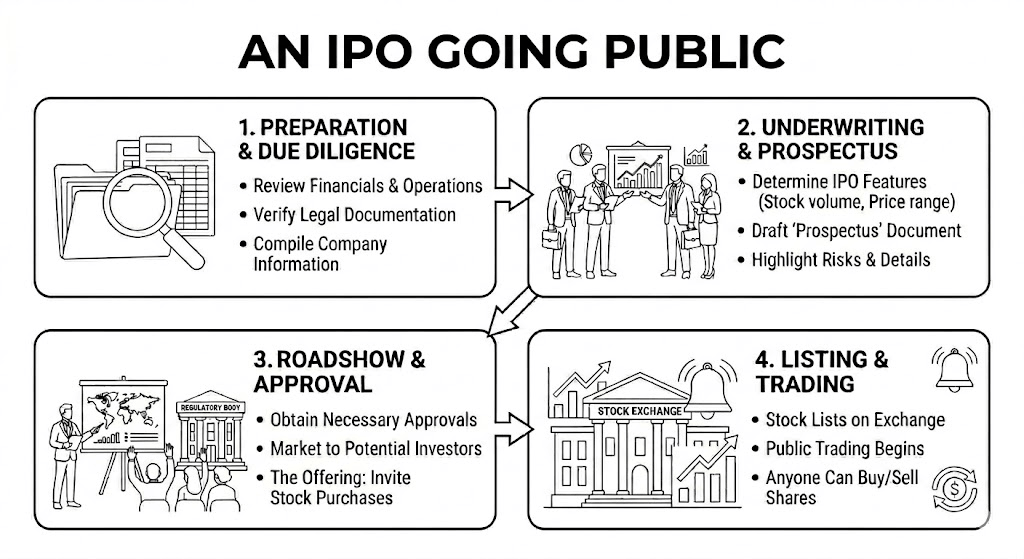
1️⃣Firstly, the company checks whether all financial documentation, operations of the business, as well as its legal documentation correspond to what is needed for being a public corporation. At the same time, the company is preparing all information about itself that will be distributed among the investors.
2️⃣Secondly, the company together with investment bankers determines all features of the IPO like how many stocks the company intends to sell as well as its price range. All these features along with some more data are described in the document called prospectus, which provides all crucial details about the company and offering.
3️⃣Thirdly, the required approvals from all relevant bodies are obtained, the company launches its IPO. The moment when the investors are offered to acquire company's shares comes.
4️⃣The last step is listing the company's stocks in one of the stock exchanges. After that, anyone is able to trade their stocks freely.
How are shares priced in an initial public offering (IPO)?
We have now discussed the procedure of the IPO, but what was not yet clear is how does the IPO pricing take place? Before the shares are issued to the public, a company normally appoints one or more investment banks to help with the process. It is through a detailed study of the company that the investment bank determines a reasonable price for the stock shares.
At this stage, a prospectus document is issued that provides necessary information regarding the company, its goals, and future strategies. And once all the processes are completed, then the shares are offered to the investors at the predetermined price.
Who sets the offering price?
The price at which the shares are offered is not decided at random but is the result of negotiations between the company and the investment bank that underwrites the offering. The bank will look at the company and the environment of the market and propose a suitable price range for the share in the light of the likely level of demand from investors.
These estimates are then used to determine the final offering price when the shares are listed on the stock exchange and begin trading among investors.
IPO VS Direct Listing
An IPO is the most popular method of accessing the equity markets; however, some firms have chosen the direct listing route. While both routes provide an opportunity to trade stocks on public exchanges, there are several distinctive features of each.
Please Note: The right decision depends on the company's financial objectives and growth approach.
Where and How UAE and Arab Investors Can Subscribe to IPOs?
In order to be able to invest in an IPO within the UAE or another Arab country, investors will be able to subscribe for shares in the IPO via participating banks including ✅Emirates NBD, ✅Abu Dhabi Commercial Bank (ADCB) and ✅First Abu Dhabi Bank (FAB) . And also via licensed brokers such as ✅BHM Capital and ✅Emirates NBD Securities.
If UAE and Arab investors want to subscribe to US IPOs, they can open an account with international brokerages, such as✅Interactive Brokers, or select global platforms that receive retail allocations. Alternatively, they can invest in US stocks directly once the shares list and begin public trading on stock brokers like Mitrade.
It should also be noted that before subscribing to an IPO, it would be necessary to open a trading account through these steps:
Step 1: Create a Trading Account
Before applying for an IPO, investors must first create an account at a licensed broker or a bank where one can participate in IPOs.
Step 2: Complete Identity Verification Process
Banks and brokers have identity verification procedures to which potential investors will be required to submit all relevant identification documents.
Step 3: Study the IPO Prospectus
Potential investors must study the prospectus issued by the corporation in order to learn about its operations and the plan to use the raised capital.
Step 4: Submit the Request Form
Investors can send their request forms for shares during the subscription period, where they will specify the sum invested.
Step 5: Wait for the Allotment of Shares
Once the subscription period ends, investors will be allotted the shares. In cases where there is high competition, investors might not be granted as many shares as they had applied for.
Step 6: Wait for Listing of Shares
Once the IPO procedure is completed and shares are listed on the stock exchange, investors can decide whether they would like to keep the shares or sell them.
As the subscription rules for the IPOs of various companies may differ, it would be reasonable to learn about the offering details, eligibility requirements, and subscription dates in advance.
Is investing in IPOs worth it?
IPOs look like an attractive chance for investors, especially when it comes to companies having strong growth potential. Getting involved in the early stages may give investors the chance to profit from a stock's appreciation if the company performs well after listing.
Nevertheless, there are no guarantees of success, as some stocks may experience significant volatility or even decrease their value after trading begins.
A company may attract a lot of attention before its listing, but popularity alone does not tell us the full story. So, looking at its business model, financial position, and future plans can provide a clearer picture.
Pros & Cons for IPOs
Like any investment opportunity, initial public offerings (IPOs) come with a mix of advantages and risks.
Advantages of IPOs:
✅They give investors the chance to buy shares of a company at the start of its public trading.
✅The stock may experience strong growth if the company successfully implements its future plans.
✅Companies benefit from IPOs by raising capital that helps them expand and develop their businesses.
Risks of IPOs:
❌They tend to be riskier compared to steady stocks, especially when a business just starts trading publicly.
❌The investor may not have enough historical data to evaluate their potential for future growth due to the fact that the company has just gone public.
How Do You Trade or Invest IPOs?
As we know how the companies go public, it is time to know how you can buy the shares and trade with them. There are two types of trading:
1 Long- Term Investing
Some investors prefer to invest for a long term. They buy shares and hold them for years if they believe in the company's future and growth potential.
2 Short- Term Investing
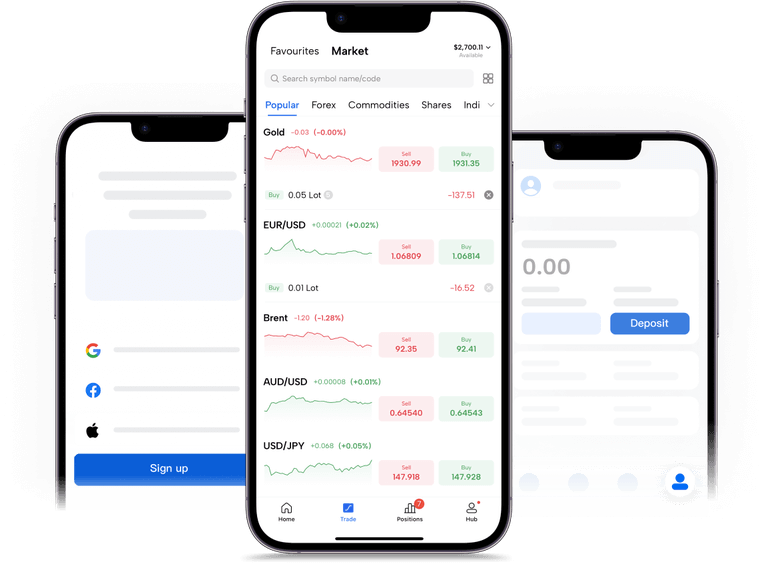
Others, prefer short-term trading and taking advantage of the often strong price movements. Simply, the trader doesn't care about the company after years, he just cares about what the stock will achieve next week or next month probably. Or in other words the trader can use instruments like CFDs to speculate on rising or falling.While platforms like Mitrade provide access to CFDs trading, enabling traders to capitalize on any market movements within a short period of time.
There is no best way for everyone. But it depends on your investment goals and how high you are able to take risks.


Common IPO Mistakes to Avoid
Be aware of these things because it's very easy for many people to be deceived.
1- Riding the hype wave
Whenever an organization goes for an initial public offering, the organization usually gets extensive coverage from the media. Some of the investors who invest in the organization do it because of the hype that surrounds its IPO, but hype does not necessarily imply good business, this research is crucial.
2- Ignoring Company Fundamentals
There are some investors who consider only the reputation of the company, but ignore important aspects such as its earning capability, profitability, and future plans for growth. Nonetheless, having a recognized name does not necessarily mean that an investor can rely on the firm.
3- Investing Too Much in One IPO
It is also quite likely that many investors invest in one particular IPO with the hope of making massive amounts of money. It should be noted that investing in one IPO is extremely risky since an IPO may fail unexpectedly. Hence, the best way would be to diversify the portfolio.
4- Hoping for Immediate Profits
It is a common misconception among investors that each new share will make an instant jump once it hits the market. However, this is far from being the case since there are IPOs whose prices remain flat for quite some time. It is thus advisable not to rely on hopes of immediate profit.
Real life examples on IPOs
There have been various examples where notable firms have successfully issued their shares for the first time through the IPO route, thus helping them grow while gaining interest from investors.
Such as:
The examples show how IPOs have been used by companies in a range of industries to raise capital, expand operations and strengthen their position in the market.
1. Alibaba

The Alibaba IPO took place in 2014, during which the corporation was able to raise $25 billion. On its first day of trade the share price reached almost 38% above the offering price. Reflecting strong investor demand. It demonstrated the rising importance of the global e-commerce industry.
2. Airbnb

Airbnb conducted its initial public offering (IPO) in 2020, after having reformed the hotel accommodations sector and raising about $3.5 billion by selling its shares for $68 each, while the price increased to more than $140 during its first trading day. This IPO faced many challenges during a time when the whole world was suffering from the global pandemic.
3. Uber

Uber started as a private company and grew so large that it now operates in dozens of countries. In 2019, it went public to raise funds to continue its expansion and develop its services. The IPO raised approximately $8.1 billion.Uber's shares were priced at $45 in its IPO but declined by 7% on the first trading day. showing that not all IPOs deliver immediate gains.
4. Aramco

The Saudi Aramco IPO took place in 2019 and generated approximately $25.6 billion, being the largest IPO ever held at that time. With an offer price of SAR 32, the stock gained around 10% in the first day of trade. At that time, it was the largest initial public offering in history.
Potential IPOs
SpaceX is gearing up for its much-anticipated IPO in June 2026. SpaceX plans to price its stock at $135 per share is on June 11th; however, the start of trading on June 12th. While the offering price is expected to be around $75 billion. This IPO has received a lot of attention among the investment community and may well turn out to be one of the biggest IPOs ever!
Conclusion
Finally, the IPOs offer an opportunity for investment in a company which may present many promises for future growth; however, this is not all that it takes for success when investing in a firm through IPOs. Since each offering is different, and there will be various circumstances associated with each of them, it is necessary to study the company in question, monitor their progress, and invest in them based on a specific strategy.
Which one is better buying a share during the IPO or after listing?
There is no suitable answer because it depends on the investor. Some prefer to buy at the IPO price, while others want to wait until the stock stabilizes after trading begins.
What’s The Difference Between IPO Subscription and IPO Trading?
The IPO subscription occurs before the listing of the stocks on the stock market. In this case, the shareholders request shares for purchases at the specified offer price.
On the contrary, the IPO trading involves trading or buying of the stocks after they have been listed on the stock market.
Can anyone join an IPO?
That depends on the conditions of the offer and the underwriter, but often the answer is yes because even private investors are able to join IPOs together with institutions.
Can stocks be traded immediately after an initial public offering (IPO)?
Yes. This is because once the IPO process has been concluded and the shares have been listed on the stock market, it becomes possible to trade with them within the stock market’s operational time.
* The content presented above, whether from a third party or not, is considered as general advice only. This article should not be construed as containing investment advice, investment recommendations, an offer of or solicitation for any transactions in financial instruments.


