


Micron or Sandisk: If I Could Only Own One for the Next 5 Years, It Would Be This One
Key Points
Micron makes both types of memory chips.
Each company is growing at a rapid pace.
Both stocks are cheaply priced.
- 10 stocks we like better than Micron Technology ›
Micron (NASDAQ: MU) and Sandisk (NASDAQ: SNDK) have had monster years this year. In the S&P 500 (SNPINDEX: ^GSPC), Sandisk is the best-performing stock, rising over 650% so far this year. Micron hasn't had a bad year itself, as it has risen nearly 300%, good enough for fourth place. These two have had a great year, but there could be a lot more coming.
I think each of these stocks still makes for a good investment now due to huge artificial intelligence (AI) demand, but which is the best? Let's take a look.
Missed AI’s "Act 1"? Act 2 Could Be 15x Bigger. Most investors think they missed the AI boat because they didn't buy Nvidia in 2005. But according to our analysts, we’re only at the end of "Act 1"—the R&D phase. "Act 2" is the global rollout. Continue »
Image source: Getty Images.
Sandisk only makes one memory type
Both companies are memory chip fabricators, but there are a handful of memory types. The two primary ones are DRAM and NAND. NAND memory is used for long-term storage and is used in products like solid-state drives (SSDs). DRAM memory is volatile and loses its information when power is lost. However, it makes up for this by allowing computing units to rapidly access information, which is what's used in laptops and other computing units like graphics processing units (GPUs).
Sandisk and Micron both make NAND memory, while Micron also makes DRAM.
Of the two businesses, I'd want to be in DRAM right now. While both types of memory are in short supply, DRAM memory may have a manufacturing edge that could lead clients to choose one supplier over another. Devices like solid-state drives are interchangeable, and it doesn't matter which manufacturer makes them. While DRAM memory has historically been seen that way too, HBM (high-bandwidth memory), a subsegment of DRAM, is starting to shift away from that universality. Micron and Nvidia (NASDAQ: NVDA) entered into an agreement to develop the first custom HBM chips, and that could be a gamechanger for Micron.
This would shift Micron away from just being a universal supplier and more of a direct partner. That bodes well for Micron and gives it the edge over Sandisk in this area.
Winner: Micron
Both companies are growing incredibly fast
There is a huge supply crunch in the memory chip space. While some investors worry that this demand wave will wrap up soon, they shouldn't. In Micron's latest earnings announcement, the company told investors that memory chip supply tightness will be worse in 2027 and 2028 than in 2026. That means more revenue growth ahead for these two, but it's hard to imagine it getting much faster than it already is now.
During Micron's Q4 of fiscal year (FY) 2027 (ending Sept. 3), it grew at a 379% pace. Sandisk technically grew slower at a 372% pace.
But does that really matter? I don't think so. Each company nearly grew its revenue 5x year over year during its last quarters. That's nothing to be worried about, and any edge given to one or the other is just splitting hairs.
Winner: Tie
Micron is cheaper by some metrics
This is where investors can realize the massive returns these two can provide. Because the market assumes that these two will see their business decrease in the coming years due to falling AI demand, they aren't priced very highly. However, investors also have information from Micron indicating that it has signed demand agreements through 2030, which means this demand wave is a long way from wrapping up. So, the current dirt cheap pricing won't last for long and makes each of these stocks a tantalizing buy.
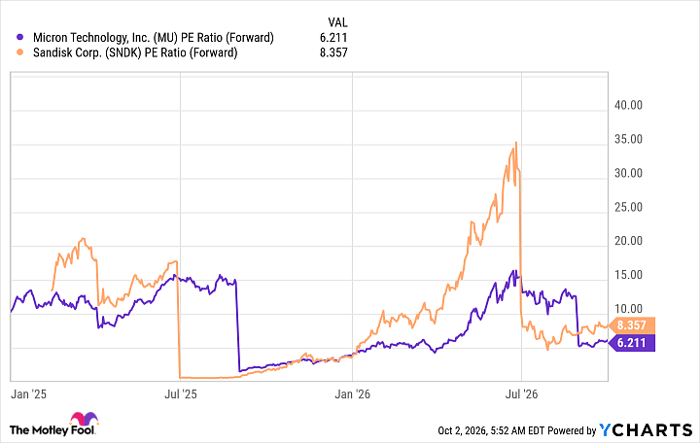
MU PE Ratio (Forward) data by YCharts.
If both stocks could rise to about 20 times trailing earnings during their respective fiscal years, that would deliver incredible upside for each stock, with Micron's stock more than tripling and Sandisk's rising by about 150%.
That gives the return edge to Micron, and with it being exposed to DRAM while Sandisk isn't, makes it the better buy overall:
Winner: Micron
Should you buy stock in Micron Technology right now?
Before you buy stock in Micron Technology, consider this:
The Motley Fool Stock Advisor analyst team just identified what they believe are the 10 best stocks for investors to buy now… and Micron Technology wasn’t one of them. The 10 stocks that made the cut could produce monster returns in the coming years.
Consider when Netflix made this list on December 17, 2004... if you invested $1,000 at the time of our recommendation, you’d have $361,650!* Or when Nvidia made this list on April 15, 2005... if you invested $1,000 at the time of our recommendation, you’d have $1,437,517!*
Now, it’s worth noting Stock Advisor’s total average return is 936% — a market-crushing outperformance compared to 213% for the S&P 500. Don't miss the latest top 10 list, available with Stock Advisor, and join an investing community built by individual investors for individual investors.
See the 10 stocks »
*Stock Advisor returns as of October 4, 2026.
Keithen Drury has positions in Nvidia. The Motley Fool has positions in and recommends Micron Technology and Nvidia. The Motley Fool has a disclosure policy.
Recommended Articles


