


Wall Street Thought Artificial Intelligence (AI) Would Decimate Software Stocks, but This One Has Tripled From Its 52-Week Low
Key Points
Software stocks plummeted earlier this year amid concern that artificial intelligence (AI) would disrupt their business model.
But many software companies, including Atlassian, have proven they can use AI to their advantage.
Atlassian stock has soared by more than 200% from its 52-week low, and its attractive valuation suggests more upside might be ahead.
- 10 stocks we like better than Atlassian ›
Earlier this year, the iShares Expanded Tech-Software ETF fell by as much as 36% from its 2025 record high. The software sector was effectively trading in bear territory during one of the strongest bull runs for the broader stock market in history.
Wall Street was concerned that artificial intelligence (AI) would decimate the software-as-a-service (SaaS) model for two reasons. First, analysts believed tools like Anthropic's Claude Code would make it easy for any business to replicate legacy software products. And second, they thought if AI reduced the global workforce by increasing economic productivity, then any SaaS company charging customers on a per-user basis would experience a sharp drop in revenue.
Missed AI’s "Act 1"? Act 2 Could Be 15x Bigger. Most investors think they missed the AI boat because they didn't buy Nvidia in 2005. But according to our analysts, we’re only at the end of "Act 1"—the R&D phase. "Act 2" is the global rollout. Continue »
But it turns out those fears were overblown, because many software companies, including Atlassian (NASDAQ: TEAM), have posted exceptional operating results during the past couple of quarters. In fact, Atlassian stock is now up more than 200% from its April low of $57 (as of Sept. 30), and here's why I predict it's going even higher.

Image source: Getty Images.
AI is enhancing Atlassian's top products
Jira and Confluence are Atlassian's flagship software platforms. Jira helps technical and non-technical teams manage projects, while Confluence is a digital town square where every employee in an organization can come together to share information and host important documents. In 2024, the company launched an AI platform called Rovo, which introduced a host of new capabilities into Jira and Confluence.
Rovo is now embedded into the search functions in Jira and Confluence, enabling employees to rapidly locate information from across their entire organization, even if it's stored outside of an Atlassian product. Rovo can also serve as a coding assistant to help software developers work faster in Jira. And with a new Atlassian product called Code Context, developers can securely give their AI agents a full view of every codebase across the entire organization, so they can act with an understanding of how software applications interact.
Data alone isn't enough for an AI agent to be effective. They need context -- the who, what, where, why, and how behind the data -- because it enables them to complete tasks more quickly and with fewer mistakes, which minimizes token costs. Agents grounded in the Atlassian ecosystem produce 44% more accurate answers while consuming 48% fewer tokens, precisely because it's where companies store so much of their contextual data, documents, and applications.
That gives Rovo a huge advantage over generic AI assistants from labs like OpenAI and Anthropic, because they simply don't have access to the same amount of contextual information. Enterprises are quickly coming aboard, because Atlassian says the annual recurring revenue (ARR) it earns from Rovo customers is growing at twice the pace of the ARR it earns from non-Rovo customers.
Crushing Wall Street's expectations
Atlassian's revenue soared by 28% year over year to $1.77 billion during its fiscal 2026 fourth quarter (ended June 30). It crushed Wall Street's forecast of $1.66 billion, so even analysts were surprised by the success of the company's AI efforts.
A lot of that revenue growth was organic, because Atlassian's operating costs only increased by 12% during the quarter. As a result, the company was able to deliver a generally accepted accounting principles (GAAP) profit of $139.1 million, a big positive swing from the $23.9 million net loss it generated in the year-ago quarter.
Moreover, Atlassian posted an adjusted (non-GAAP) profit of $473.1 million, up by an eye-popping 83%. That figure excludes one-off and non-cash expenses like stock-based compensation.
Simply put, these results suggest that Atlassian is thriving, not struggling, during the AI revolution.
Atlassian stock still might be cheap, despite its recent gains
Despite Atlassian's 200% rally from its April low, it's still trading at an attractive price-to-sales (P/S) ratio of 7.1, which is a discount to its three-year average of 9.8. Therefore, there is still plenty of room for upside based on valuation alone.
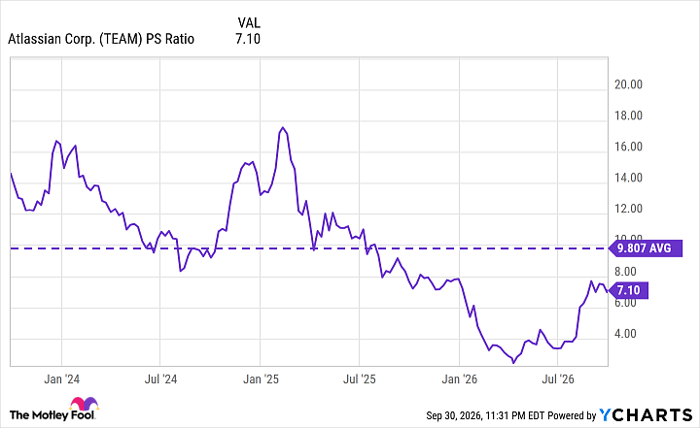
TEAM PS Ratio data by YCharts
I think Atlassian will continue to thrive as AI adoption grows, because it owns the ecosystem where more than 350,000 enterprises store their most valuable data. It's important to remember that even if some of those businesses could build their own versions of Jira and Confluence, they still have to manage the security, infrastructure, and technical aspects involved with deploying them successfully. The costs alone would be prohibitive for most businesses, whereas Atlassian can manage them because it has economies of scale.
As a result, I think Atlassian stock could be a solid long-term buy from here.
Should you buy stock in Atlassian right now?
Before you buy stock in Atlassian, consider this:
The Motley Fool Stock Advisor analyst team just identified what they believe are the 10 best stocks for investors to buy now… and Atlassian wasn’t one of them. The 10 stocks that made the cut could produce monster returns in the coming years.
Consider when Netflix made this list on December 17, 2004... if you invested $1,000 at the time of our recommendation, you’d have $361,650!* Or when Nvidia made this list on April 15, 2005... if you invested $1,000 at the time of our recommendation, you’d have $1,437,517!*
Now, it’s worth noting Stock Advisor’s total average return is 936% — a market-crushing outperformance compared to 211% for the S&P 500. Don't miss the latest top 10 list, available with Stock Advisor, and join an investing community built by individual investors for individual investors.
See the 10 stocks »
*Stock Advisor returns as of October 4, 2026.
Anthony Di Pizio has positions in Atlassian. The Motley Fool has positions in and recommends Atlassian. The Motley Fool has a disclosure policy.
Recommended Articles


