


The Nuclear Renaissance Explained: 3 Ways to Invest
Key Points
Nuclear energy is benefiting from rising AI adoption.
Ways to invest in nuclear include traditional utilities that are leaning into this power source and uranium ETFs.
- These 10 stocks could mint the next wave of millionaires ›
The nuclear renaissance has arrived. At least that's the opinion of a growing number of Wall Street firms.
"After decades of underinvestment, a convergence of generational technological breakthroughs, intensifying geopolitical competition, and the need for clean, dense, reliable power are positioning nuclear energy for a renaissance," concludes a report from Goldman Sachs.
Missed AI’s "Act 1"? Act 2 Could Be 15x Bigger. Most investors think they missed the AI boat because they didn't buy Nvidia in 2005. But according to our analysts, we’re only at the end of "Act 1"—the R&D phase. "Act 2" is the global rollout. Continue »
The force behind nuclear's rise is clear.
"After being roughly flat for years, data centers' demand for power is expected to accelerate 175% by 2030 (from 2023 levels)," Goldman Sachs observes. "This is the equivalent of another top 10 power-consuming nation coming online."
Want to get exposure to the nuclear renaissance? There are three obvious ways to invest in this multi-decade opportunity.
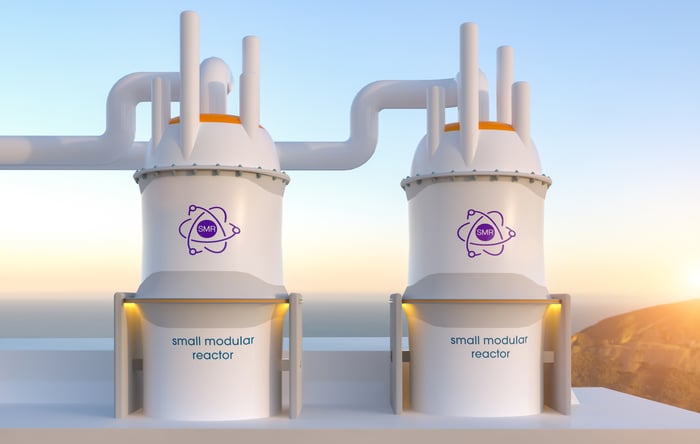
Image source: Getty Images.
1. SMR stocks like NuScale Power and Oklo Inc.
One of the most popular ways to invest in nuclear energy right now is by buying shares of companies developing small modular reactors, or SMRs. The two largest pure-play SMR stocks are NuScale Power (NYSE: SMR) and Oklo Inc. (NYSE: OKLO).
NuScale is focused on selling SMR systems to utility operators. Oklo, meanwhile, sells directly to artificial intelligence data centers -- the culprits behind the spike in energy usage globally.
NuScale's approach makes sense if you believe most energy users, including AI data center businesses, will prefer a traditional grid connection. Because SMRs are cheaper and faster to deploy than conventional nuclear power plants, utility operators can get more nuclear power online quickly by deploying NuScale's SMR systems.
Oklo, meanwhile, intends to advantage of SMR's relatively small footprint by co-locating these facilities near the AI data centers themselves. AI companies are deploying billions of dollars to scale energy infrastructure, and Oklo is betting that its go-to-market approach will cut out the utility middleman and appeal directly to deep-budgeted big tech firms.
2. Traditional utilities betting on nuclear power
Another approach is to buy electric utility stocks rather than buy the developers of nuclear energy systems themselves. Constellation Energy (NASDAQ: CEG), for example, is the largest U.S. nuclear fleet operator. It already has long-term power purchase agreements with big tech firms, including Microsoft. The company is restarting old nuclear facilities, including the Three Mile Island nuclear plant. It even directly invested in Blue Energy, an SMR start-up.
Utility stocks may not have as much upside as pure-play SMR stocks, but they're directly exposed to rising energy demand for nuclear power.
3. Uranium ETFs
"Nuclear energy has a 'monopoly' on uranium reserves," research from Bank of America concludes. According to the bank, around "99% of the Earth's mined uranium goes toward this type of power generation."
Investors, therefore, may be wise to gain direct exposure to uranium through an ETF such as the Roundhill Uranium ETF (NYSEMKT: UX). This ETF is relatively new, and its expense ratio is on the higher end at 0.77%. But investors have other uranium options as well, including the Global X Uranium ETF (NYSEMKT: URA), which has more than $5 billion in assets, plus a slightly more palatable 0.69% expense ratio. Just understand that this ETF gives you exposure to uranium miners and nuclear component manufacturers -- so it tracks far more than the physical price of uranium.
Where to invest $1,000 right now
When our analyst team has a stock tip, it can pay to listen. After all, Stock Advisor’s total average return is 930%* — a market-crushing outperformance compared to 211% for the S&P 500.
They just revealed what they believe are the 10 best stocks for investors to buy right now, available when you join Stock Advisor.
See the stocks »
*Stock Advisor returns as of October 2, 2026.
Bank of America is an advertising partner of Motley Fool Money. Ryan Vanzo has no position in any of the stocks mentioned. The Motley Fool has positions in and recommends Constellation Energy, Goldman Sachs Group, and Microsoft. The Motley Fool recommends NuScale Power. The Motley Fool has a disclosure policy.
Recommended Articles


