


This Semiconductor Stock Could Be a Better Way to Invest in AI and Satellites Than SpaceX
Key Points
SpaceX is planning to increase both its satellite and AI compute capacities by at least tenfold.
This chipmaker makes key components for both data centers and satellites.
The stock trades at a much more attractive valuation than SpaceX.
- 10 stocks we like better than STMicroelectronics ›
Space Exploration Technologies (NASDAQ: SPCX), better known as SpaceX, is working to upend the AI and communications industries.
Not only is the company led by Elon Musk deploying gigawatts of AI servers in its massive data centers, but it also plans to launch orbital data centers as soon as next year. Meanwhile, management is already planning to launch tens of thousands more low earth orbit satellites for its Starlink internet service.
Missed AI’s "Act 1"? Act 2 Could Be 15x Bigger. Most investors think they missed the AI boat because they didn't buy Nvidia in 2005. But according to our analysts, we’re only at the end of "Act 1"—the R&D phase. "Act 2" is the global rollout. Continue »
But SpaceX is just one way to invest in the growth of AI and satellite connectivity. A better option may be investing in a small chipmaker that stands to benefit from the growth of both industries, regardless of whether SpaceX is the company to bring us into the next frontier of either.
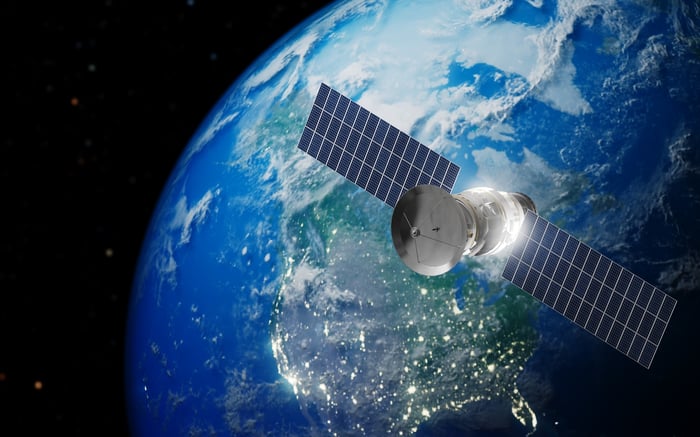
Image source: Getty Images.
How big could SpaceX's businesses grow?
SpaceX didn't just raise $86 billion in equity and another $25 billion in debt for no reason. The company is planning to build a lot.
It expects to end 2026 with approximately 2 gigawatts of compute capacity. By the end of next year, that number could be "closer to 10 gigawatts than 5 gigawatts," Musk told analysts on the company's second-quarter earnings call.
Meanwhile, it's getting set to launch V3 of its Starlink satellite. Musk said he plans to launch "an order of magnitude more Starlink V3 satellites" than V2 satellites. For reference, it counted 10,200 satellites in orbit as of the end of the second quarter. So, Musk suggests 100,000 more satellites could be entering orbit over the next few years.
And SpaceX isn't planning to slow its spending anytime soon. The company expects to have enough assets in place to generate $1 trillion by 2030. Even at the high end of Musk's estimate for compute monetization ($50 per watt), that implies about 20 gigawatts of compute capacity.
But investing in SpaceX comes with significant risks. Not only is there execution risk, but the company will also likely need to raise additional capital to fund its massive build-out, which poses financial risk. At its current price of around 100 times sales, the stock is priced for perfection.
That doesn't mean the AI and satellite business isn't worth investing in, though. Both are likely to see significant growth over the next few years. But another company offers a better way to invest in the trends.
This is the stock to buy
Instead of buying the company that's spending hundreds of billions of dollars on AI data centers and satellites, a company supplying key semiconductor components for both could offer better risk-adjusted returns. STMicroelectronics (NYSE: STM) offers a broad portfolio of semiconductors across various industries and applications, and it's finding huge growth opportunities ahead in AI data centers and low earth orbit satellites.
STMicro doesn't make the heavy-duty processors used for training and running AI. It makes key components for various applications, including power conversion and thermal management.
Its biggest growth driver for its data center business, however, is its position in optical connectivity -- chips that enable AI servers to transmit data to one another. Management expects its data center segment to generate $1 billion in revenue in 2026 and to more than double that in 2027. That's a huge growth segment for a company that produced $11.8 billion in revenue last year.
STMicro has been making chips for outer space operations since the 1970s. But its partnership with SpaceX to develop chips for use on its satellites and in its ground equipment has significantly increased its revenue in recent quarters. The company makes radio-frequency chips that help steer beams toward SpaceX satellites. It also makes a range of specialized chips for use in the satellites themselves.
As SpaceX launches more satellites, STMicro expects its revenue related to the business to total $3 billion between 2026 and 2028. That outlook doesn't include any potential upside from SpaceX's plans for orbital data centers.
There's plenty of growth ahead across STMicro's portfolio. The company guided for $18 billion in revenue by 2028 at its Capital Markets Day in 2024. With the stronger-than-anticipated growth in both AI and space, it should be able to outperform that outlook. Additionally, it should be able to generate improvements in gross margin and operating income as demand for its chips continues to climb and it uses more of its manufacturing capacity. That should ultimately lead to a strong earnings cycle for the company through the end of the decade.
The stock currently trades around 37 times forward earnings estimates, but that multiple will decline over the next few years as EPS is expected to nearly triple from this year through 2028.
However, investors shouldn't expect the stock to move in lockstep with earnings growth, as the semiconductor stock can be extremely cyclical, pushing its earnings multiple much lower as earnings peak. Still, it looks much more attractive at its current price than SpaceX stock.
Should you buy stock in STMicroelectronics right now?
Before you buy stock in STMicroelectronics, consider this:
The Motley Fool Stock Advisor analyst team just identified what they believe are the 10 best stocks for investors to buy now… and STMicroelectronics wasn’t one of them. The 10 stocks that made the cut could produce monster returns in the coming years.
Consider when Netflix made this list on December 17, 2004... if you invested $1,000 at the time of our recommendation, you’d have $389,154!* Or when Nvidia made this list on April 15, 2005... if you invested $1,000 at the time of our recommendation, you’d have $1,406,303!*
Now, it’s worth noting Stock Advisor’s total average return is 949% — a market-crushing outperformance compared to 214% for the S&P 500. Don't miss the latest top 10 list, available with Stock Advisor, and join an investing community built by individual investors for individual investors.
See the 10 stocks »
*Stock Advisor returns as of September 24, 2026.
Adam Levy has no position in any of the stocks mentioned. The Motley Fool has no position in any of the stocks mentioned. The Motley Fool has a disclosure policy.
Recommended Articles


