


Oracle Stock Price Forecast: $18 Billion Data Center Loan Deeply Discounted, Will ORCL Continue to Fall?
TradingKey - Oracle (ORCL)'s leased Project Jupiter data center in New Mexico is facing new financing pressure. The distribution of an approximately $18 billion syndicated loan associated with the project has stalled, reflecting growing investor concerns over project progress, financing costs, and Oracle's credit profile.
According to the Financial Times, syndicated banks including Santander and Jefferies are currently offering private quotes of just 89 to 91 cents on the dollar for the loan, corresponding to a market value of roughly $16 billion to $16.4 billion. Compared with healthy debt that typically trades near par, such a significant discount implies that investors are demanding higher risk compensation.
To be clear, this loan is tied to the Project Jupiter data center leased by Oracle and represents project financing, which is not equivalent to $18 billion in corporate bonds directly issued by Oracle. However, as Oracle is the core tenant of the project, the stalled loan distribution will still deepen market concerns regarding its lease commitments, capital expenditures, and credit risk.
Loan Discounts Expose Oracle's AI Expansion Financing Pressure
Located in Doña Ana County, New Mexico, Project Jupiter spans about 1,400 acres and serves as key infrastructure for Oracle to provide AI computing power to OpenAI. It is also closely tied to the "Stargate" project jointly pursued by OpenAI, SoftBank, and Oracle. At the end of last year, the project secured roughly $18 billion in syndicated loans and brought in Blue Owl to provide billions of dollars in equity capital.
Banks originally planned to sell the loans further to institutional investors to free up balance sheet space. However, mounting market concerns over project progress, Oracle's credit quality, and OpenAI's ability to pay have stalled debt distribution, leaving the participating banks with larger risk exposures than originally planned.
Loan quotes dropping to 89 to 91 cents do not mean the project has defaulted, but they indicate that credit markets are reassessing its risk. If banks are unable to complete distribution in the long term, future similar projects may need to pay higher interest rates, offer more collateral, or bring in larger equity cushions, and capital costs for Oracle to further expand its AI data centers could rise accordingly.
Such concerns are not without context.
S&P Global Ratings downgraded Oracle's long-term credit rating from BBB to BBB- in July, leaving it just one notch away from non-investment grade. The rating agency noted that Oracle's rapidly expanding AI infrastructure spending and its high reliance on OpenAI are weakening the company's credit profile.
Local Resistance and OpenAI Cash Burn Amplify Uncertainty
The challenges facing Project Jupiter do not stem solely from the financing side.
The project was originally planned to be powered by 2.2-gigawatt gas turbines, but New Mexico land management authorities rejected the natural gas pipeline construction application. Oracle subsequently turned to Bloom Energy's fuel cell solution, but the related fuel supply and emission permits have drawn similar scrutiny.
Local residents and environmental groups worry that large-scale data centers could impact water resources, air quality, and the power supply. The project's emission permits were temporarily halted due to litigation; although the court later allowed the approval process to proceed, the construction timeline has already been affected. Market intelligence firm SynMax estimates that early-stage progress on the project has been delayed by at least seven months compared to the original schedule.
Political risks are also rising. New Mexico gubernatorial candidate Deb Haaland stated that if elected, she would pause approvals for new large data centers and require developers to increase investments in renewable energy. Local polls show that residents opposing large-scale data center construction significantly outnumber supporters. Even if existing projects are not directly canceled, slower approvals and additional environmental requirements could drive up construction costs.
A larger issue lies in whether OpenAI can sustain its massive computing power procurement commitments over the long term. According to internal projections cited by the Financial Times, OpenAI expects a cumulative negative free cash flow of approximately $278 billion from 2026 to 2030, during which computing and infrastructure expenditures could reach $856 billion. Although the company expects revenue to grow from $36 billion in 2026 to $350 billion in 2030, its financing needs remain immense.
This does not mean OpenAI will be unable to fulfill its contracts with Oracle, but it does mean that the risks of both parties are deeply intertwined. If OpenAI's financing remains smooth, Oracle's backlog is expected to gradually convert into cloud revenue. However, if changes occur in OpenAI's financing, product commercialization, or AI development pace, Oracle may still need to bear massive data center lease and infrastructure commitments.
Oracle Stock Technical Analysis
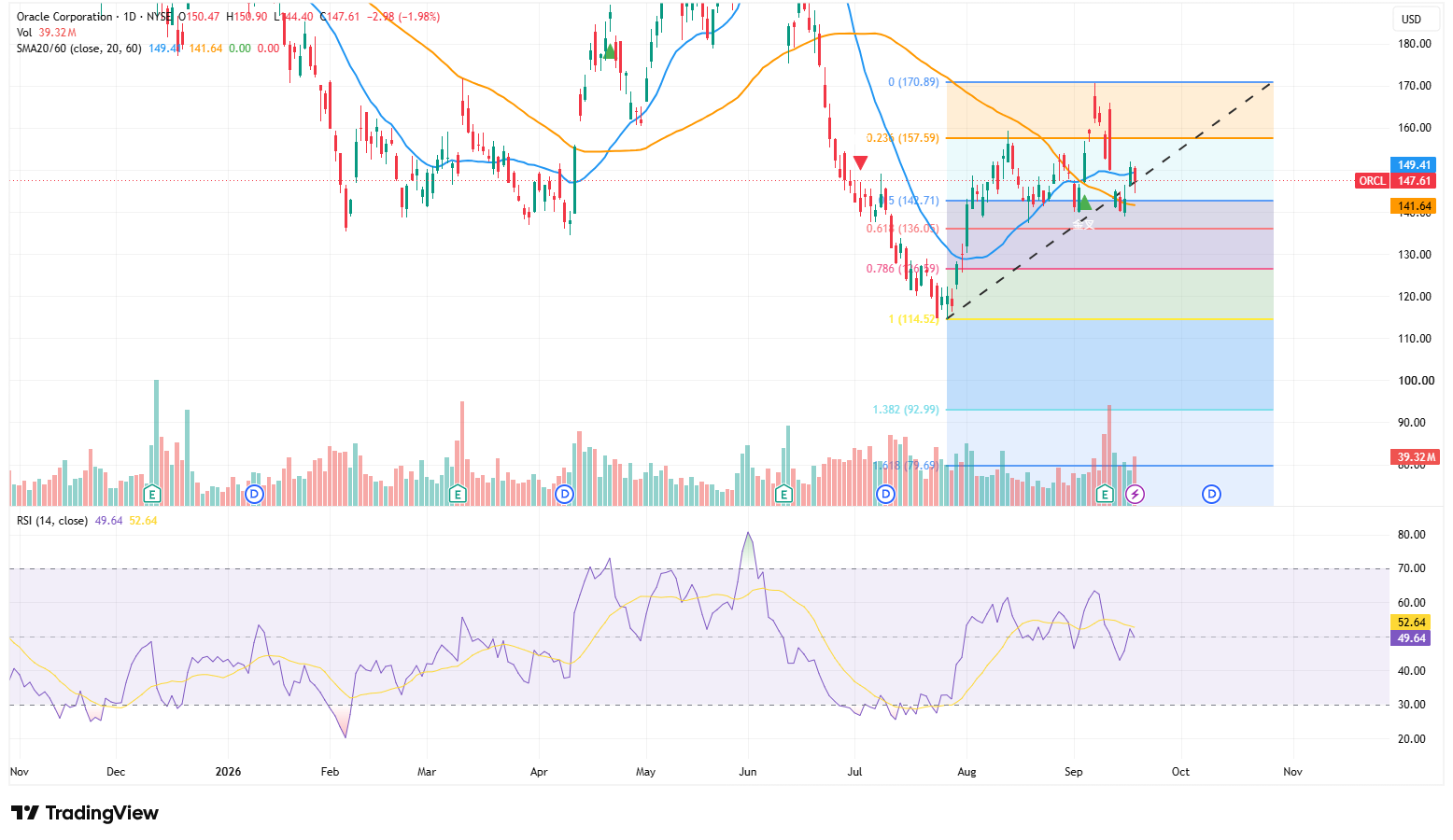
Source: TradingView
Technically, ORCL recently fell 1.98% to close at $147.61, after dipping to an intraday low of $144.40 at one point, with short-term selling pressure intensifying.
The stock price has currently broken below the 20-day moving average of $149.41 while returning near a short-term ascending trendline, indicating that the previous rebound from $114.52 is cooling off. However, the 20-day moving average remains above the 60-day moving average of $141.64, and the stock price has not yet broken below the 60-day moving average, so the medium-term rebound structure has not been fully compromised.
The 0.382 Fibonacci level at around $149 coincides with the 20-day moving average, forming the first immediate resistance level. ORCL needs to reclaim and hold above $149–$150 to ease current downside pressure; upon a further breakout, attention can be focused on $157.59 above. Only a renewed breakout above the previous high of $170.89 would signify a resumption of the medium-term uptrend.
In terms of momentum, the 14-day RSI has dropped to 49.64, below the neutral 50 mark and the signal line of 52.64, indicating that bears hold a slight edge, though it has not yet entered oversold territory. Therefore, the stock price may still test lower support levels, and no clear signal of an oversold rebound has emerged yet.
The most important support below lies at $141.64–$142.71, a zone formed jointly by the 60-day moving average and the 0.5 Fibonacci retracement level. If the stock price can hold this zone, it may continue to consolidate between $141 and $150; if the daily chart breaks below $141 on heavy volume, the next support will shift down to $136.05, and further test $126.59. The level of $114.52 is a key medium-term defensive line for this rebound that cannot easily be surrendered.
Recommended Articles


