


Is Berkshire Hathaway Stock a Better Buy Than an S&P 500 Index Fund?
Key Points
Berkshire Hathaway and S&P 500 index funds are both smart, all-around choices for long-term investors.
Although both are solid buy-and-hold investments, they're distinctly different in a way that may matter quite a bit.
The market environment could be very different for the next several years, changing their risk-reward profiles.
- 10 stocks we like better than Berkshire Hathaway ›
Experienced investors know the advantages of buying and holding S&P 500 index funds like the Vanguard S&P 500 ETF (NYSEMKT: VOO) or the SPDR S&P 500 ETF Trust (NYSEMKT: SPY). Not only are they super simple, but statistically speaking, you're likely to get better performance from them than you are by picking individual stocks or by owning an actively managed fund.
Nevertheless, given its long-term (and often market-beating) track record, even the most disciplined of investors might have the itch to step into a stake in Berkshire Hathaway (NYSE: BRKA) (NYSE: BRKB). But is it actually the better buy?
Missed AI’s "Act 1"? Act 2 Could Be 15x Bigger. Most investors think they missed the AI boat because they didn't buy Nvidia in 2005. But according to our analysts, we’re only at the end of "Act 1"—the R&D phase. "Act 2" is the global rollout. Continue »
What Berkshire Hathaway is
Berkshire Hathaway is a conglomerate consisting of several dozen reliable cash-producing businesses as well as a portfolio of hand-picked stocks. Brought to prominence by Warren Buffett, the company's flexible structure has enabled its shares to consistently outperform the S&P 500 since Buffett first took the helm in 1965.
It hasn't beaten the market every year since then, to be clear. Some years it did. Other years it didn't. It typically achieved the feat in five-year time frames.
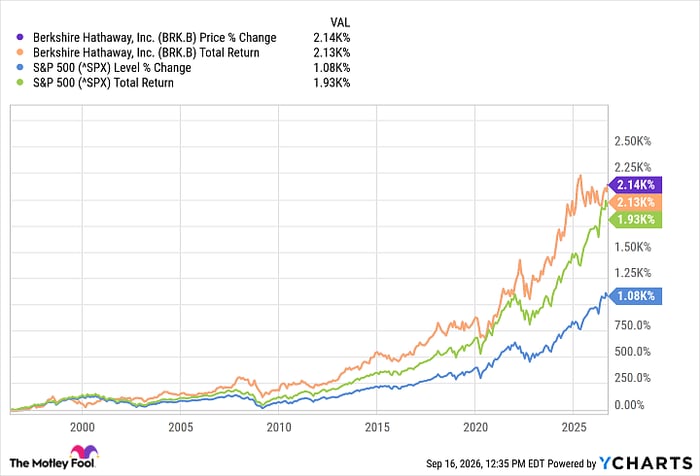
BRK.B data by YCharts
It's happening less and less, however, now that the conglomerate has reached its enormous market value of $1.1 trillion. As Buffett warned in 2023's letter to Berkshire shareholders posted in early 2024, "There remain only a handful of companies in this country capable of truly moving the needle at Berkshire, and they have been endlessly picked over by us and by others ... all in all, we have no possibility of eye-popping performance."
And that should concern interested investors. The question is, is it true?
The argument
There may be a good reason for you to own either, or neither, or both. For most investors looking for a long-term growth holding right now, however, Berkshire is arguably the better bet, for a couple of reasons.
One of these reasons is the S&P 500's overall valuation. Although it's mostly due to a handful of very large technology stocks, the index's forward-looking price-to-earnings ratio of more than 20 is well above norms. The underlying expected earnings growth largely depends on the continued growth of an artificial intelligence industry that may run into a headwind sooner rather than later, too.
Indeed, this valuation and lofty earnings expectations are at least part of the reason that both Vanguard and Goldman Sachs expect the S&P 500 to earn an average annual return of between 6% and 7% for the next 10 years versus its long-term average annual gain of 10%. If this outlook is on target, stocks don't offer much reward for their risk.

Image source: Getty Images.
The other component of the argument for owning Berkshire rather than an S&P 500 index fund for the foreseeable future is that, if nothing else, Berkshire's wholly owned businesses are reliable cash cows, on pace to generate nearly $50 billion in net earnings this year alone. With most of the stock market's foreseeable future being so uncertain, this cash flow becomes an incredibly valuable attribute.
Just some food for thought.
Should you buy stock in Berkshire Hathaway right now?
Before you buy stock in Berkshire Hathaway, consider this:
The Motley Fool Stock Advisor analyst team just identified what they believe are the 10 best stocks for investors to buy now… and Berkshire Hathaway wasn’t one of them. The 10 stocks that made the cut could produce monster returns in the coming years.
Consider when Netflix made this list on December 17, 2004... if you invested $1,000 at the time of our recommendation, you’d have $387,158!* Or when Nvidia made this list on April 15, 2005... if you invested $1,000 at the time of our recommendation, you’d have $1,365,749!*
Now, it’s worth noting Stock Advisor’s total average return is 932% — a market-crushing outperformance compared to 211% for the S&P 500. Don't miss the latest top 10 list, available with Stock Advisor, and join an investing community built by individual investors for individual investors.
See the 10 stocks »
*Stock Advisor returns as of September 19, 2026.
James Brumley has no position in any of the stocks mentioned. The Motley Fool has positions in and recommends Berkshire Hathaway and Goldman Sachs Group. The Motley Fool has a disclosure policy.
Recommended Articles


