


Global AI Infrastructure Spending Will Hit $31.6 Trillion by 2050. This Is the Stock That Could Benefit the Most
Key Points
PwC expects a significant uptick in annual data center spending between 2026 and 2050.
The firm notes that more money will be spent on AI chips after 25 years.
Nvidia remains the leader in the AI chip market, and the secular growth of this space will ensure terrific long-term growth for the company.
- 10 stocks we like better than Nvidia ›
Artificial intelligence (AI) infrastructure spending isn't showing any signs of slowing down. Industry bellwether Nvidia (NASDAQ:NVDA) noted on its August earnings call that the top five U.S. hyperscalers alone are on track to clock $800 billion in capital expenditure this year.
Even better, Nvidia projects that this figure will jump to $1.3 trillion in 2027. What's worth noting is that Nvidia's estimate doesn't include the spending by neocloud providers and AI labs, such as OpenAI and Anthropic. So, the overall spending on AI infrastructure could be much larger. Importantly, these robust spending levels seem sustainable for the long run.
Missed AI’s "Act 1"? Act 2 Could Be 15x Bigger. Most investors think they missed the AI boat because they didn't buy Nvidia in 2005. But according to our analysts, we’re only at the end of "Act 1"—the R&D phase. "Act 2" is the global rollout. Continue »
Consulting firm PwC recently noted that cumulative AI infrastructure spending through 2050 could reach $31.6 trillion. A closer look at this report will tell us that this is great news for Nvidia for a very simple reason.

Image source: Nvidia.
Chip upgrades should ensure healthy demand for Nvidia's chips
PwC points out that spending on chips and other hardware will account for a major share of this $31.6 trillion outlay. The consulting firm notes that around 70% of AI infrastructure spending is currently going toward information and communications technology (ICT) equipment, including chips.
However, that proportion will rise to 93% by 2050. This acceleration will be driven by the need to upgrade chip equipment every few years. It is also worth noting that the annual outlay on AI data center infrastructure could increase from around $800 billion in 2026 to $1.8 trillion in 2050.
It is easy to see why PwC sees chip upgrades driving elevated AI infrastructure spending levels over the long run. Every new generation of chips brings about improvements in computing power while reducing power consumption. Nvidia, for instance, claims that its latest Vera Rubin chip systems will consume 2x the power of the preceding Blackwell chips, but will deliver a 10x increase in performance per watt, according to CNBC.
So, hyperscalers, neocloud providers, and AI labs can get more value for every dollar they spend on upgraded chip systems, thereby lowering the cost of running workloads. As a result, Nvidia's core data center business can sustain healthy long-term growth, driven by chip upgrade cycles.
The company has generated $164 billion in revenue from its data center segment in the first six months of fiscal 2027. That translates into an annual run rate of just under $330 billion for the full year. The $1.8 trillion annual revenue opportunity cited by PwC suggests that Nvidia's data center business still has significant room for growth, especially given its impressive market share.
Nvidia controls an estimated 80% of the AI accelerator market, according to semiconductor industry tracker Silicon Analysts. Importantly, the company is taking steps to ensure it remains the dominant player in this space. It anticipates a big jump in server processor revenue, a market that it has just entered.
Additionally, the company is strengthening its ecosystem by partnering with MediaTek and Marvell Technology to connect custom AI processors with Nvidia's rack-scale server systems. So, I won't be surprised to see Nvidia win big from the $1.8 trillion annual spending on AI data center infrastructure in the long run.
Here are some no-brainer reasons to buy the stock
PwC's long-term AI infrastructure forecast clearly indicates that investments in AI data centers aren't a one-time thing. Chip upgrades will be needed to run more complex AI models, as well as to run AI inference applications that require more compute because of their advanced reasoning capability.
So, Nvidia's primary growth engine is going to keep running over the long run. At the same time, Nvidia is focused on tapping the massive addressable opportunity in emerging areas such as physical AI. As a result, it is easy to see why analysts have become more bullish about Nvidia's long-term growth prospects.
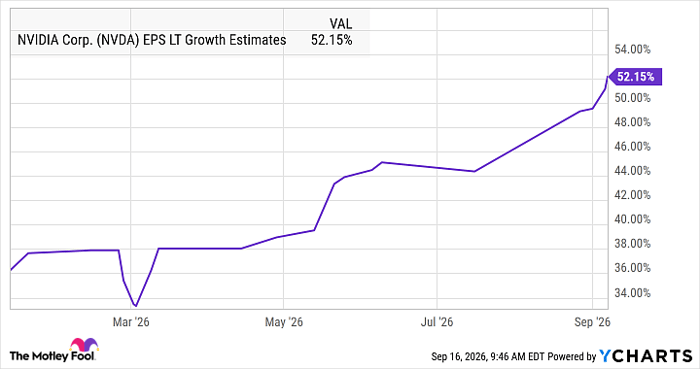
NVDA EPS LT Growth Estimates data by YCharts
A projected annual long-term earnings growth rate of over 50% is indeed healthy, considering that Nvidia is the largest company in the world. Moreover, Nvidia remains undervalued when its growth potential is taken into account. This is evident from its price/earnings-to-growth ratio (PEG ratio) of just 0.45, based on the annual earnings growth it could clock over the next five years, according to Yahoo! Finance.
The PEG ratio is calculated by dividing a company's trailing earnings multiple by its projected annual earnings growth. A reading below 1 suggests that the stock is undervalued, and Nvidia sits well below that threshold. So, Nvidia remains a solid long-term investment for anyone looking to add a growth stock to their portfolio, as the enormous investments in AI data center infrastructure can ensure years of healthy earnings growth for the company.
Should you buy stock in Nvidia right now?
Before you buy stock in Nvidia, consider this:
The Motley Fool Stock Advisor analyst team just identified what they believe are the 10 best stocks for investors to buy now… and Nvidia wasn’t one of them. The 10 stocks that made the cut could produce monster returns in the coming years.
Consider when Netflix made this list on December 17, 2004... if you invested $1,000 at the time of our recommendation, you’d have $406,141!* Or when Nvidia made this list on April 15, 2005... if you invested $1,000 at the time of our recommendation, you’d have $1,347,745!*
Now, it’s worth noting Stock Advisor’s total average return is 940% — a market-crushing outperformance compared to 211% for the S&P 500. Don't miss the latest top 10 list, available with Stock Advisor, and join an investing community built by individual investors for individual investors.
See the 10 stocks »
*Stock Advisor returns as of September 18, 2026.
Harsh Chauhan has no position in any of the stocks mentioned. The Motley Fool has positions in and recommends Marvell Technology and Nvidia. The Motley Fool has a disclosure policy.
Recommended Articles


