


7 Words From Warren Buffett That Could Change How Every Investor Thinks About Market Downturns
Key Points
Warren Buffett has long considered market pullbacks to be buying opportunities.
His quote from a 2008 New York Times op-ed demonstrates this clearly.
Historical returns when buying during 10%+ corrections show that Buffett's advice is backed by evidence.
- 10 stocks we like better than S&P 500 Index ›
What should you do when the stock market starts falling and every bit of bad news seems to just give you another reason to sell?
Warren Buffett offered his answer during one of the scariest events of the past several generations. In October 2008, with the financial crisis at its worst and stock prices plunging, Buffett wrote seven words that are worth remembering during every market downturn.
Missed Nvidia in 2009? This Rare Signal Is Flashing Again. In 2009, a "Double Down" signal flashed for a little-known chipmaker called Nvidia. For the first time in years, that same "Total Conviction" signal is flashing for a company 1/100th the size of Nvidia. Continue »
"Bad news is an investor's best friend."
That sounds almost absurd when your portfolio is losing thousands of dollars. But history suggests Buffett understood something about market declines that can be incredibly valuable to long-term investors today.
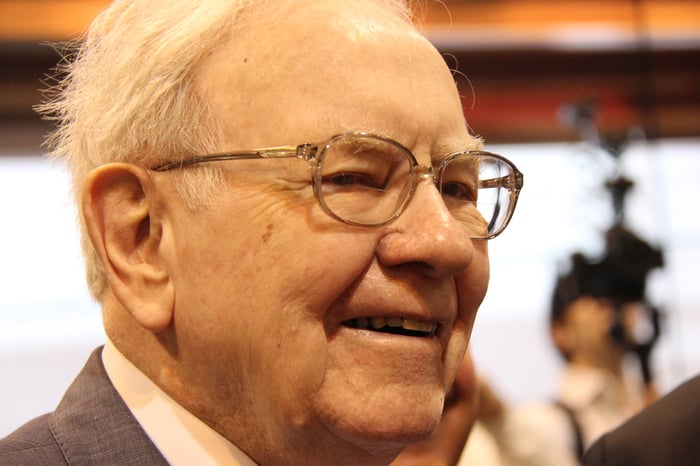
Source: Motley Fool.
How Buffett took advantage of bad news
Buffett wasn't arguing that recessions or steep declines in the S&P 500 (SNPINDEX: ^GSPC) are good things. He was talking about when entry points for stocks become more attractive.
Bad news creates fear and that fear can cause investors to sell. That kind of spiral can push the prices of otherwise strong businesses below where they should be valued under normal conditions.
As Buffett explained in that 2008 New York Times opinion piece, bad news allows investors to buy "a slice of America's future at a marked-down price."
The timing of that statement is interesting because the S&P 500 would continue falling well into the first half of 2009 before hitting a bottom. But from that March low through the end of 2009, the index rallied nearly 70% (with dividends reinvested).
Any investor waiting for the news to become better would have very likely missed out on a substantial portion of that recovery.
Market downturns tend to create buying opportunities for investors
Of course, these kinds of opportunities to buy stocks at sale prices extend beyond just deep recessions.
Since 1980, the S&P 500 has suffered an average intra-year decline of roughly 14%. Yet its average calendar year return over that same time was 13.3% (including dividends).
There are two takeaways from this factoid:
- Even severe corrections of more than 10% have historically produced attractive entry points.
- 10% market corrections are normal and occur roughly once a year. These should be expected throughout the course of long-term investing.
A Fidelity study also found that following the low point of a market correction (defined as the S&P 500 falling between 10-19%), the average return for the index in the subsequent one year was 30%. Following the bottom of a bear market decline of more than 20%, the average one-year gain was 37%.
That doesn't mean you should expect those types of returns after the next bear market. It simply means that falling stock prices and negative headlines have historically been terrible reasons to abandon long-term investment plans.
But Buffett thinks they could be really good reasons to buy at a discount.
The best time to buy rarely feels like it
Buffett's seven words capture one of investing's true counterintuitive ideas.
Stocks feel safest after they've risen in price and optimism is everywhere. But that's often when you're paying higher prices. Stocks feel most dangerous after they've fallen and the headlines are terrible. Yet that's when expected long-term returns can become more attractive.
There is one more important qualification. Money needed within the next few years generally shouldn't depend on stocks recovering quickly. Bear markets can always become deeper and last longer than expected.
But for investors with diversified portfolios and long time horizons, the next downturn shouldn't necessarily be viewed as something to avoid completely.
It could be an opportunity to keep adding to your investments or even increase your contributions while prices are lower.
Buffett's advice isn't that bad news guarantees good returns going forward. It's that the price you pay matters.
Should you buy stock in S&P 500 Index right now?
Before you buy stock in S&P 500 Index, consider this:
The Motley Fool Stock Advisor analyst team just identified what they believe are the 10 best stocks for investors to buy now… and S&P 500 Index wasn’t one of them. The 10 stocks that made the cut could produce monster returns in the coming years.
Consider when Netflix made this list on December 17, 2004... if you invested $1,000 at the time of our recommendation, you’d have $412,074!* Or when Nvidia made this list on April 15, 2005... if you invested $1,000 at the time of our recommendation, you’d have $1,314,319!*
Now, it’s worth noting Stock Advisor’s total average return is 935% — a market-crushing outperformance compared to 210% for the S&P 500. Don't miss the latest top 10 list, available with Stock Advisor, and join an investing community built by individual investors for individual investors.
See the 10 stocks »
*Stock Advisor returns as of September 17, 2026.
David Dierking has no position in any of the stocks mentioned. The Motley Fool has no position in any of the stocks mentioned. The Motley Fool has a disclosure policy.
Recommended Articles


