


The 1 Metric That Separates Joby From Archer in the Race to FAA Certification
Key Points
Joby is ahead of Archer in the race for FAA certification.
Joby also generates a lot more revenue than Archer.
- 10 stocks we like better than Joby Aviation ›
Joby Aviation (NYSE: JOBY) and Archer Aviation (NYSE: ACHR) are both early movers in the nascent electric vertical take-off and landing (eVTOL) aircraft market. But over the past 12 months, shares of Joby and Archer have declined about 60% and 40%, respectively.
Without the Federal Aviation Administration's (FAA) certification for their first commercial flights, both companies struggled to impress their investors. Geopolitical conflicts, inflation, and fears of interest rate hikes also drove many investors toward more conservative investments.
Missed Nvidia in 2009? This Rare Signal Is Flashing Again. In 2009, a "Double Down" signal flashed for a little-known chipmaker called Nvidia. For the first time in years, that same "Total Conviction" signal is flashing for a company 1/100th the size of Nvidia. Continue »
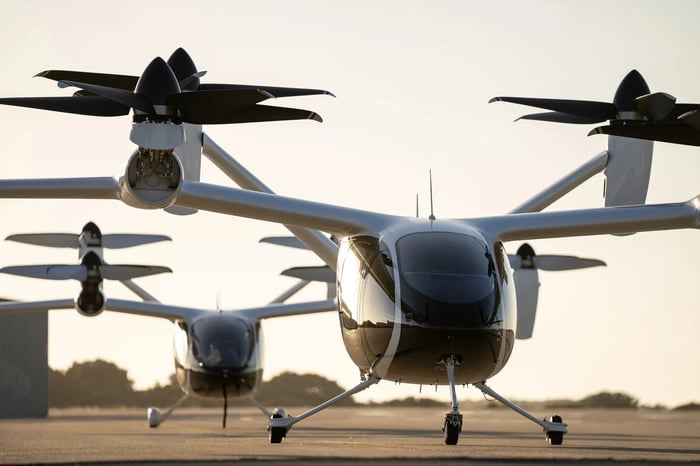
Image source: Joby Aviation.
But if we take a closer look at Joby and Archer, we'll notice that one key metric sets the two companies apart. With a market cap of $6.1 billion, Joby trades at 51 times this year's sales. Archer, which is valued at $4.2 billion, trades at 278 times this year's sales. Let's see why Archer's price-to-sales ratio is so much higher than Joby's, and if that will change in the future.
Joby generates much more revenue than Archer
Neither Joby nor Archer generates any revenue from commercial eVTOL flights. However, Joby's revenue surged from less than $1 million in 2024 to $53.4 million in 2025 as it received the first payments from its contracts with the U.S. Air Force's Agility Prime program. It also recognized some revenue from its acquisition of Blade Air Mobility's passenger business, a provider of helicopter and seaplane services, which closed last August.
For 2026, analysts expect its revenue to more than double to $119.5 million as it integrates Blade's passenger business and generates more revenue from its Agility Prime R&D contracts.
Archer also holds contracts with the Agility Prime program, but they function more like government-subsidized test flights rather than revenue-generating R&D projects. Unlike Joby, which plans to become a vertically integrated "transportation as a service" business that manufactures, owns, and operates its own air taxi network, Archer is an original equipment manufacturer (OEM) that sells most of its aircraft to third-party fleets. That's why it hasn't acquired any consumer-facing, revenue-generating businesses.
Archer generated less than $1 million in revenue in 2025. Still, analysts expect that figure to rise to $15.1 million in 2026 as it collects more leases and utilization fees from Hawthorne Airport in Southern California, which it acquired as a hub and test site last November.
But is Archer actually cheaper relative to its long-term growth potential?
The FAA certification process consists of five stages. Joby has already reached the fifth stage, while Archer has just completed the third stage.
Therefore, Joby could launch its first commercial flights in the U.S. before Archer. However, Archer's business could expand faster than Joby's -- albeit at lower margins -- because it's an OEM that will sell its Midnight eVTOLs to other companies. Joby will primarily use its S4 eVTOLs on its own air-taxi network, which will be integrated with Uber's platform.
Both companies have big manufacturing partners. Toyota backs Joby, and Stellantis supports Archer. However, Joby's partnership with Toyota is deeper and more structurally symbiotic than Stellantis' investment-driven deal with Joby.
By 2028, analysts expect Joby's revenue to reach $434.8 million. At its current market cap, it's valued at 14 times that estimate. But Archer's revenue is expected to reach $511.5 million by 2028 -- and it trades at just eight times that estimate. So while Archer looks more expensive than Joby today, that balance could shift over the next few years as it ramps up its production.
That said, I still think Joby is a better all-around eVTOL stock than Archer for three reasons. First, the S4's single tilt-rotor propellers make it faster and more energy-efficient than the Midnight. Second, Joby's vertically integrated business will generate higher margins than Archer's OEM business. Lastly, it's further ahead of Archer in the FAA certification race.
Should you buy stock in Joby Aviation right now?
Before you buy stock in Joby Aviation, consider this:
The Motley Fool Stock Advisor analyst team just identified what they believe are the 10 best stocks for investors to buy now… and Joby Aviation wasn’t one of them. The 10 stocks that made the cut could produce monster returns in the coming years.
Consider when Netflix made this list on December 17, 2004... if you invested $1,000 at the time of our recommendation, you’d have $420,109!* Or when Nvidia made this list on April 15, 2005... if you invested $1,000 at the time of our recommendation, you’d have $1,303,689!*
Now, it’s worth noting Stock Advisor’s total average return is 938% — a market-crushing outperformance compared to 211% for the S&P 500. Don't miss the latest top 10 list, available with Stock Advisor, and join an investing community built by individual investors for individual investors.
See the 10 stocks »
*Stock Advisor returns as of September 16, 2026.
Leo Sun has no position in any of the stocks mentioned. The Motley Fool recommends Stellantis and Uber Technologies. The Motley Fool has a disclosure policy.
Recommended Articles


