


September Fed Decision: Rate Hike Cycle Restarts After Three Years as 16 Officials Back One More Hike This Year
TradingKey - On September 16 Eastern Time, the Federal Reserve's latest interest rate policy statement noted that the meeting decided to raise the target range for the federal funds rate by 25 basis points to 3.75%–4.00%, marking the first rate hike since July 2023. The decision was passed unanimously by a 12–0 vote, while keeping the monetary policy framework of ample reserves in the banking system unchanged.
The statement noted that U.S. economic activity is expanding at a solid pace. Although uncertainty remains elevated, driven in part by geopolitical tensions, domestic spending has remained resilient, productivity growth is strong, and business capital spending has performed soundly. Job growth has been roughly in step with the expansion of the labor force, and the unemployment rate has changed little.
Inflation currently remains elevated, deviating from the 2% policy target. The Federal Reserve stated that this policy action will help inflation return to the 2% target in a more timely manner, and reaffirmed the Committee's commitment to price stability.
Dot Plot Changes
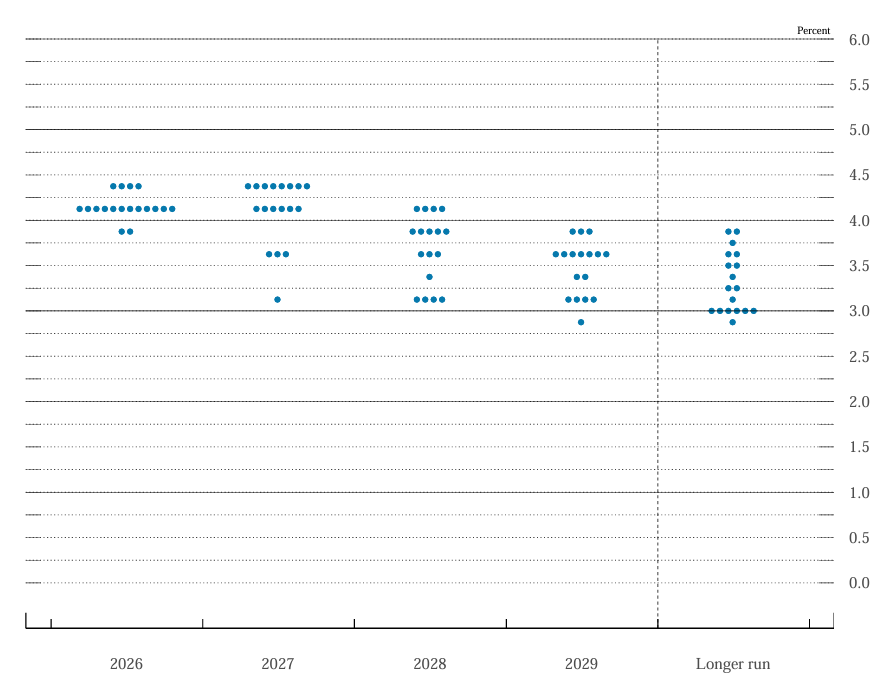
The interest rate dot plot released with this Federal Reserve rate decision continued to signal a hawkish stance. The median rate on the dot plot came in at 4.1%, up 30 basis points from the 3.8% forecast in June, implying a median path of another 25-basis-point rate hike within 2026 following this rate increase.
The dot plot showed that officials' expectations for the appropriate interest rate in 2026 narrowed significantly and shifted upward overall, with the lowest forecast around 3.9% and the highest near 4.4%. The vast majority of officials were concentrated in the 4.1%–4.4% range, with no officials expecting the rate at year-end to fall below 3.75%.
Of the 19 officials, only 18 submitted dot plot projections. Starting from the pre-hike range of 3.50%–3.75%, among the 18 officials, four believed rates should be raised by a cumulative 75 basis points in 2026, 12 saw a cumulative hike of 50 basis points, two favored a cumulative hike of 25 basis points, while no official expected rates to remain unchanged or called for rate cuts.
In other words, beyond the 25-basis-point hike already implemented, 16 officials still believed that rates should be raised at least once more in 2026, with four of them advocating for an additional 50 basis points.
Overall, Fed officials currently generally believe that the 2026 interest rate path has shifted from the June expectation of "holding at high levels with modest cuts" to "resuming rate hikes with an extended duration of high rates," meaning the federal funds rate will operate in a higher range.
[Dot Plot, Source: Federal Reserve]
For 2027, the median dot plot rate came in at 4.1%, a sharp upward revision of 50 basis points from the 3.6% forecast in June, implying almost no rate cuts in 2027 under the median path. The distribution of officials' expectations remained relatively wide, with rate forecasts ranging from a low of around 3.1% to a high of 4.4%, while most officials were concentrated in the 3.6%–4.4% range.
The median rate for 2028 was revised upward to 3.9% (compared to 3.4% in June), and the 2029 median stood at 3.6%, while the long-run interest rate expectation was slightly revised up from 3.1% in June to 3.2%. Of the 18 officials who submitted projections, one did not provide dots for 2028 and 2029. This shows that even if rate cuts are eventually resumed, the pace will be significantly slower than projected in June, as sticky inflation makes officials cautious about easing rapidly.
Overall, this rate-setting meeting not only resumed rate hikes but also shifted the policy communication framework further toward "higher for longer," which may trigger a market reassessment of pricing expectations for the future rate path.
Summary of Economic Projections (SEP)
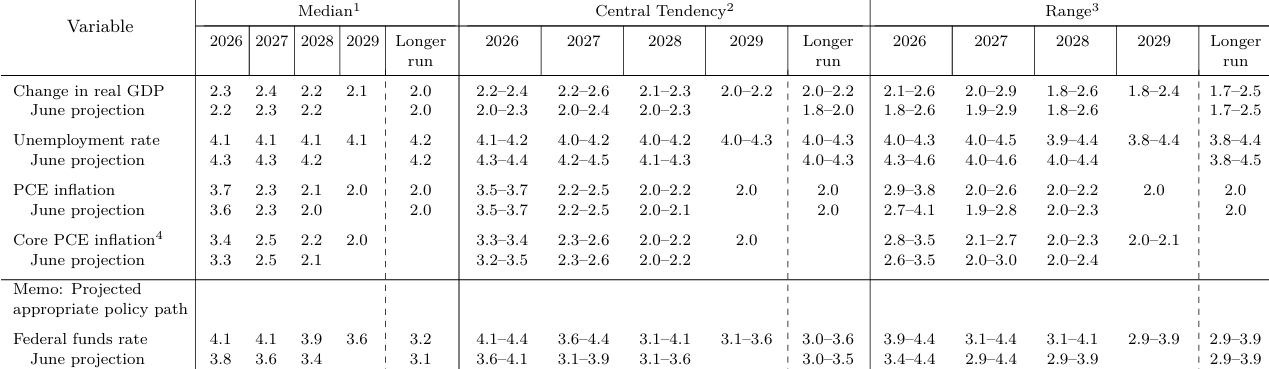
The Federal Reserve's latest Summary of Economic Projections (SEP) shows that policymakers slightly revised up U.S. economic growth forecasts and lowered unemployment rate projections.
In the latest estimates, the median projection for real U.S. GDP growth in 2026 was raised to 2.3%, up 0.1 percentage point from the 2.2% forecasted in June; the real GDP growth forecast for 2027 was revised up to 2.4% (from 2.3% in June), while the growth expectation for 2028 remained unchanged at 2.2%, and the projection for 2029 stood at 2.1%.
Over the long run, Fed officials maintained their projection for the U.S. longer-run potential economic growth rate at 2.0%, broadly anticipating that the U.S. economy will maintain a steady pace of expansion in the coming years.
[Source: Federal Reserve]
Regarding the labor market, the Fed noticeably lowered its unemployment rate forecasts this time. Policymakers' latest estimates show the median U.S. unemployment rate at 4.1% in 2026, down 0.2 percentage point from the 4.3% projected in June; the unemployment rate forecast for 2027 was likewise lowered to 4.1% (from 4.3% in June), while the expectations for 2028 and 2029 were both set at 4.1%, below the longer-run normal unemployment rate projection of 4.2%.
Overall, Fed officials judge that the U.S. labor market as a whole will remain stable over the next few years—and could prove even more resilient than anticipated in June—without suffering a sharp deterioration.
On inflation, the Fed continued to revise up short-term inflation forecasts, indicating that the pace of price deceleration remains slower than projected in June and that inflationary pressures stay elevated relative to the 2% policy target. For headline PCE inflation, officials raised the median projection for year-over-year personal consumption expenditures price index growth in 2026 to 3.7%, up from the 3.6% forecast in June; PCE inflation is expected to cool to 2.3% in 2027, unchanged from June; slow to 2.1% in 2028 (versus 2.0% in June); and further ease to 2.0% in 2029, ultimately returning to the Fed's long-term inflation goal. Core PCE inflation projections, which exclude volatile food and energy components, were also revised upward: the median forecast for core PCE inflation in 2026 rose to 3.4%, higher than the 3.3% projected in June; it remains at 2.5% for 2027, was revised up to 2.2% for 2028 (from 2.1% in June), and cools to 2.0% in 2029.
This clearly demonstrates that Fed policymakers have reached a consensus that the current disinflationary process will be slower than previously expected. The confluence of high growth, low unemployment, and elevated inflation forms the macroeconomic backdrop for restarting rate hikes and revising the interest rate path upward.
Recommended Articles


