


Meet This Eventual Member of the $1 Trillion Club. The Stock Trades Below 15x Forward Earnings and Is Not a Pure-Play Artificial Intelligence (AI) Stock.
Key Points
Most of the stocks in the $1 trillion market cap club have surged due to their strong exposure to artificial intelligence.
As the AI trade becomes more risky, investors will want to own large stocks with less exposure to AI.
- 10 stocks we like better than JPMorgan Chase ›
There are currently 15 publicly traded stocks in the world with a market cap north of $1 trillion. Several others are knocking on the door.
Once unimaginable, the advent of artificial intelligence has made the $1 trillion market-cap club much more achievable. Although there are a few outliers, such as Berkshire Hathaway and Saudi Aramco, the bulk of the members in this club have benefited from big tech, particularly AI.
Missed Nvidia in 2009? This Rare Signal Is Flashing Again. In 2009, a "Double Down" signal flashed for a little-known chipmaker called Nvidia. For the first time in years, that same "Total Conviction" signal is flashing for a company 1/100th the size of Nvidia. Continue »
AI is the greatest technological innovation since the internet, and many investors believe it could even be more disruptive. But that's also made the AI trade crowded.
Meet this eventual member of the $1 trillion club that trades below 15 times forward earnings and is not a pure-play AI stock.

Image source: Getty Images.
A boring business built over time
Banks are not the most exciting of sectors, as banking as a business has been around for decades. Banks also don't tend to grow earnings and revenue at rates as high as those of growth and tech stocks; they're typically constrained by the need to hold regulatory capital.
The sector took an enormous hit during the Great Recession of 2008, and it's taken decades to recover reputationally and reclaim the valuations it traded at before the Great Recession.
However, JPMorgan Chase (NYSE: JPM) CEO Jamie Dimon successfully steered the bank through the Great Recession and used it as a springboard to become the largest bank in the country by assets.
At the end of 2007, JPMorgan had roughly $1.56 trillion in total assets. At the end of the second quarter of 2026, the bank had eclipsed over $5 trillion in total assets.
Now, larger assets at a bank certainly don't make it an elite stock. However, growing the balance sheet prudently should lead to higher earnings because banks are typically in the business of lending. The bigger your loan book gets, the more interest a bank should accrue.
JPMorgan is also a leader in investment banking, asset management, and payments, among other businesses. In JPMorgan's case, a larger balance sheet has translated into much higher, more durable returns.
For the full year of 2007, JPMorgan earned a 13% return on common equity, and banks were more leveraged back then, which typically leads to higher earnings because the bank can lend more.
The bank operated with a leverage ratio of about 6% to 6.2% in 2007, measured as core regulatory capital as a percentage of total assets. The lower the ratio, the more leveraged a bank is. In 2025, JPMorgan generated a 17% return on common equity, while having a leverage ratio of 6.9% to 7.2%.
As of this writing, JPMorgan Chase had a market cap of $930 billion, so it's likely only a matter of time before it joins the $1 trillion club.
Is the stock a buy?
JPMorgan Chase continues to generate returns at the top end of its large-bank peer group. Dimon is also a highly regarded CEO on Wall Street, having successfully run the bank for decades and turned it into the juggernaut it is today.
Money center banks like JPMorgan are also viewed as too big to fail because allowing a bank like JPMorgan to fail would likely trigger a ripple effect across financial markets.
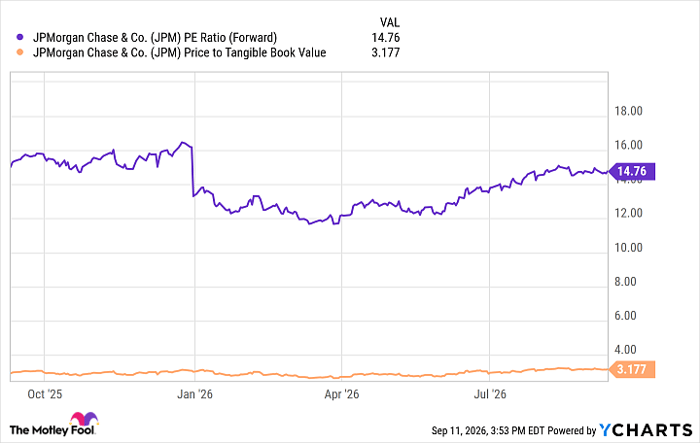
JPM PE Ratio (Forward) data by YCharts
In terms of the stock price, JPMorgan trades slightly under 15 times forward earnings and 3.2 times its tangible book value, or theoretical liquidation value, a popular way banks are valued.
Now, these aren't exactly cheap valuations for a large money-center bank, but I think JPMorgan has earned the premium due to its diversity of revenue streams, significant scale, and peer-leading returns.
It's also a stock that investors will be compelled to own, simply because it is very large and not a pure-play AI stock. Sure, AI has changed banking and will significantly change the company, but that's from an operational standpoint. AI is not the core way JPMorgan makes money.
Bank stocks can also serve as a hedge against inflation, and JPMorgan has businesses that will benefit across different interest-rate environments. All of these factors have made it a stock that many investors will want at least some exposure to.
Should you buy stock in JPMorgan Chase right now?
Before you buy stock in JPMorgan Chase, consider this:
The Motley Fool Stock Advisor analyst team just identified what they believe are the 10 best stocks for investors to buy now… and JPMorgan Chase wasn’t one of them. The 10 stocks that made the cut could produce monster returns in the coming years.
Consider when Netflix made this list on December 17, 2004... if you invested $1,000 at the time of our recommendation, you’d have $417,413!* Or when Nvidia made this list on April 15, 2005... if you invested $1,000 at the time of our recommendation, you’d have $1,341,294!*
Now, it’s worth noting Stock Advisor’s total average return is 950% — a market-crushing outperformance compared to 212% for the S&P 500. Don't miss the latest top 10 list, available with Stock Advisor, and join an investing community built by individual investors for individual investors.
See the 10 stocks »
*Stock Advisor returns as of September 14, 2026.
JPMorgan Chase is an advertising partner of Motley Fool Money. Bram Berkowitz has no position in any of the stocks mentioned. The Motley Fool has positions in and recommends Berkshire Hathaway and JPMorgan Chase. The Motley Fool has a disclosure policy.
Recommended Articles


