


The Stock Market Is Doing Something Incredibly Rare Right Now, and History Has Promising News for Investors
Key Points
Stocks are surging, but consumer confidence is near an all-time low.
Some experts are sounding the alarm about an AI bubble.
Even if a downturn is looming, the market's long-term potential is incredibly promising.
- 10 stocks we like better than S&P 500 Index ›
The stock market has defied the odds this year, largely shrugging off hurdles such as the Iran war, ongoing tariffs, and stubbornly high inflation.
But many everyday Americans have a very different view of the overall economy. While major market indexes are closing in on new record highs, consumer sentiment is near an all-time low. This extreme disconnect can be a warning signal for volatility, but there's still good news for investors.
Missed Nvidia in 2009? This Rare Signal Is Flashing Again. In 2009, a "Double Down" signal flashed for a little-known chipmaker called Nvidia. For the first time in years, that same "Total Conviction" signal is flashing for a company 1/100th the size of Nvidia. Continue »
Image source: Getty Images.
American consumers are feeling pessimistic
The University of Michigan Consumer Sentiment Index tracks U.S. consumers' confidence in the economy. Higher values reflect greater confidence and more willingness to spend, while lower figures suggest less confidence.
As of September 2026, this metric is just under 48 -- one of its lowest readings on record. For context, its next-lowest reading occurred in May 2022, when it sank to around 50 during a period of runaway inflation. Before that, it reached a low of 55 in November 2008 -- just over a year into the Great Recession.
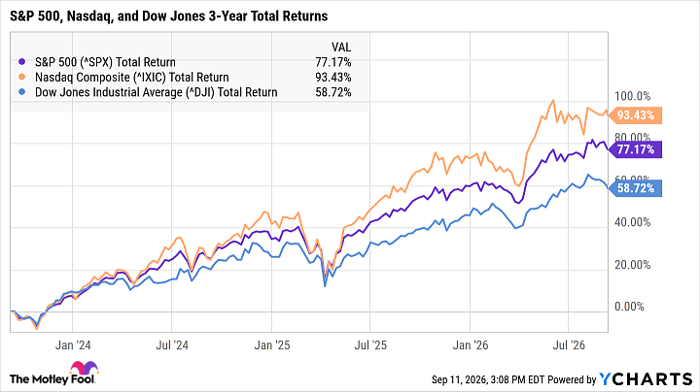
Based solely on the stock market's performance, however, one would be hard-pressed to believe that consumer confidence is near a historic low. The S&P 500 (SNPINDEX: ^GSPC) has already notched multiple all-time highs this year alone, and it's just 2.5% down from its most recent record. The Nasdaq Composite (NASDAQINDEX: ^IXIC) and Dow Jones Industrial Average (DJINDICES: ^DJI) are each about 4% away from a new high.
^SPX data by YCharts
So what does this disconnect actually signal? For one, it could be at least partly related to artificial intelligence (AI) spending.
Big tech companies have poured billions of dollars into AI-related infrastructure like data centers in hopes that it will lead to increased revenue. Microsoft, Meta Platforms, Amazon, and Google parent company Alphabet spent a combined $303 billion on data centers in the first half of 2026 alone.
All of this spending has led to explosive returns for large tech stocks, lifting the entire market to new heights even when many consumers are not feeling the gains in their wallets.
History has good and bad news for investors
The bad news is that some experts warn we may be in an AI bubble. In fact, around 45% of fund managers believe an AI bubble is the single greatest tail risk facing the market right now, according to Bank of America's July Global Fund Managers Survey.
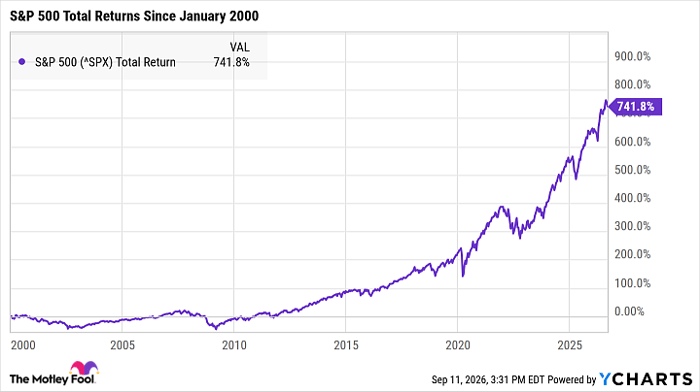
The good news is that no matter what happens in the near term, the market's long-term future is bright. In the last two decades alone, the market has faced some of the most severe recessions in history -- including the dot-com bubble, the Great Recession, and the sudden COVID-19 crash.
Yet despite significant volatility in those years, the S&P 500 has soared by around 742% since January 2000.
^SPX data by YCharts
No two bear markets or recessions are the same, so trying to predict the market's future based on past performance can be risky.
What investors can bank on, however, is the fact that strong stocks have the potential for lucrative returns over time. Even if a downturn is coming, investing in quality companies and holding them for at least a few years is key to building long-term wealth.
Should you buy stock in S&P 500 Index right now?
Before you buy stock in S&P 500 Index, consider this:
The Motley Fool Stock Advisor analyst team just identified what they believe are the 10 best stocks for investors to buy now… and S&P 500 Index wasn’t one of them. The 10 stocks that made the cut could produce monster returns in the coming years.
Consider when Netflix made this list on December 17, 2004... if you invested $1,000 at the time of our recommendation, you’d have $417,413!* Or when Nvidia made this list on April 15, 2005... if you invested $1,000 at the time of our recommendation, you’d have $1,341,294!*
Now, it’s worth noting Stock Advisor’s total average return is 950% — a market-crushing outperformance compared to 212% for the S&P 500. Don't miss the latest top 10 list, available with Stock Advisor, and join an investing community built by individual investors for individual investors.
See the 10 stocks »
*Stock Advisor returns as of September 14, 2026.
Bank of America is an advertising partner of Motley Fool Money. Katie Brockman has no position in any of the stocks mentioned. The Motley Fool has positions in and recommends Alphabet, Amazon, Meta Platforms, and Microsoft. The Motley Fool has a disclosure policy.
Recommended Articles


