


Nvidia Stock Could Reach $490 by End of 2027 Based on Current Growth Projections
Key Points
Nvidia is expanding its growth opportunities by investing in other AI companies and by launching more powerful products.
Wall Street expects revenue to increase 80% this year, and management is guiding for 70% next year.
Nvidia stock trades at a high price-to-sales ratio, and it's likely to come down.
- 10 stocks we like better than Nvidia ›
Missed Nvidia in 2009? This Rare Signal Is Flashing Again. In 2009, a "Double Down" signal flashed for a little-known chipmaker called Nvidia. For the first time in years, that same "Total Conviction" signal is flashing for a company 1/100th the size of Nvidia. Continue »
Nvidia (NASDAQ: NVDA) stock has returned to outperforming the market, up 24% year to date versus a 14% gain for the S&P 500.
But what investors really want to know is whether or not Nvidia can continue to outperform the market, and if it makes sense to buy its stock today. While no one knows what the future will bring, there are ways to evaluate its business and prospects as well as signals about market sentiment.
For example, management provides guidance for near-term growth, and Wall Street analysts model growth expectations based on internal and external factors. Based on some of these projections, here's where Nvidia stock could be at the end of 2027.
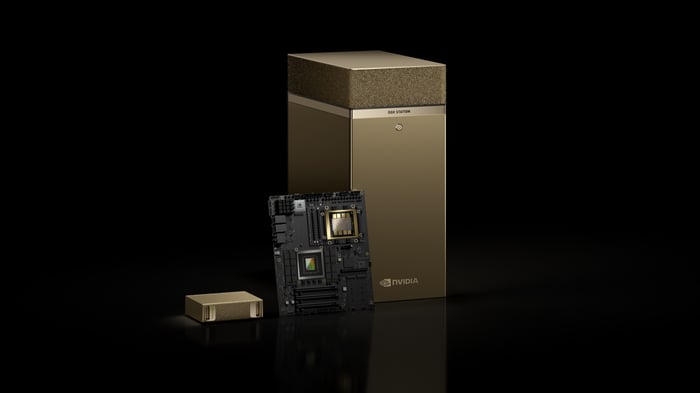
Image source: Nvidia.
Nvidia is expected to keep up high growth
Nvidia blasted past estimates and management's guidance in the company's 2027 fiscal second quarter, delivering 106% sales growth. Artificial intelligence (AI) development continues to expand at accelerating rates, and Nvidia's graphics processing units (GPU) are a critical piece of the process.
The company is launching new, more powerful chips and expanding its stake in AI by rolling out products that integrate with its ecosystem, creating high barriers to entry for competitors. It's also acquiring smaller businesses and providing funding for other AI players. For example, it just announced that it's acquiring AI platform Hugging Face for $12.9 billion, and Nvidia invested $2 billion in CoreWeave this year on top of earlier investments. That increases its exposure to AI growth, expands its addressable market, and has helped accelerate revenue growth.
Wall Street expects Nvidia revenue to increase 80% this year and 63% next year. In the second-quarter earnings call, though, CFO Colette Kress said that Nvidia expects to grow 70% next year, or fiscal 2028.
Using Wall Street's estimate for 2026 (fiscal 2027) and management's guidance for next year (fiscal 2028), Nvidia revenue would be $699.3 billion at the end of 2027. Using a price-to-sales ratio of 17, below today's 19, Nvidia would reach a market cap of 11.9 trillion. That's a 113% increase from today's, and the stock would reach $490. At a lower ratio, say 15, it would be nearly $10.5 trillion, an 89% increase.
The average Wall Street target price is 38% higher than today over the next 12 to 18 months, with a high 0f 208%.
Can Nvidia truly reach those highs in such a short time? If so, it would be a strong buy today.
In general, Nvidia stock does usually spike after its earnings reports as revenue jumps, as seen in this chart, but not always.
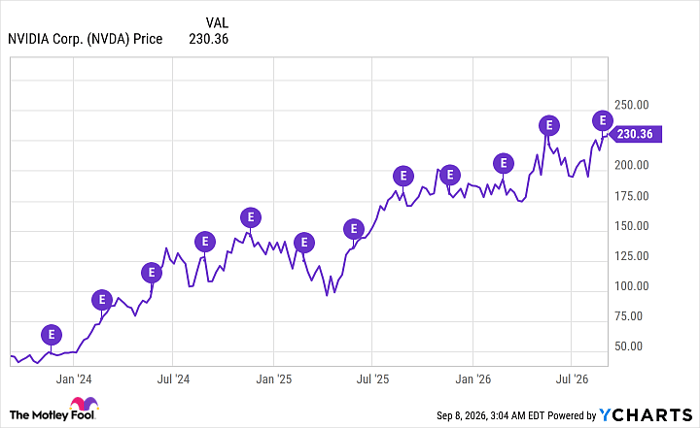
NVDA data by YCharts
Despite what's likely to be fantastic growth over the next two years or so, the stock may not gain quite as much as the expected growth rates and valuation multiples today imply. Management's 2027 guidance boosted market confidence about continued high growth after the second-quarter report, but the market has been concerned about competition, external AI developments, and potential deceleration. The price-to-sales ratio continues to decline, too. Over the next year or so, Nvidia stock could fall or gain much more modestly if growth slows and the valuation comes down.
Should you buy stock in Nvidia right now?
Before you buy stock in Nvidia, consider this:
The Motley Fool Stock Advisor analyst team just identified what they believe are the 10 best stocks for investors to buy now… and Nvidia wasn’t one of them. The 10 stocks that made the cut could produce monster returns in the coming years.
Consider when Netflix made this list on December 17, 2004... if you invested $1,000 at the time of our recommendation, you’d have $409,917!* Or when Nvidia made this list on April 15, 2005... if you invested $1,000 at the time of our recommendation, you’d have $1,341,724!*
Now, it’s worth noting Stock Advisor’s total average return is 942% — a market-crushing outperformance compared to 211% for the S&P 500. Don't miss the latest top 10 list, available with Stock Advisor, and join an investing community built by individual investors for individual investors.
See the 10 stocks »
*Stock Advisor returns as of September 12, 2026.
Jennifer Saibil has no position in any of the stocks mentioned. The Motley Fool has positions in and recommends Nvidia. The Motley Fool has a disclosure policy.
Recommended Articles


