


PANW Stock Forecast: Plunges 9% Despite Earnings Beat, Can It Break $400?
TradingKey - Palo Alto Networks (PANW) delivered better-than-expected results in its latest earnings report, but its stock price dropped significantly. On September 2 Eastern Time, PANW fell 9.28% to $328.48, touching an intraday low of $321.39; compared with the closing price of $382.13 on August 31, its two-day cumulative decline has exceeded 14%.
Based on the earnings report, PANW's fourth-quarter revenue, adjusted EPS, and NGS ARR all maintained strong growth, and its FY2027 revenue and EPS guidance were also higher than market expectations. But why did its stock price fall?
Why Is PANW Stock Falling?
Financial results show that PANW's fourth-quarter revenue for fiscal year 2026 reached $3.41 billion, up 34% year-over-year, exceeding market expectations of $3.35 billion; adjusted EPS reached $1.02, also beating market expectations of $0.98.
More importantly, the company's Next-Generation Security Annual Recurring Revenue (NGS ARR) reached $9.1 billion, up 63% year-over-year, with net additions in a single quarter approaching $1 billion; remaining performance obligations (RPO) reached $21.2 billion, up 34% year-over-year, indicating that enterprise cybersecurity spending remains strong.
Although the earnings beat expectations, the core reasons driving the stock price down were excessively high market expectations and cash flow margin guidance that fell below market expectations.
First, market expectations were already excessively high. Prior to the earnings release, PANW's year-to-date gain had at one point approached 100%, setting a new record high. Bank of America analysts noted that because market expectations were already extremely high, investors actually needed to see stronger performance to continue driving the stock price higher.
Most importantly, the key issue lies in the cash flow margin guidance. The company expects its adjusted free cash flow margin for fiscal year 2027 to be around 37.5%–38%. This figure is not only slightly below the higher expectations previously held by the buy side, but also represents a slowdown relative to its long-sought 40% cash flow target, exposing short-term financial pressure on the company and consequently weighing on the stock price.
Can PANW Stock Keep Rising?
Despite the sharp short-term drop in its stock price, PANW's medium- to long-term growth thesis has not fundamentally changed.
The company expects FY2027 revenue to reach $14.1 billion to $14.2 billion, up 23% to 24% year-over-year; NGS ARR to reach $11.075 billion to $11.175 billion, up 22% to 23% year-over-year; and adjusted EPS to reach $4.16 to $4.19. Overall revenue and EPS guidance remain above previous market expectations.
AI will likely continue to be an important source of demand for the cybersecurity industry. As enterprises deploy AI agents, large models, and automated workflows, the importance of identity authentication, data protection, cloud security, and AI model security is rising simultaneously. CEO Nikesh Arora stated that AI technology developments are elevating cybersecurity to a CIO priority, and the company maintains its long-term goal of reaching $20 billion in NGS ARR by FY2030.
PANW's platformization strategy is also reinforcing this logic. The company wants customers to stop buying firewalls, cloud security, identity security, and security operations products separately, and instead gradually integrate them into platforms such as Network & AI Security, Cortex, and Idira. This not only increases spending per customer, but also helps raise customer switching costs and long-term renewal capability.
Wall Street firms have not turned pessimistic following the sharp drop in the stock price, continuing to characterize the pullback driven by cash flow guidance as a 'good opportunity to buy on dips.' RBC Capital Markets raised its price target for PANW from $434 to $475 while maintaining an 'Outperform' rating; DA Davidson raised its price target from $345 to $420; and Morgan Stanley also raised its price target from $387 to $394, noting that enterprise cybersecurity demand surrounding AI remains in its early stages.
PANW Stock Price Technical Analysis
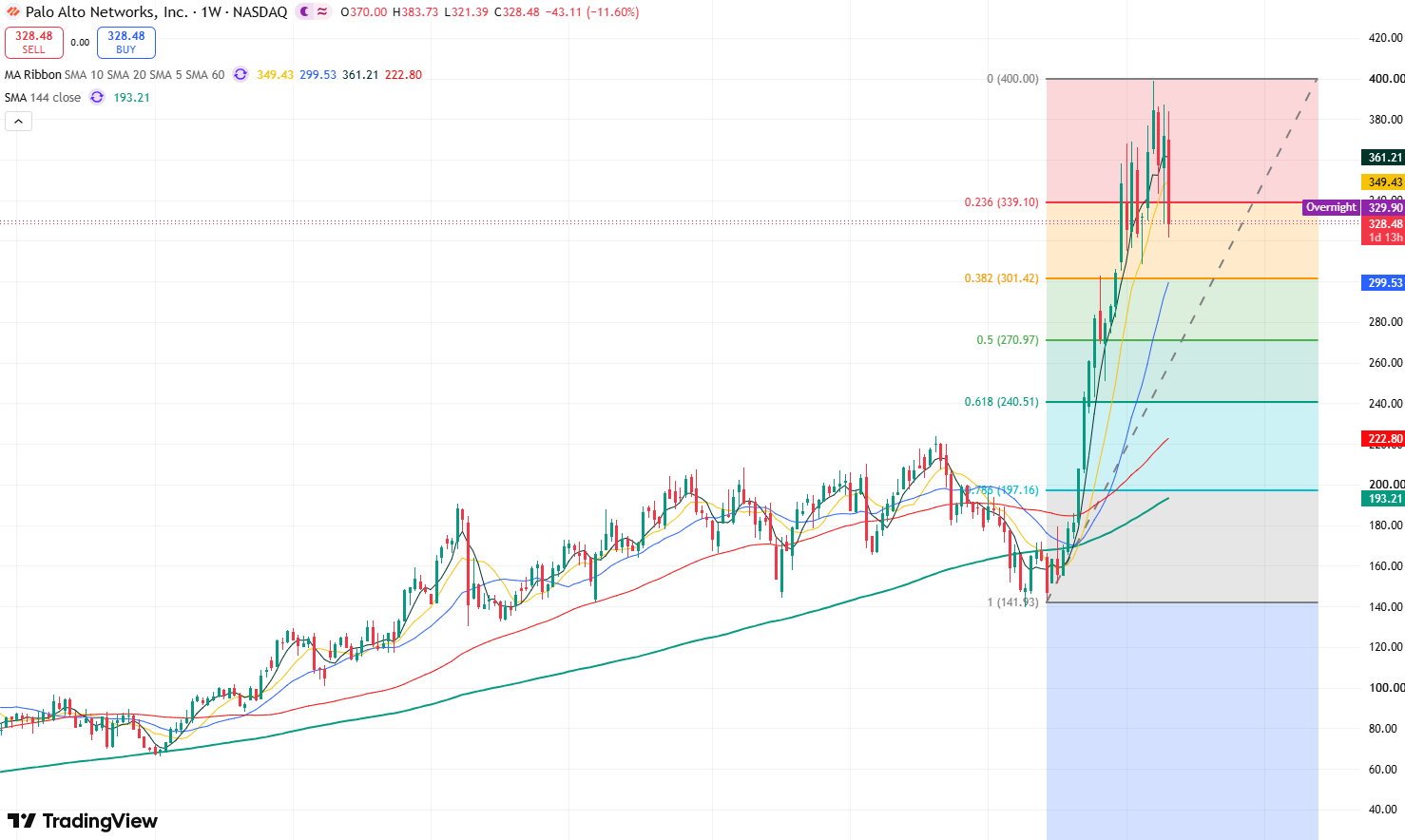
PANW stock price weekly chart, Source: TradingView
From the weekly chart of PANW's stock price, the stock has successively broken below both the 5-period and 10-period simple moving averages (SMA5 and SMA10), with the candlestick structure weakening noticeably. Meanwhile, as the stock broke below the August 26 low of $328, bearish momentum was further reinforced, indicating that the stock may continue to fall in the short term.
On the downside, the primary support level to watch is the $300 mark, which aligns with the 20-period simple moving average (SMA20) and may form a confluence of support. Traders could consider buying on dips near this level. If this support fails to hold, the stock could drop further toward the support level near $260.
On the upside, the key resistance level to watch is the upper boundary of the gap formed on September 2 at $362. If the stock fills this gap and holds above $362, it will likely test the recent high of $387.33. A breakthrough above this level would open up upside room toward above $400.
Recommended Articles


