


Jensen Huang Said This Word Exactly 1 Time During Nvidia's Earnings Call, and That Was Enough to Put Artificial Intelligence (AI) Bubble Fears to Rest
Key Points
The top five AI hyperscalers are expected to spend close to $800 billion on capex this year and $1.3 trillion next year.
Big tech companies are spending enormous sums procuring chips, networking gear, optical components, and software to build AI data centers.
While Nvidia is best known for its GPUs, the company has quietly integrated itself across the entire data center supply chain.
- 10 stocks we like better than Nvidia ›
During Nvidia's (NASDAQ: NVDA) second-quarter earnings call, Jensen Huang used the word "visibility" only once. He did not spend an extended period of time arguing with skeptical analysts about the durability of the artificial intelligence (AI) build-out.
Instead, he explained that Nvidia can now see further upstream and downstream than it ever has -- into wafers, memory, optics, land, power, and the facilities that will house the next wave of AI systems. This single word, set against yet another quarter of record results and a supply-constrained outlook, is more meaningful than the bubble commentary that has followed Nvidia stock for over a year.
Missed Nvidia in 2009? This Rare Signal Is Flashing Again. In 2009, a "Double Down" signal flashed for a little-known chipmaker called Nvidia. For the first time in years, that same "Total Conviction" signal is flashing for a company 1/100th the size of Nvidia. Continue »
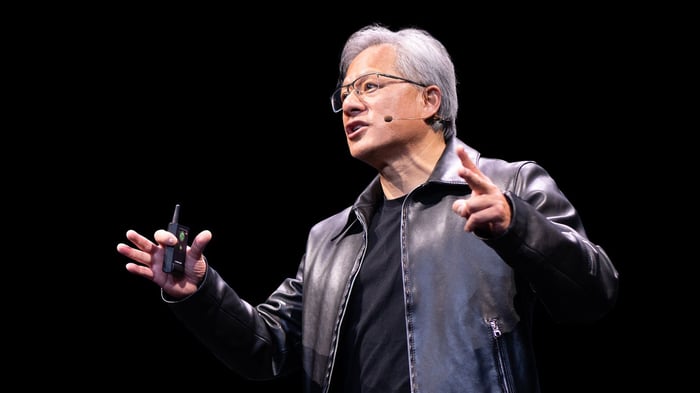
Jensen Huang: Image source: Nvidia.
Why does the AI bubble story exist?
The stance that the AI sector is in a bubble is nothing new. It is a story wrapped around circular financing deals, stretched balance sheets, and a lingering fear that demand is being manufactured by the same companies that are selling the picks and shovels. Hyperscalers and AI labs are spending enormous sums procuring accelerators that are then used to generate tokens. The resulting revenues from generative models and cloud infrastructure are subsequently used to justify the premise that more chips are needed. Critics see a loop that looks eerily similar to the fiber optic infrastructure build-out of the late 1990s, when installed capacity raced far ahead of profitable uses.
Skeptics also view the growing market for custom silicon to support the idea that Nvidia's moat is narrowing. If Amazon, Alphabet, Microsoft, and Meta Platforms design their own AI accelerators, then Nvidia's pricing power should erode, in theory. In addition, they point to free cash flow turning negative at some of the largest AI spenders as their capital expenditures surge ahead of their operating cash flows.
Against this backdrop, Nvidia starts to look like a fashion design that will fade after the first generation of data centers is fully depreciated and the second generation starts to look optional. At first glance, this logic may look sound. However, it is also incomplete. Bears are treating Nvidia as nothing more than a chip vendor waiting for purchase orders rather than as the company organizing the entire factory that produces artificial intelligence.
Nvidia just offered fiscal 2028 guidance early
Huang explained that by working with "land, power, and shell companies all around the world," Nvidia can better prepare "all of this computing that's going to be built that will ultimately deploy for our ecosystem and our customers."
That planning has given Nvidia unprecedented visibility, which is why the company was able to guide for 70% revenue growth for its fiscal 2028, which won't start until Jan. 31, 2027, even though it has historically refused to forecast that far ahead. Management made it clear that based strictly on the level of demand for Nvidia's products, it could deliver growth significantly greater than 70%. But given the supply constraints on the hardware that goes into its architectures, 70% growth is a floor the company believes it can deliver while keeping customers, shareholders, and the supply chain aligned.
Nvidia's visibility is not abstract in the slightest. The top five hyperscalers are expected to lay out nearly $800 billion on capital expenditures in 2026 and $1.3 trillion next year. Meanwhile, cloud backlogs are around $2 trillion. These figures matter because they are not being used for marketing. They are being published to support the case around build plans of the customers that account for half of Nvidia's data center business. The other half -- neoclouds, sovereign projects, industrial buyers, and enterprises, which are grouped as ACIE (AI clouds, industrial, and enterprise) -- is growing even faster and compounding at a pace that looks far different from a traditional fashion cycle.
When spending at this scale is tied to multiyear site development plans, power interconnects, and memory allocations, demand signals stop looking like quarterly swings and start looking like a city industrial plan. Nvidia's confidence to publish a forecast for its next fiscal year is the public company equivalent of that plan. Think about it: Bubbles usually don't form when manufacturers tell their entire ecosystem how much product they will actually be able to ship a year ahead of time.
Nvidia is moving from chips to factories
Smart investors are beginning to recognize how Nvidia is expanding beyond graphics processing units (GPUs) and central processing units (CPUs). The company is quietly building the architecture of AI factories: full-stack systems in which the CPUs, GPUs, networking, software, and the physical site are designed in unison so that each new product raises the revenue opportunity per gigawatt of power.
That opportunity is already on display as costs have grown from roughly $18 billion per gigawatt in the Hopper era to $25 billion with Blackwell and now $40 billion with Vera Rubin. Nvidia understands how incremental market share will come not from winning another server rack but from owning more of the entire factory.
This is where Marvell Technology, Nokia, and Coherent fit into the equation. Nvidia holds equity stakes in each of these companies, which bring custom silicon, radio-access networks (RAN), and optical interconnects onto one platform.
Marvell specializes in custom XPUs (specialized accelerator chips designed for specific use cases) and silicon photonics used in Nvidia's NVLink Fusion fabric. Nvidia's partnership with Nokia extends its reach into AI-RAN, turning edge devices into another platform for producing and consuming tokens. Meanwhile, Coherent supports the optical backbone that replaces copper connectivity products as chip clusters grow. Taken together, these relationships give Nvidia a line of sight into networking, photonics, and telecommunications demand that a pure-play GPU designer would never see.
This level of visibility changes planning all across the supply chain. Nvidia has already warned that rising memory prices will put pressure on its gross margins into next year. But because Nvidia sits so far upstream with the three major memory suppliers -- Micron Technology, SK Hynix, and Samsung -- and sees land, power, and shell demands years in advance, it can redesign architectures, lock in capacity and supply agreements, and set customer expectations before a shortage turns into a surprise.
The takeaway here is straightforward: AI spending can still be cyclical at the margin level as memory inflation will stress near-term profitability. But this is not the same thing as a bubble preparing to pop. A bubble bursts when demand evaporates because sentiment suddenly changes.
What Huang is describing is secular demand that is already booked across land, megawatts, and critical components, with Nvidia positioned to capture a rising share of each new factory rather than fighting to maintain its share of each incremental chip shipment. For investors with long-term time horizons, now looks like just as good a time as ever to scoop up some shares of Nvidia and hold onto them as the AI infrastructure era kicks into gear.
Should you buy stock in Nvidia right now?
Before you buy stock in Nvidia, consider this:
The Motley Fool Stock Advisor analyst team just identified what they believe are the 10 best stocks for investors to buy now… and Nvidia wasn’t one of them. The 10 stocks that made the cut could produce monster returns in the coming years.
Consider when Netflix made this list on December 17, 2004... if you invested $1,000 at the time of our recommendation, you’d have $445,833!* Or when Nvidia made this list on April 15, 2005... if you invested $1,000 at the time of our recommendation, you’d have $1,402,153!*
Now, it’s worth noting Stock Advisor’s total average return is 993% — a market-crushing outperformance compared to 214% for the S&P 500. Don't miss the latest top 10 list, available with Stock Advisor, and join an investing community built by individual investors for individual investors.
See the 10 stocks »
*Stock Advisor returns as of September 4, 2026.
Adam Spatacco has positions in Alphabet, Amazon, Microsoft, and Nvidia. The Motley Fool has positions in and recommends Alphabet, Amazon, Coherent, Marvell Technology, Meta Platforms, Micron Technology, Microsoft, and Nvidia. The Motley Fool has a disclosure policy.
Recommended Articles


