


September Is the Stock Market's Worst Month on Record. Here's the 1 Move History Says AI Investors Should Make.
Key Points
The S&P 500 and Nasdaq Composite both typically have negative returns during the month of September.
Returns during September have been mixed throughout the artificial intelligence (AI) revolution.
Smart investors understand that seasonal weakness can be a lucrative opportunity to buy quality companies.
- 10 stocks we like better than S&P 500 Index ›
September has a reputation problem on Wall Street, and if you own a basket of artificial intelligence (AI) stocks, it is hard to ignore. Investors talk about the September Effect the same way people talk about the first week back at the office after a summer vacation: The pace picks up, patience is thin, and small problems suddenly feel bigger.
Since 1928, the S&P 500 (SNPINDEX: ^GSPC) has posted an average return of -1% in September. The Nasdaq Composite (NASDAQINDEX: ^IXIC) features a similar September decline since its inception in 1971.
Missed Nvidia in 2009? This Rare Signal Is Flashing Again. In 2009, a "Double Down" signal flashed for a little-known chipmaker called Nvidia. For the first time in years, that same "Total Conviction" signal is flashing for a company 1/100th the size of Nvidia. Continue »
The long-running theory behind September sell-offs is that as fund managers come back from vacation, they rebalance their portfolios -- taking gains in stocks that have rallied hard while harvesting losses from laggards.
The ironic part of the September Effect is that the month actually finishes higher almost as often as it finishes lower. It's just that long-term average returns get dragged down by the ugliest years.
For those invested in the AI complex, the question is not whether a calendar anomaly exists. It is whether the September Effect still applies once you zoom in on the specific stocks that have defined the AI revolution over the last few years.

Image source: Getty Images.
The September Effect vs. the AI boom
The AI trade did not really get going until late 2022, after OpenAI commercially launched ChatGPT. While small, this gives us a useful sample: the Septembers of 2023, 2024, and 2025. Interestingly, they do not tell a linear story.
September 2023
The S&P 500 dropped about 5%, while the Nasdaq fell closer to 6%. Nvidia, which had just entered the trillion-dollar club, lost more than 10%. Macroeconomic factors, including relatively high interest rates and the possibility of a government shutdown, would be enough to make most investors uneasy in a normal year.
But when you layer on the fact that no one had ever witnessed anything quite like the AI boom, investors simply decided they had seen enough rallying in tech stocks for the time being. It felt like the September Effect arrived right on schedule and rocked the most expensive names hardest.
September 2024 and 2025
September 2024 was modestly positive for the S&P 500 and the Nasdaq, with both indexes rising about 2%. Big tech also fared well, with the "Magnificent Seven" rising anywhere between 2% and 22% during the month.
The script changed entirely in September 2025. The Nasdaq Composite jumped nearly 6%, while the S&P 500 rose 3.5%. Once again, megacap tech collectively boasted a strong performance, with Tesla and Alphabet rising 33% and 14%, respectively. The seasonal weakness that everyone usually braces for simply did not show up.
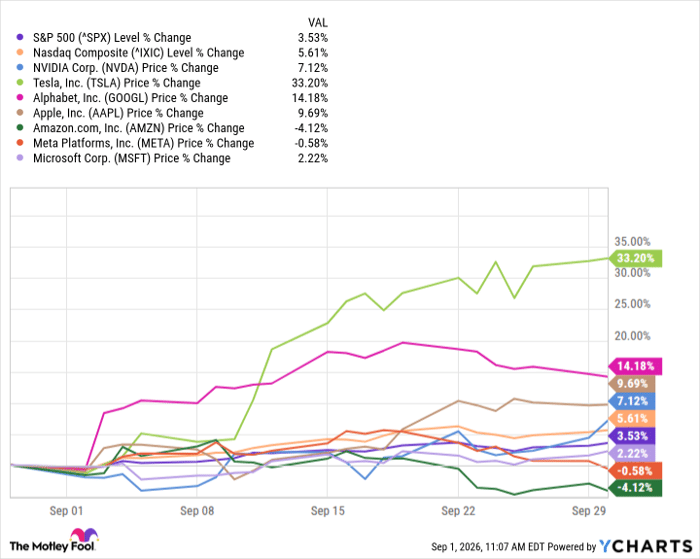
^SPX data by YCharts
Indeed, three years is not a century of data. Still, recent history shows mixed results rather than a uniformly grim performance. When investors are already nervous, growth stocks often get hit hardest because they carry higher valuations and more concentrated ownership.
On the flip side, when sentiment is positive, these same stocks have proven to be perfectly capable of ignoring September storms. That is the key takeaway: The September Effect is nothing more than a tendency. It is not a law, and the largest AI stocks have already shown they can shrug off that tendency.
How should investors prepare for September?
Perhaps the most useful thing an AI investor can do this September is refuse to treat the month as an all-or-nothing event. What I mean by that is do not dump your whole portfolio simply because a statistic from 1928 makes you feel cautious. Moreover, it's not wise to sit on 100% exposure to stocks if a 5% sell-off would force you to dump something you actually like.
The more balanced approach is to maintain a modest cash buffer and use any weakness as an opportunity to buy the dip in companies that already have real earnings growth powered by the AI story. Some quality examples include Nvidia, Microsoft, Alphabet, and Apple -- each of which has spent the last three years proving it can generate enough cash flow to fund its infrastructure build-outs.
Those are the types of businesses you want to own more of if the market decides to throw a seasonal tantrum. By contrast, speculative names generally only work out when everything else is already going up. Those are positions you can afford to trim before the calendar even turns.
Don't be fooled: I am not suggesting investors should try to time the market. Instead, I'm simply acknowledging that September tends to create air pockets and that smart investors would rather be buyers than forced sellers. The last three Septembers prove that these air pockets are not guaranteed in the AI era. But either way, having some dry powder and a short list of high-quality blue chip names you would happily buy at lower prices can keep September from turning into a point of regret.
Should you buy stock in S&P 500 Index right now?
Before you buy stock in S&P 500 Index, consider this:
The Motley Fool Stock Advisor analyst team just identified what they believe are the 10 best stocks for investors to buy now… and S&P 500 Index wasn’t one of them. The 10 stocks that made the cut could produce monster returns in the coming years.
Consider when Netflix made this list on December 17, 2004... if you invested $1,000 at the time of our recommendation, you’d have $446,157!* Or when Nvidia made this list on April 15, 2005... if you invested $1,000 at the time of our recommendation, you’d have $1,377,357!*
Now, it’s worth noting Stock Advisor’s total average return is 984% — a market-crushing outperformance compared to 212% for the S&P 500. Don't miss the latest top 10 list, available with Stock Advisor, and join an investing community built by individual investors for individual investors.
See the 10 stocks »
*Stock Advisor returns as of September 3, 2026.
Adam Spatacco has positions in Alphabet, Amazon, Microsoft, Nvidia, and Tesla. The Motley Fool has positions in and recommends Alphabet, Amazon, Apple, Meta Platforms, Microsoft, Nvidia, and Tesla. The Motley Fool has a disclosure policy.
Recommended Articles


