


Better Stock: Lucid vs. Rivian? (Hint: Unit Economics and Gross Profits Are Key.)
Key Points
The EV industry is off to a slower than anticipated start in the U.S., making life difficult for young EV makers.
Rivian's focus on removing redundant parts and improving production has helped improve its gross profitability.
Lucid hasn't been able to replicate Rivian's work on gross profitability or capture a similar joint venture that has handsomely rewarded its rival.
- 10 stocks we like better than Rivian Automotive ›
Investors would certainly love to find the next high-flying Tesla stock, which made many long-term shareholders wealthy. Right now, the electric vehicle (EV) industry is slowly gaining traction after fuel economy regulations were relaxed and the $7,500 federal EV tax credit ended, and that gives investors a chance to gauge EV investments and potentially start a position before the industry accelerates forward, and eventually, it will. When comparing two young EV makers, Rivian (NASDAQ: RIVN) and Lucid (NASDAQ: LCID), one of the most important factors is gross profitability.
Here's how the two compare, and why it matters.
Missed Nvidia in 2009? This Rare Signal Is Flashing Again. In 2009, a "Double Down" signal flashed for a little-known chipmaker called Nvidia. For the first time in years, that same "Total Conviction" signal is flashing for a company 1/100th the size of Nvidia. Continue »
All about the money
Gross profitability is hugely important for young companies such as Rivian and Lucid. Gross profitability is simply how much profit a company makes after paying the direct costs to create its product or services, in this case, EVs (mostly); more on this later. It proves to investors that the core business model is sound before adding other expenses and complications. It's also important to attract more investors, which increases demand for the stock and raises its price, as they'll see the investment as more long-term viable.
While Lucid and Rivian share many similarities, gross profitability is the first major factor that separates the two.
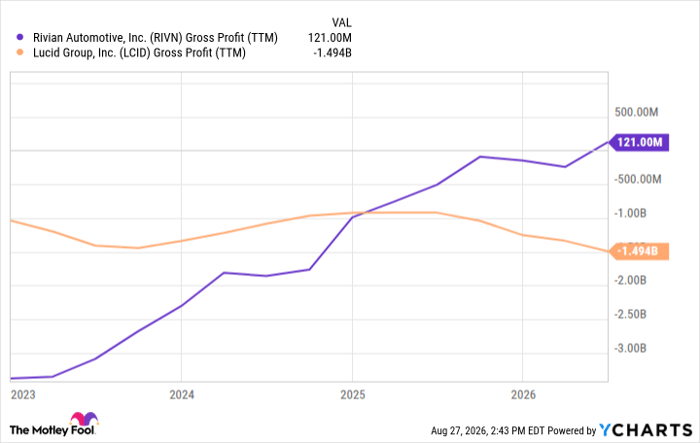
RIVN Gross Profit (TTM) data by YCharts.
As you can see, Rivian has consistently and methodically improved gross profitability since 2023, while Lucid has wavered at best and moved in the wrong direction for about a year and a half.
Driving forces
There are three primary reasons for this separation. First, Rivian simply has more scale, although both remain at low volumes compared to traditional automakers. Rivian delivered more than double the number of vehicles in 2025 with over 42,000 vehicles compared to Lucid's almost 16,000 vehicles.
The second reason for Rivian's better gross profitability is its extensive per-unit cost cuts. The automaker has done a fantastic job removing redundant parts and even large amounts of wiring, among other things, saving thousands of dollars per vehicle. Furthermore, the company has even renegotiated with suppliers to improve unit economics.

Rivian's R2. Image source: Rivian.
Lastly, and perhaps the most important reason, is that Rivian's advanced electronics and software stack were enough to convince Volkswagen to team up in a joint venture that pays Rivian handsomely and helps split development costs. Rivian's joint venture has significantly boosted its gross profits: Consider that Rivian's second-quarter automotive gross profit was a loss of $36 million, while its software and services segment checked in at $215 million. Furthermore, the software segment's gross margin was a strong 42%.
What it all means
The biggest step a young company can take is to prove to investors that its business model can work in the long term, which means showing consistent gross profitability. Rivian has consistently improved, and its upside is solely due to its software advantage. Investors also have to consider that Rivian has been far less dilutive to shareholders than Lucid has been, making it a much better investment as things currently stand.
Should you buy stock in Rivian Automotive right now?
Before you buy stock in Rivian Automotive, consider this:
The Motley Fool Stock Advisor analyst team just identified what they believe are the 10 best stocks for investors to buy now… and Rivian Automotive wasn’t one of them. The 10 stocks that made the cut could produce monster returns in the coming years.
Consider when Netflix made this list on December 17, 2004... if you invested $1,000 at the time of our recommendation, you’d have $435,803!* Or when Nvidia made this list on April 15, 2005... if you invested $1,000 at the time of our recommendation, you’d have $1,334,577!*
Now, it’s worth noting Stock Advisor’s total average return is 966% — a market-crushing outperformance compared to 211% for the S&P 500. Don't miss the latest top 10 list, available with Stock Advisor, and join an investing community built by individual investors for individual investors.
See the 10 stocks »
*Stock Advisor returns as of September 3, 2026.
Daniel Miller has no position in any of the stocks mentioned. The Motley Fool has positions in and recommends Tesla. The Motley Fool has a disclosure policy.
Recommended Articles


