


One Huge Fund Just Bought Taiwan Semiconductor Manufacturing and Dumped Micron Stock. Which Stock Is the Superior Choice?
Key Points
Taiwan Semiconductor is dominant in its industry.
The memory chip industry is commoditized.
- 10 stocks we like better than Taiwan Semiconductor Manufacturing ›
Following what hedge funds do is a great way to track the smart money and get a second opinion on what you should do in your own portfolio. Finding successful hedge fund managers that have a track record of long-term investing is smart, because investors only get updates on hedge fund holdings once every quarter, and the information is 45 days old at the time of release.
One interesting move that billionaire David Tepper and Appaloosa Management made during the second quarter was to sell Micron Technology (NASDAQ: MU) stock and buy shares of Taiwan Semiconductor Manufacturing (NYSE: TSM). Both stocks are significant positions in the fund, but was this the right move? Let's take a look.
Missed Nvidia in 2009? This Rare Signal Is Flashing Again. In 2009, a "Double Down" signal flashed for a little-known chipmaker called Nvidia. For the first time in years, that same "Total Conviction" signal is flashing for a company 1/100th the size of Nvidia. Continue »
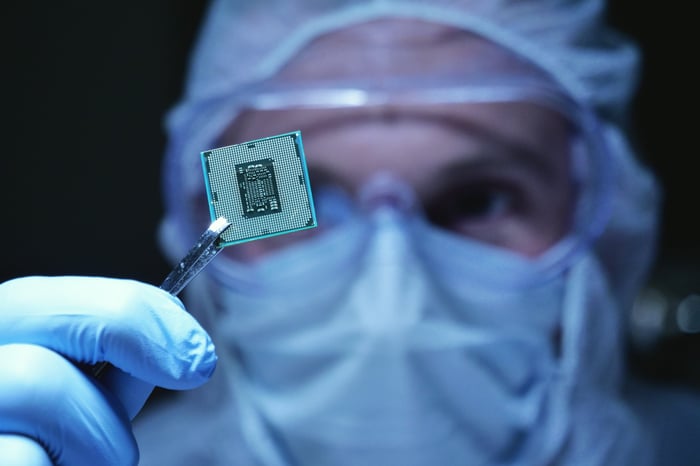
Image source: Getty Images.
Taiwan Semiconductor and Micron share some similarities
In Q2, Appaloosa sold more than 40% of its Micron stake, although it still makes up about 15% of its investment portfolio value. It also added nearly 25% to its stake in TSMC, making it the firm's third-largest position at nearly 11%. So, just because Appaloosa sold Micron shares during Q2 doesn't mean it has lost faith. In fact, it probably sold shares because Micron rose so much that it was becoming an unhealthy portion of its overall holdings.
That changes the nature of this analysis a bit, because Micron still makes up a larger share of Appaloosa's fund than Taiwan Semiconductor.
So, which of the two makes for a better buy?
On the surface, the two look like fairly similar businesses. Both companies fabricate chips, with Taiwan Semiconductor creating logic chips and Micron producing memory chips. Depending on the type of chip being manufactured, there are nuances in the process and design that dramatically distinguish one type from another.
Memory chips are fairly straightforward, and there isn't a whole lot that separates one memory chip manufacturer from another. That's why you can swap out memory sticks in a computer with relative ease, regardless of the manufacturer. The logic chip inside a computer is far more complex and cannot be swapped out because much of the software a computer runs is designed to match how the chip processes the workload.
This gives Taiwan Semiconductor a leg up on Micron, because it's not an easily replaced supplier. Meanwhile, if a computing company cannot get what it needs from Micron, it can probably get it from one of Micron's rivals.
However, there's also an odd dynamic in the memory chip industry right now. Demand has far exceeded supply, and prices are soaring as a result. This is making Micron and its peers a fortune, and making investors question which segment is a better one to invest in.
Although Taiwan Semiconductor's corner of the chip market has competitive advantages and isn't replaceable, Micron's product costs are soaring, allowing it to make a boatload of money.
So, which is the better buy?
The better buy depends on your time frame
If you're looking to maximize how much money you can make in an investment during the next year, then Micron may be the better pick. It will continue to thrive thanks to a memory supply shortage, but that could be relieved as soon as 2028. There's a lot of time between now and then to make a profit, but what comes in three to five years is a lot harder to project.
If you have a three- to five-year time frame, then I think Taiwan Semiconductor is the better pick, as it's slated to cash in on the vast AI build-out. It won't have nearly the growth highs that Micron has, but it won't experience the lows either when more when more memory chip production capacity comes online.
These two stocks are very different despite being in similar industries, but each has its merits, and both are worth investing in right now.
Should you buy stock in Taiwan Semiconductor Manufacturing right now?
Before you buy stock in Taiwan Semiconductor Manufacturing, consider this:
The Motley Fool Stock Advisor analyst team just identified what they believe are the 10 best stocks for investors to buy now… and Taiwan Semiconductor Manufacturing wasn’t one of them. The 10 stocks that made the cut could produce monster returns in the coming years.
Consider when Netflix made this list on December 17, 2004... if you invested $1,000 at the time of our recommendation, you’d have $435,803!* Or when Nvidia made this list on April 15, 2005... if you invested $1,000 at the time of our recommendation, you’d have $1,334,577!*
Now, it’s worth noting Stock Advisor’s total average return is 966% — a market-crushing outperformance compared to 211% for the S&P 500. Don't miss the latest top 10 list, available with Stock Advisor, and join an investing community built by individual investors for individual investors.
See the 10 stocks »
*Stock Advisor returns as of September 3, 2026.
Keithen Drury has positions in Taiwan Semiconductor Manufacturing. The Motley Fool has positions in and recommends Micron Technology and Taiwan Semiconductor Manufacturing. The Motley Fool has a disclosure policy.
Recommended Articles


