


The Odds of a September Rate Hike Have Nearly Doubled, Courtesy of Fed Chair Kevin Warsh -- Here's What He Just Said
Key Points
Although the Dow Jones Industrial Average, S&P 500, and Nasdaq Composite have zoomed to new highs since early June, these gains aren't reflective of America's inflationary headwinds.
Following Fed Chair Kevin Warsh's speech in Jackson Hole, Wyoming, the probability of a September interest rate hike surged to 60%.
Warsh's and the Federal Open Market Committee's patience with persistently elevated inflation may be wearing thin.
- 10 stocks we like better than S&P 500 Index ›
Since early June, the iconic Dow Jones Industrial Average (DJINDICES: ^DJI), benchmark S&P 500 (SNPINDEX: ^GSPC), and innovation-powered Nasdaq Composite (NASDAQINDEX: ^IXIC) have rallied to fresh all-time highs. But these gains aren't reflective of the inflationary headwinds that lie beneath the surface.
In May, the trailing 12-month U.S. inflation rate reached a three-year high of 4.2%, which is more than double the Federal Reserve's long-term target of 2%. In addition to expected inflationary factors, such as businesses possessing modest pricing power over their goods and services amid an expanding economy, several of President Donald Trump's policies have contributed to higher inflation, including tariffs and the Iran war.
Missed Nvidia in 2009? This Rare Signal Is Flashing Again. In 2009, a "Double Down" signal flashed for a little-known chipmaker called Nvidia. For the first time in years, that same "Total Conviction" signal is flashing for a company 1/100th the size of Nvidia. Continue »
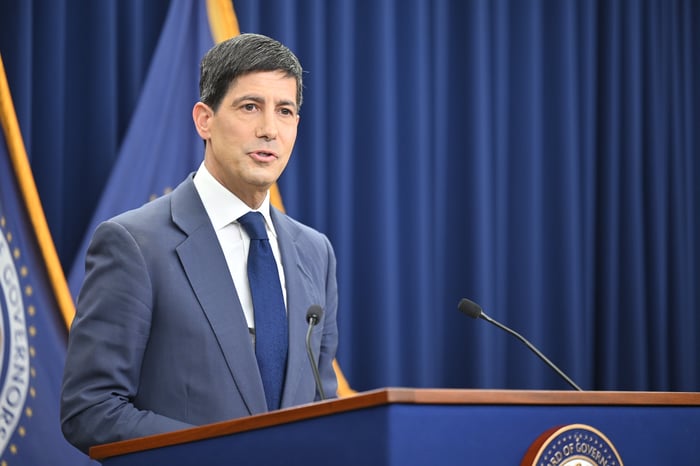
Fed Chair Kevin Warsh's Jackson Hole speech riled up Wall Street. Image source: Official Federal Reserve Photo.
Persistently elevated inflation has investors questioning whether Fed Chair Kevin Warsh and the Federal Open Market Committee (FOMC) will take action and adjust short-term lending rates to deliver price stability.
The probability of a September rate hike has surged to 60%
As of Aug. 27, the CME Group's FedWatch Tool, which uses 30-day Fed Funds futures prices to estimate the probability of federal funds target rate changes at upcoming FOMC meetings, assigned a 35% chance of a rate hike at the Sept. 15-16 meeting.
But following Warsh's comments at the annual economic symposium in Jackson Hole, Wyoming, on Aug. 28, the odds of a September rate hike have nearly doubled to 60%. Several of Warsh's to-the-point comments spooked Wall Street and appeared to clarify his and the FOMC's stance on inflation.
Fed Chair Kevin Warsh says the central bank may need to raise rates if underlying inflation does not return to its 2% target, as financial conditions remain insufficiently restrictive https://t.co/p3RmFyyO8g pic.twitter.com/oemokaCXav
-- Reuters Business (@ReutersBiz) August 28, 2026
For starters, Warsh effectively weighed the economic risks of both aspects of the dual mandate, maximum employment and price stability, and determined the latter to be of the utmost importance. While noting that neither the Personal Consumption Expenditures price index nor the Consumer Price Index were perfect, the new Fed chair stated:
Inflation is running above our two percent target. So the Fed's predominant focus right now should be on prices.
In discussing the Fed's key principles, Warsh proclaimed that "short-term interest rates are the predominant tool to achieve the dual mandate." While a surge in long-duration bond yields has worked in the central bank's favor -- higher yields at the long end of the yield curve can increase borrowing costs for businesses and essentially pump the brakes on inflation -- Warsh recognizes that the FOMC is ultimately responsible for price stability.
But perhaps the biggest reaction in Fed Funds futures activity, and the reason the odds of a September rate hike surged after the Fed chair's Jackson Hole speech, was his summation of the central bank's objectives. Warsh opined:
Here is my standard: We must be confident that underlying inflation is moving to our objective, clearly and at sufficient speed. Otherwise, we have work to do.
In particular, it's the addition of "at sufficient speed" that likely sent shockwaves through the stock market. Warsh noted that prevailing inflation has been above the Fed's long-term target of 2% for 65 months. His patience, and that of his FOMC colleagues, for persistently elevated inflation may be wearing thin.
If the FOMC does hike interest rates in September, it may mark the end of Wall Street's historic artificial intelligence (AI)-driven rally. The stock market is priced for perfection, and anything that could slow the AI infrastructure build-out, such as elevated borrowing costs, can halt Wall Street's bull market rally in its tracks.
Should you buy stock in S&P 500 Index right now?
Before you buy stock in S&P 500 Index, consider this:
The Motley Fool Stock Advisor analyst team just identified what they believe are the 10 best stocks for investors to buy now… and S&P 500 Index wasn’t one of them. The 10 stocks that made the cut could produce monster returns in the coming years.
Consider when Netflix made this list on December 17, 2004... if you invested $1,000 at the time of our recommendation, you’d have $440,710!* Or when Nvidia made this list on April 15, 2005... if you invested $1,000 at the time of our recommendation, you’d have $1,335,252!*
Now, it’s worth noting Stock Advisor’s total average return is 978% — a market-crushing outperformance compared to 213% for the S&P 500. Don't miss the latest top 10 list, available with Stock Advisor, and join an investing community built by individual investors for individual investors.
See the 10 stocks »
*Stock Advisor returns as of September 1, 2026.
Sean Williams has no position in any of the stocks mentioned. The Motley Fool has positions in and recommends CME Group. The Motley Fool has a disclosure policy.
Recommended Articles


