


Prediction: This Is Where Nvidia Stock Will Be When September Ends
Key Points
Nvidia delivered impressive growth last quarter, and its fiscal 2028 guidance is well above expectations.
Analysts now expect stronger growth from the company over the next three years.
Investors can consider buying Nvidia while it trades at attractive levels.
- 10 stocks we like better than Nvidia ›
Nvidia (NASDAQ: NVDA) stock has underperformed the broader semiconductor sector index so far in 2026, gaining just 16% as of this writing, compared to the 62% spike in the PHLX Semiconductor Sector index.
However, shares of the semiconductor bellwether received a nice shot in the arm following the release of its fiscal 2027 second-quarter results (for the quarter ended July 26) on Aug. 26. Nvidia stock jumped nearly 9% the following day, driven by its better-than-expected results and impressive guidance.
Missed Nvidia in 2009? This Rare Signal Is Flashing Again. In 2009, a "Double Down" signal flashed for a little-known chipmaker called Nvidia. For the first time in years, that same "Total Conviction" signal is flashing for a company 1/100th the size of Nvidia. Continue »
I won't be surprised to see Nvidia sustaining its post-earnings momentum in September and head higher. Let's see where this semiconductor stock could be by the end of next month.
Image source: The Motley Fool.
Nvidia's post-earnings pop is sustainable
Nvidia's fiscal Q2 revenue jumped 106% year over year to $96.2 billion. Meanwhile, its non-GAAP earnings increased by 120% to $2.22 per share. The numbers trounced analysts' expectations of $2.09 in earnings per share on revenue of $92.3 billion.
The good news for Nvidia investors is that the phenomenal growth rate is sustainable. The $108 billion revenue forecast for the current quarter points to a potential year-over-year increase of 89%. It is worth noting that Nvidia reported a 62% revenue jump in the third quarter of fiscal 2026. However, the biggest takeaway from Nvidia's latest quarterly report was that it expects its robust growth momentum to continue beyond the current quarter.
CFO Colette Kress noted on the latest earnings call:
We expect to grow revenue by approximately 70% in fiscal 2028. This is a supply constrained outlook.
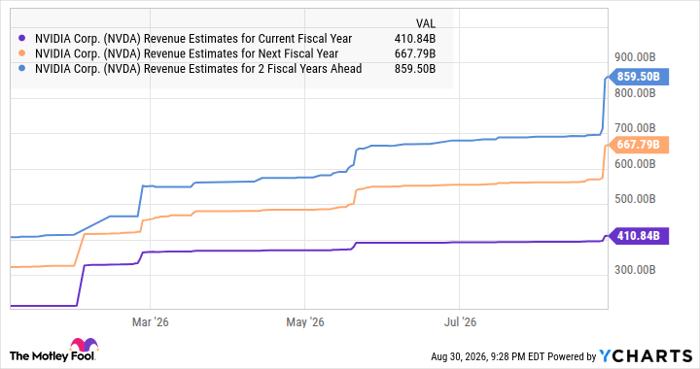
This forecast took the market by surprise. Analysts were expecting Nvidia's revenue to increase by 44% in fiscal 2028, following an 83% spike in fiscal 2027 to $397 billion. Not surprisingly, analysts have scrambled to increase their growth expectations following the latest results.
Data by YCharts
Even then, the fiscal 2028 revenue estimate shown above doesn't align with Nvidia's guidance. Analysts, therefore, are still underestimating Nvidia's growth potential, especially considering that its fiscal 2028 revenue forecast takes supply constraints into account. If Nvidia manages to build more capacity with its supply chain partners, I won't be surprised to see it clock stronger growth.
For example, Nvidia's foundry partner Taiwan Semiconductor Manufacturing has increased its 2026 capital expenditure guidance by $8 billion to $62 billion. That would be an increase of more than 50% from its 2025 capex of $40.9 billion. Additionally, TSMC has committed to spend another $100 billion to boost its manufacturing capacity in the U.S., on top of its earlier commitment of $165 billion.
The aggressive expansion by TSMC bodes well for Nvidia, putting the latter in a solid position to capitalize on the healthy artificial intelligence (AI) infrastructure spending environment. Nvidia notes that the cloud computing industry is sitting on a backlog of more than $2 trillion. As a result, the company believes that the capital expenditures of the top five hyperscalers in the U.S. could jump from $800 billion in 2026 to $1.3 trillion in 2027.
These positive developments should rub off positively on this AI stock in September, especially considering that it trades at a really attractive valuation.
Here's why the stock will keep soaring in September
Nvidia trades at 29 times earnings, a discount to the tech-focused Nasdaq-100 index's earnings multiple of 34. The stock's forward earnings multiple of 26 is slightly higher than the index's average multiple of 24. However, analysts are now anticipating a larger increase in Nvidia's earnings in fiscal 2027 to $9.29 per share. That's a potential increase of 95% over the prior year.
So, Nvidia should ideally be trading at a premium to the tech sector. Assuming it trades at 40 times earnings at the end of fiscal 2027 and its earnings per share reach $9.29, its share price could jump to $372 in six months. That's a potential 71% jump in a short time, which is why I think Nvidia stock will trade at a significantly higher level in September than it is right now.
Given that Nvidia trades at attractive multiples, investors should consider buying this AI pioneer before it surges higher in September.
Should you buy stock in Nvidia right now?
Before you buy stock in Nvidia, consider this:
The Motley Fool Stock Advisor analyst team just identified what they believe are the 10 best stocks for investors to buy now… and Nvidia wasn’t one of them. The 10 stocks that made the cut could produce monster returns in the coming years.
Consider when Netflix made this list on December 17, 2004... if you invested $1,000 at the time of our recommendation, you’d have $440,710!* Or when Nvidia made this list on April 15, 2005... if you invested $1,000 at the time of our recommendation, you’d have $1,335,252!*
Now, it’s worth noting Stock Advisor’s total average return is 978% — a market-crushing outperformance compared to 213% for the S&P 500. Don't miss the latest top 10 list, available with Stock Advisor, and join an investing community built by individual investors for individual investors.
See the 10 stocks »
*Stock Advisor returns as of August 31, 2026.
Harsh Chauhan has no position in any of the stocks mentioned. The Motley Fool has positions in and recommends Nvidia and Taiwan Semiconductor Manufacturing. The Motley Fool has a disclosure policy.
Recommended Articles


