


The Biggest Risk Facing Tesla Stock Right Now
Key Points
Tesla's major risk is heavy investment in robotaxis and Optimus with uncertain near-term returns.
Wall Street expects negative cash flow until 2029, then growth if new ventures succeed.
Tesla's strong balance sheet reduces funding risk, but delays could cause stock volatility.
- These 10 stocks could mint the next wave of millionaires ›
Tesla's (NASDAQ: TSLA) biggest near-term risk lies in the two things that CEO Elon Musk believes are its biggest value-creation drivers: Cybercab/robotaxis and Optimus robots. In both cases, the company is aggressively ramping up up-front spending to support its development.
That's fine in itself, but it does expose the company to the risk of bleeding cash if robotaxi and Optimus don't generate earnings and cash flow in line with management's plans.
Missed Nvidia in 2009? This Rare Signal Is Flashing Again. In 2009, a "Double Down" signal flashed for a little-known chipmaker called Nvidia. For the first time in years, that same "Total Conviction" signal is flashing for a company 1/100th the size of Nvidia. Continue »
Tesla's cash flow dynamics
Tesla's free cash flow (FCF) is becoming a stick the bears are using to beat the stock with. The company's capital spending is set to turn it from a cash-generative company to a net user of cash, as its earnings and operating cash flow (OCF) generation fail to offset the increase in spending. The dynamics of Wall Street analysts are shown in the chart, using data courtesy of Visible Alpha.
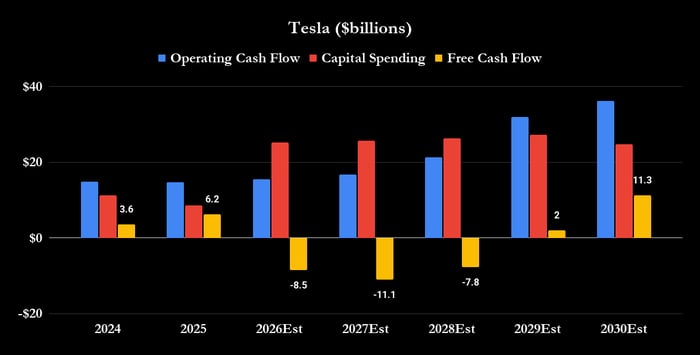
Data source: Visible Alpha. Chart by author.
Note how OCF growth, mainly from the electric vehicle (EV) business, isn't enough to fully offset the increase in capital spending, and Wall Street expects Tesla to have cash outflows from 2026 to 2028, only to return to FCF generation in 2029 as robotaxi and Optimus revenue starts to kick in, leading to the beginning of a multiyear growth in FCF as robotaxi/Optimus generate a long-term stream of recurring income.
Based on these Wall Street projections, investors shouldn't be perturbed. After all, there's a reason for the elevated levels of capital spending, and it comes down to investing in the growth of robotaxi and Optimus, as well as substantive actions to secure and de-risk its EV and energy supply chain, such as investments in a lithium refinery, AI compute, and lithium iron phosphate (LFP) battery production.
The ultimate aim is to support long-term growth that would otherwise be threatened if these investments aren't made.
The risk facing Tesla
However, if there's a delay in the growth of robotaxi/Optimus revenue, there will be negative consequences for Tesla's cash flow, not least because it won't be able to significantly moderate capital spending on essential growth investments. This would put more pressure on the EV business to generate the earnings and cash flow necessary to support it, even as Tesla's focus shifts toward investment in Cybercab/robotaxi and Optimus.
Moreover, if there are significant delays in Cybercabs/robotaxis, there's likely to be a highly visible abundance of inactive Cybercabs, which represent cash usage and a drain on liquidity.
What will it mean for the investment case?
Any delay to Wall Street expectations would likely pressure the stock, as investors potentially focus more on weaker FCF generation due to lower-than-expected revenue and rising capital spending.
Image source: Tesla.
That said, Tesla can still generate billions in cash from its EV and energy business, and it holds a fortress-like balance sheet. According to S&P Global Market Intelligence estimates, Tesla will end 2026 with $23 billion in net cash, so there's little risk it won't be able to fund its growth aspirations. Moreover, there's plenty of evidence that Tesla is making excellent progress on its robotaxi rollout in terms of safety.
Tesla has real potential to achieve its long-term aims. Still, investors need to take a long-term view of the stock and be prepared for any near-term volatility if Cybercab/robotaxi, in particular, is delayed. Overall, the stock remains attractive, but patience is required.
Don’t miss this second chance at a potentially lucrative opportunity
Ever feel like you missed the boat in buying the most successful stocks? Then you’ll want to hear this.
On rare occasions, our expert team of analysts issues a “Double Down” stock recommendation for companies that they think are about to pop. If you’re worried you’ve already missed your chance to invest, now is the best time to buy before it’s too late. And the numbers speak for themselves:
- Nvidia: if you invested $1,000 when we doubled down in 2009, you’d have $564,953!*
- Apple: if you invested $1,000 when we doubled down in 2008, you’d have $60,985!*
- Netflix: if you invested $1,000 when we doubled down in 2004, you’d have $440,710!*
Right now, we’re issuing “Double Down” alerts for three incredible companies, available when you join Stock Advisor, and there may not be another chance like this anytime soon.
See the 3 stocks »
*Stock Advisor returns as of August 30, 2026.
Lee Samaha has no position in any of the stocks mentioned. The Motley Fool has positions in and recommends S&P Global and Tesla. The Motley Fool has a disclosure policy.
Recommended Articles


