


Should You Invest in Nvidia After Its Blowout Second-Quarter Results? Here's the Good News and the Bad News.
Key Points
Nvidia supplies the world's best data center chips and components for processing AI workloads.
The company's revenue doubled in Q2, and yet its stock continues to trade at a very attractive valuation.
However, a series of circular financing deals could expose the company to volatile financial results in the future, especially if the AI boom hits a speed bump.
- 10 stocks we like better than Nvidia ›
After the close of trading on Aug. 26, Nvidia (NASDAQ: NVDA) reported a set of operating results for its fiscal 2027 second quarter (ended July 26, 2026) that blew away Wall Street's expectations, and the company also unexpectedly offered some very bullish forward revenue guidance for fiscal 2028. As a result, Nvidia's stock price soared by almost 9% the very next day.
There is a long list of reasons why Nvidia stock is still a buy, but there is also room for caution right now, particularly surrounding the deals that management is cutting with many of the company's biggest artificial intelligence (AI) customers. So, before investors buy the stock, here's a breakdown of the good news and the bad news.
Missed Nvidia in 2009? This Rare Signal Is Flashing Again. In 2009, a "Double Down" signal flashed for a little-known chipmaker called Nvidia. For the first time in years, that same "Total Conviction" signal is flashing for a company 1/100th the size of Nvidia. Continue »

Image source: Nvidia.
The good news: Rapid growth and an attractive valuation
Nvidia supplies the world's best graphics processing units (GPUs) for data centers, which are the main chips used in AI training and inference workloads. The company's new Vera Rubin systems, which include Rubin GPUs, Vera central processors (CPUs), and a series of advanced networking components, provide up to 30 times more performance per megawatt than its previous Blackwell Ultra systems, highlighting the sheer pace of innovation.
Nvidia says Vera Rubin systems will also reduce inference token costs by a staggering 97% compared to Blackwell Ultra. Inference tokens are the text, images, or computer code generated by an AI model in response to a query, so these new chips will dramatically reduce the cost of deploying AI software. This might encourage more AI usage while making data center operators more profitable, which will only increase demand for Nvidia's chips.
Wall Street expected Nvidia to generate $92.2 billion in revenue during its fiscal 2027 second quarter, but the company blew that away by bringing in $96.2 billion, a whopping 106% increase from the year-ago period. The data center segment accounted for $89 billion of that total, and it grew at an even faster rate of 117%.
The global shortage of AI chips and components is giving Nvidia an unprecedented ability to dictate prices, which is also a massive tailwind for its bottom line. As a result, its adjusted (non-GAAP) earnings surged by 120% to $2.22 per share during the second quarter.
That brings me to Nvidia's valuation; the company has now delivered adjusted trailing 12-month earnings of $7.01 per share, placing its stock at a price-to-earnings (P/E) ratio of just 34.9. That is a steep discount to its 10-year average of 61.5, suggesting it might be undervalued right now.
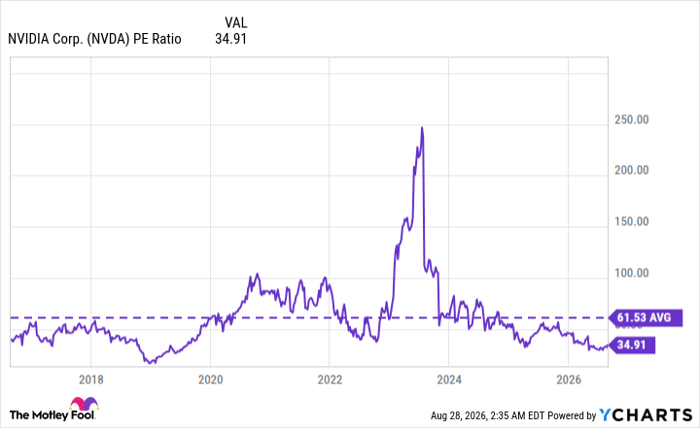
Data by YCharts.
Moreover, Nvidia just told investors to expect revenue growth of at least 70% in fiscal 2028. The company never issues guidance a year in advance, so this caught Wall Street's attention in the best possible way.
The bad news: Concerning circular financing deals
The numbers can vary based on location, but building a one-gigawatt data center can cost around $38 billion, with the bulk of that money going toward GPUs and components. Nvidia says the top five hyperscalers, which include the likes of Microsoft and Amazon, will spend a combined $800 billion on AI infrastructure this year, and then a further $1.3 trillion next year. But smaller AI labs are struggling to compete because they simply don't have the same financial resources.
As a result, Nvidia is helping them achieve their goals by investing directly into their companies, and also by partially financing their purchases of GPUs and other hardware. These deals are often called "circular" because Nvidia is basically funding the sale of its own products.
According to the latest guidance from chief financial officer Colette Kress, around 25% of Nvidia's sales in fiscal 2028 will come from customers it has financed in some way. Since the company's revenue could top $670 billion next year, around $168 billion could be funded by its own balance sheet. To put it another way, a huge chunk of Nvidia's forecasted growth is expected to come from customers who don't necessarily have the money to pay for its products up front.
Nvidia has invested in practically every major AI lab, including OpenAI, Anthropic, xAI, Mistral AI, and Perplexity. But these early-stage companies continue to lose truckloads of money while they race to build the best models and attract the most customers, so although Nvidia says its circular financing agreements present a low risk, I think its high degree of ongoing exposure could get really uncomfortable if the AI boom hits a speed bump. That will be especially true if similar deals account for even more of its sales beyond fiscal 2028.
The verdict
Based on its attractive valuation and the company's rapid growth, Nvidia stock could be a great addition to a diversified portfolio, particularly one that already has a low level of exposure to AI stocks.
Nvidia is likely to remain the undisputed leader in AI hardware for years to come, but it's important for investors to pay close attention to further developments in circular financing. If these deals become a much bigger part of the company's revenue in the future, it might be a good idea for investors to trim their position to reduce risk.
Should you buy stock in Nvidia right now?
Before you buy stock in Nvidia, consider this:
The Motley Fool Stock Advisor analyst team just identified what they believe are the 10 best stocks for investors to buy now… and Nvidia wasn’t one of them. The 10 stocks that made the cut could produce monster returns in the coming years.
Consider when Netflix made this list on December 17, 2004... if you invested $1,000 at the time of our recommendation, you’d have $440,710!* Or when Nvidia made this list on April 15, 2005... if you invested $1,000 at the time of our recommendation, you’d have $1,335,252!*
Now, it’s worth noting Stock Advisor’s total average return is 978% — a market-crushing outperformance compared to 213% for the S&P 500. Don't miss the latest top 10 list, available with Stock Advisor, and join an investing community built by individual investors for individual investors.
See the 10 stocks »
*Stock Advisor returns as of August 30, 2026.
Anthony Di Pizio has no position in any of the stocks mentioned. The Motley Fool has positions in and recommends Amazon, Microsoft, and Nvidia. The Motley Fool has a disclosure policy.
Recommended Articles


