


US Stocks Fall as Philadelphia Semiconductor Index Drops Over 3%; Cloud Service Providers Buck Trend, Optical Communication Stocks Lead Losses; Marvell Falls 10% Post-Earnings, Nvidia Drops 4%
TradingKey - US stocks fell after Federal Reserve Chair Kevin Warsh expressed concern earlier today over current inflation trends. Cloud service providers (CSPs) bucked the trend to gain, while the optical communications sector led the declines.
At the close, the Dow Jones Industrial Average fell 0.02% to 53,559.99; the Nasdaq Composite Index dropped 0.52% to 26,402.42; and the S&P 500 Index slipped 0.25% to 7,711.76.
Tech Stock Performance
Marvell Technology (MRVL) fell 10.28% post-earnings, closing at $216.62.
Marvell Technology reported second-quarter revenue of $2.5 billion, in line with market expectations. The company issued third-quarter guidance of $3.15 billion in revenue, plus or minus 5%, and adjusted earnings per share of $1.10, plus or minus $0.05, compared with analysts' previous estimates of $3.04 billion in revenue and adjusted EPS of $1.08. Morgan Stanley noted that the Google-related revenue contribution 'was already largely reflected in prior guidance,' so mechanically, while Marvell Technology's guidance was raised, it remains 'broadly consistent' with the long-term growth trajectory previously outlined by management.
Among mega-cap tech stocks, Amazon (AMZN) rose 3.97%, Google (GOOGL) gained 1.74%, Microsoft (MSFT) advanced 1.68%, Apple (AAPL) rose 1.63%, Meta Platforms (META) gained 1.21%, and SpaceX (SPCX) rose 0.45%; on the downside, Nvidia (NVDA) fell 4.57%, Tesla (TSLA) dropped 1.71%, and Broadcom (AVGO) declined 0.74%.
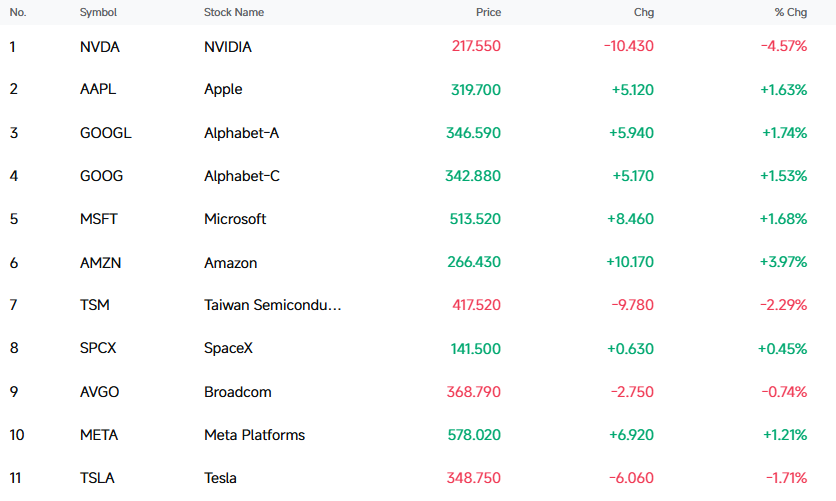
[Source: FutuBull]
The Philadelphia Semiconductor Index fell 3.47% to close at 11,469.66 points, with all 30 constituents declining.
Among optical communications stocks, Marvell Technology (MRVL) fell 10.28%, Lumentum (LITE) dropped 6.39%, Applied Optoelectronics (AAOI) fell 6.22%, Coherent (COHR) dropped 5.56%, and Ciena (CIEN) declined 5.35%.
Company News
Apple Raises Subscription Prices for Apple TV and Apple One
Apple recently raised the prices of its Apple TV streaming service and Apple One subscription bundles in the U.S. market. Among them, the monthly fee for Apple TV increased from $12.99 to $14.99, while the annual fee rose from $99 to $119. The Apple One individual plan, which includes services such as Apple TV, iCloud, and Apple Music, also saw its monthly fee increase from $19.95 to $21.95. Looking back, Apple TV cost just $4.99 per month when it launched in 2019, and with this price hike, its pricing is gradually approaching the levels of its major competitors. This marks Apple's second price adjustment for its subscription services in recent months. In July this year, Apple raised the monthly fee for Apple Music by $1, citing increased licensing costs.
Chevron and Other U.S. Energy Companies Plan Billions in Investments in Venezuelan Oil Fields
Chevron and other U.S. energy companies are close to reaching an agreement to invest billions of dollars in Venezuelan oil fields. This could deliver a win for President Trump after months of slow-moving negotiations. People familiar with the matter revealed that Chevron is close to an agreement to expand its long-standing operations in the Latin American country, with the potential to add two more heavy oil fields in Venezuela to its portfolio. Currently, Chevron operates three joint ventures with Venezuela's state oil company, PdVSA, and is currently the only major U.S. company operating in Venezuela.
SoftBank Seeks $10 Billion Loan to Refinance OpenAI Investment
SoftBank Group is seeking a $10 billion loan to secure additional funds and refinance debt used for its investment in U.S. tech giant OpenAI, according to media reports. The margin on the two-year loan will be about 275 basis points above the benchmark Secured Overnight Financing Rate (SOFR), with Mizuho Bank serving as the mandated lead arranger and bookrunner. The loan will be part of a series of debt financing activities by SoftBank recently related to its bet on OpenAI. People familiar with the matter said part of the proceeds from this loan may be used to repay a $40 billion bridge loan SoftBank obtained earlier this year to invest in OpenAI. The deadline for loan commitments is August 31, and several banks have already held discussions regarding participation. SoftBank is also considering raising additional funds through the bond market, contemplating the issuance of $10 billion to $20 billion in bonds to help refinance the bridge loan, while planning to issue a record 1 trillion yen in retail bonds in the Japanese domestic market.
Industry & Macro News
Fed Chair Warsh: Inflation Has Not Really Come Down
Federal Reserve Chair Kevin Warsh delivered a speech on Friday at the Jackson Hole symposium. He acknowledged that U.S. inflation remains elevated and hinted that interest rates may need to be raised further if no more progress is made on price pressures, but he offered no direct policy signal for the September meeting. Warsh stated that although summer inflation data was better than expected, "that does not tell me that the underlying trend has meaningfully improved." The Fed must confirm that underlying inflation is returning to the 2% target quickly enough; otherwise, "we still have work to do."
Trump Signs Executive Order to Create U.S. Space Academy
Trump signed an executive order initiating the process to create a "U.S. Space Academy," saying the academy will serve the U.S. Space Force, NASA, and the civilian space industry, while taking military academies such as West Point and the U.S. Naval Academy as benchmarks to "attract, educate, and graduate America's best and brightest." Trump stated that the location of the academy will be announced later, hinting that Texas Senator Ted Cruz has been lobbying to bring it to Texas. Trump also emphasized his space strategy, including the creation of the Space Force during his first term and a Mars mission planned for 2028, which will deploy a nuclear-powered starship.
Bessent Says Disorderly Yen Volatility Would Drive Up U.S. Interest Rates
U.S. Treasury Secretary Scott Bessent sent a letter to Democratic Senator Elizabeth Warren on August 27, defending his use of the Exchange Stabilization Fund (ESF) last month to intervene in the yen exchange rate. Bessent stated that disorderly volatility in the yen market could trigger forced liquidations by Japan, a major holder of U.S. Treasuries, thereby disrupting global market stability and ultimately pushing up borrowing costs for U.S. households and businesses. He declined to disclose the size of the funds deployed in the intervention, confirming only that existing foreign currency assets of the ESF were used to buy yen, while hinting at having used euros.
Recommended Articles


