


This Was Situational Awareness's Top 5 Holdings at the End of Q2. They're All on Sale Now
Key Points
Leopold Aschenbrenner's Situational Awareness was a top-performing hedge fund until it blew up in late July.
Recent 13-F filings show which AI stocks the fund held before it collapsed.
The top five holdings offer a good balance of exposure to different components of the AI sector.
- 10 stocks we like better than Micron Technology ›
The tale of Icarus, the boy who flew too close to the sun, is as old as time, and the stock market has a way of serving up a reminder of that fable every now and then.
The latest version of the story belongs to Leopold Aschenbrenner and his hedge fund Situational Awareness. Aschenbrenner, regarded as a 24-year-old wunderkind and the "Nostradamus of AI," had delivered eye-popping returns for investors, but his fund blew up at the end of July as his highly leveraged bets on AI stocks led to margin calls when the sector tumbled. Aschenbrenner ended up selling more than $10 billion of his AI portfolio to Ken Griffin's Citadel.
Missed Nvidia in 2009? This Rare Signal Is Flashing Again. In 2009, a "Double Down" signal flashed for a little-known chipmaker called Nvidia. For the first time in years, that same "Total Conviction" signal is flashing for a company 1/100th the size of Nvidia. Continue »
The lesson in Aschenbrenner's folly isn't that AI stocks should be avoided, but that leverage can be toxic, especially when investing in volatile stocks that can shift rapidly.
At the end of the second quarter, Aschenbrenner's top five holdings were made up of the following:
- Sandisk (NASDAQ: SNDK): (2.5 million shares)
- Micron (NASDAQ: MU): (4.8 million shares)
- Bloom Energy (NYSE: BE): (6.2 million shares)
- Taiwan Semiconductor Manufacturing (NYSE: TSM): (2.6 million shares)
- Nebius (NASDAQ: NBIS): (4.5 million shares)
Situational Awareness sold most of those holdings, but those stocks still offer a good glimpse at a high-growth AI portfolio, and they are still all down double-digits from the end of the second quarter, as the chart below shows.
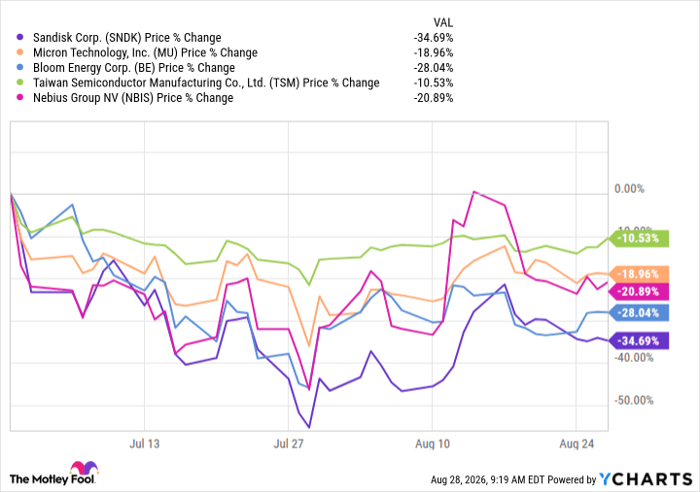
SNDK data by YCharts
Following Nvidia's blockbuster earnings report on Wednesday, are any of these buys? Let's take a closer look.
Sandisk and Micron: The memory chipmakers
Sandisk and Micron have been two of the biggest winners in the AI boom, and a big reason for Aschenbrenner's blockbuster returns before the blowup.
Sandisk is up more than 2,700% over the last year, while Micron has gained more than 600%. Both stocks look cheap on a forward basis as memory chip prices continue to spike, and valuations are low because of the historical cyclicality in the memory sector.
Of the two of them, Micron looks better-suited for the long term, thanks to its strength in high-bandwidth memory (HBM) used for AI applications, while Sandisk is known for flash memory, which is more of a commodity than HBM. Given the signs pointing to continued tightness in memory, both stocks could move higher in the near term.

Image source: Getty Images.
Bloom Energy: The AI energy play
Bloom Energy has emerged as one of the winners in the evolving AI energy sector, as the huge demand for energy from AI data centers will require more efficient sources of energy like small modular nuclear reactors (SMR) and hydrogen fuel-cell technology like Bloom.
Unlike SMR stocks like NuScale Energy and Oklo, Bloom is seeing real growth, and in June, it announced a $25 billion strategic partnership with Brookfield Asset Management, one of the world's biggest real estate developers. In its most recent quarter, revenue jumped 166% to $1.07 billion, and it is profitable with a generally accepted accounting principles (GAAP) operating income of $182.2 million.
Bloom is an expensive stock, but it gives investors unique exposure to an AI energy supplier.
Taiwan Semiconductor: The stalwart
Taiwan Semiconductor Manufacturing Corporation (NYSE: TSM) may be the most resilient AI stock on the market. It's the world's biggest manufacturer of semiconductors and has dominant market share among contract chip manufacturers.
The stock combines strong growth with a reasonable valuation, and while it's exposed to the cyclicality of the chip sector and AI demand, its competitive advantage in scale and technology seems unassailable.
For AI investors looking to add some ballast to their portfolio, TSMC looks like a great choice.
Nebius and CoreWeave: The neoclouds
Neocloud companies Nebius and CoreWeave (NASDAQ: CRWV), Situational Awareness's sixth biggest holding at the end of Q2, round out the top holdings in the fund's AI portfolio.
These stocks represent the riskiest options in the group. They are both growing rapidly, with triple-digit revenue growth, a sign of the insatiable demand for AI compute, but they are also putting up massive losses as they need to spend aggressively to fund new data centers. Both companies have also taken on billions in debt.
While both stocks, especially Nebius, have performed well since their debut, they have the most to lose if the AI trade goes south.
A worthy portfolio
Together, Situational Awareness's top five stocks give investors a reasonably balanced portfolio with exposure to memory, the biggest bottleneck in the AI trade, a booming energy supplier, the security of TSMC, and the explosive potential of the neoclouds.
Situational Awareness the hedge fund might have collapsed, but the portfolio can still beat the market.
Should you buy stock in Micron Technology right now?
Before you buy stock in Micron Technology, consider this:
The Motley Fool Stock Advisor analyst team just identified what they believe are the 10 best stocks for investors to buy now… and Micron Technology wasn’t one of them. The 10 stocks that made the cut could produce monster returns in the coming years.
Consider when Netflix made this list on December 17, 2004... if you invested $1,000 at the time of our recommendation, you’d have $430,571!* Or when Nvidia made this list on April 15, 2005... if you invested $1,000 at the time of our recommendation, you’d have $1,399,268!*
Now, it’s worth noting Stock Advisor’s total average return is 986% — a market-crushing outperformance compared to 214% for the S&P 500. Don't miss the latest top 10 list, available with Stock Advisor, and join an investing community built by individual investors for individual investors.
See the 10 stocks »
*Stock Advisor returns as of August 28, 2026.
Jeremy Bowman has positions in CoreWeave, Micron Technology, Nvidia, and Taiwan Semiconductor Manufacturing. The Motley Fool has positions in and recommends Bloom Energy, Brookfield Asset Management, Micron Technology, Nvidia, and Taiwan Semiconductor Manufacturing. The Motley Fool recommends NuScale Power. The Motley Fool has a disclosure policy.
Recommended Articles


