


SK Hynix Rises 4.5%, Outperforms KOSPI on Plan to Build Memory Chip Plant in Japan
TradingKey - According to South Korea's Hankyoreh on August 21, SK Hynix (SKHY) is evaluating plans to invest in building a memory chip manufacturing plant in Japan, with Miyagi Prefecture in northeastern Japan as a candidate site.
Driven by the news, SK Hynix shares rose over 4.5% during intraday trading on Friday to 1,768,000 won, significantly outperforming the South Korean Composite Stock Price Index (KOSPI), which edged up 0.9% over the same period.
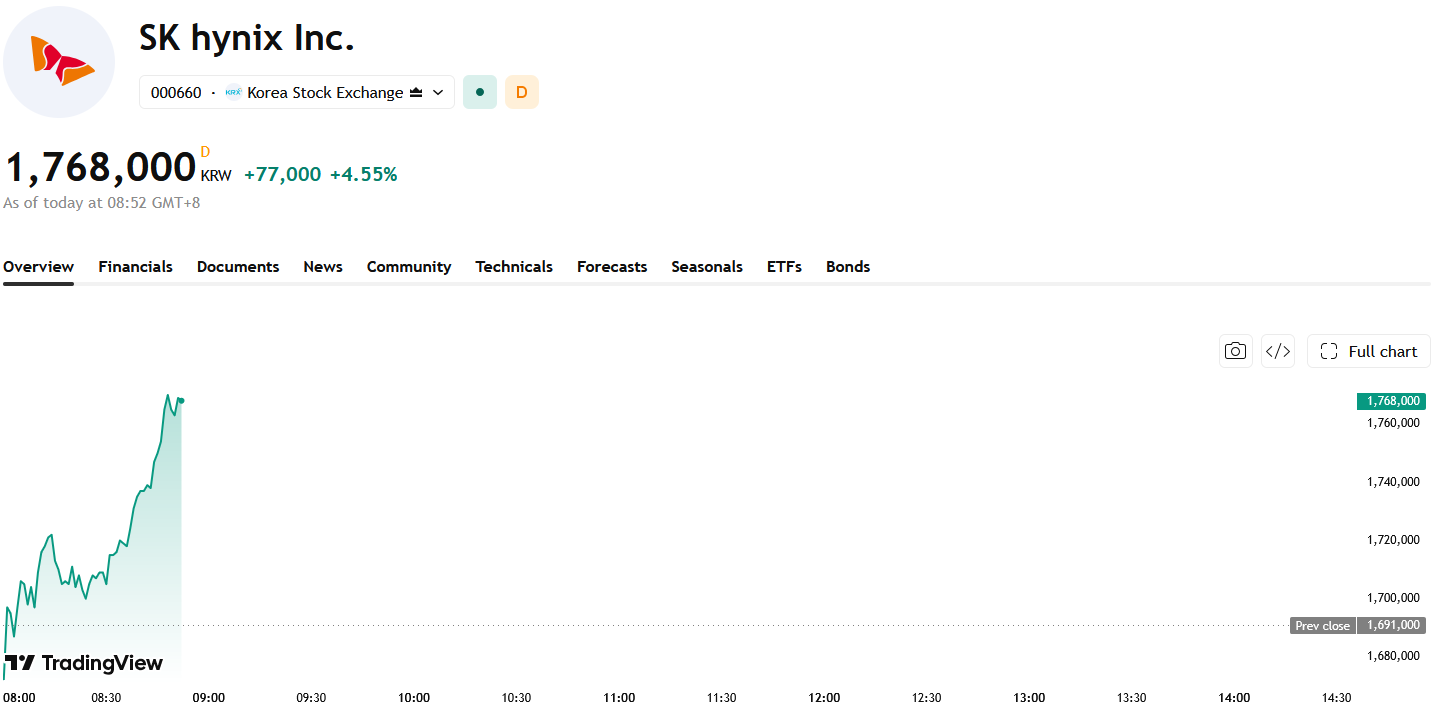
Source: TradingView
According to the report, Chey Tae-won, Chairman of SK Group, recently visited Miyagi Prefecture in person for an inspection. Along with Kyushu and Hokkaido, Miyagi is currently designated by the Japanese government as a key region for promoting semiconductor industry development.
In response, SK Hynix stated that any site capable of meeting the infrastructure requirements for production could be a potential candidate, though the company has not yet made a final decision.
From an industrial layout perspective, the Japan project appears more like a supplement to SK Hynix's global capacity expansion strategy. In recent years, the company has continuously increased its investment in South Korea's domestic semiconductor industry, with clusters in Yongin and Honam involving large-scale investments.
Considering a new production base in Japan serves to further diversify its capacity layout overseas. As the AI industry expands rapidly and demand for High Bandwidth Memory (HBM) and other memory products continues to rise, supply and demand in the global memory chip market have tightened, making securing additional capacity in advance a crucial competitive strategy for manufacturers.
If the Miyagi project is ultimately approved and built, SK Hynix will become another overseas enterprise with semiconductor manufacturing facilities in Japan, following Micron Technology (MU) and TSMC (TSM). In contrast, Samsung Electronics' current facility in Yokohama, Japan, is primarily a next-generation semiconductor packaging R&D center rather than a wafer fabrication base.
However, SK Hynix's choices for overseas capacity expansion face a more complex external environment. The U.S. has been pushing South Korean semiconductor companies to expand their investments and production capacity in the United States in recent years. If the Japan project progresses alongside its U.S. expansion plans, the company will need to rebalance capital expenditures, supply chain security, and market demand across different regions in the future.
In addition, given the strong strategic nature of the semiconductor industry, large-scale investment by SK Hynix in Japan could spark domestic debates in South Korea regarding industrial hollowing out, employment, and national industrial competitiveness.
At present, the report has not disclosed the specific investment amount, construction timeline, or expected production start date for the project, nor has it confirmed that SK Hynix's board of directors has officially approved the plan.
Recommended Articles


