


Eli Lilly Revenue Jumps 48% as Mounjaro and Zepbound Sales Reach $14.9B
TradingKey - Eli Lilly (LLY) reported their Q2 2026 results on August 5. Lilly’s focus on diabetes and obesity therapy has proven successful with 48% year over year revenue growth. Revenue reached $22.97 billion with Mounjaro and Zepbound driving strong results.
EPS was $7.94 and Non-GAAP EPS was $8.38, which increased by 26% and 33%, respectively. Both figures included $3.03 per share of acquired in-process research and development charges, primarily related to Lilly’s recent business-development transactions.
Lilly also raised their 2026 revenue guidance to the range of $85-$87 billion with a margin performance goal of 49%-50.5%. Lilly has expanded its weight-management portfolio with the recently launched Foundayo, while positive Phase 3 results have moved investigational retatrutide closer to regulatory submission.
Volume Drove the Revenue Increase
Lilly’s revenue for Q2 2026 increased from $15.56 billion to $22.97 billion and sales volume increased 60% with a 13% decrease in average selling price.
Revenue for the United States increased by 33% and reached $14.4 billion. Revenue outside the U.S. increased 80% to $8.6 billion, driven by a 113% increase in volume and partially offset by a 36% decline in realized prices. Lilly said the pricing decline was primarily attributable to Mounjaro’s addition to China’s National Reimbursement Drug List.
Reported gross margin grew to $19.7 billion, or 85.8% of revenue, compared to 84.3% for the same period one year prior. This was attributed to favorable production costs and a more favorable product mix, which was offset by lower average selling prices.
Research and Development costs increased to $3.8 billion while Marketing, Selling and Administrative costs increased to $3.4 billion.
Mounjaro and Zepbound Generated $14.87 Billion
Lilly’s Mounjaro was the top seller of the quarter at $9.94 billion (91% YoY increase) giving it the title of Lilly’s largest product. In the US, sales grew 45% to $4.8 billion. International sales grew 172% to $5.2 billion with the new patient access, yet pricing decreased with changes in reimbursement in China.
Zepbound sales increased 46% worldwide to $4.93 billion with US sales increasing 44% with more prescriptions. However, losses with cash paying customers and lower price realization offset the increase. The combined sales for Mounjaro and Zepbound represented 65% of Lilly’s total quarterly sales and reached $14.87 billion.
While this provides significant growth, it shows Lilly’s level of concern for competitive players and pricing strategy, as well as the performance of manufacturing of each of the drugs in the family.
Foundayo Adds an Oral Weight-Loss Option
Though only reported for a quarter following the US launch in April, Foundayo has brought in $98 million as its branded name for orforglipron. Foundayo is a once daily oral GLP-1 treatment for patients with obesity or overweight with comorbidities for which other weight loss treatments are mainly taken with food and water restriction.
With Foundayo, Lilly offers its first oral over injectable weight loss treatment, with the drug awaiting approval for use in type 2 diabetes. In international markets, Lilly seeks approval for orforglipron for use in T2D as well. Despite early stage sales of Foundayo, it offers the possibility to extend the treatment population with improvement in reimbursement and physician prescribing.
Retatrutide Moves Toward Regulatory Submission
Retatrutide is an investigational drug that is a glucose dependent insulinotropic polypeptide (GIP), glucagon-like peptide-1 (GLP-1) and glucagon receptor agonist. Participants in the Phase 3 TRIUMPH-2 study lost an average of 12.7%, 19.1% and 20.8% of their body weight, depending on the dose.
Similarly, participants of Phase 3 TRIUMPH-3 study lost an average of 21.6% and 22.6% of their body weight, depending on the dose. Lilly has the clinical data necessary to submit global regulatory applications for obesity, obstructive sleep apnea and knee osteoarthritis pain. Lilly intends to submit a Biologics License Application to the US Food and Drug Administration during the first quarter of 2027.
Retatrutide may compete for patients with Zepbound, but may also provide another treatment option for Lilly to expand into severe obesity and its associated comorbidities. Lilly filed six lawsuits against companies selling retatrutide on August 12, prior to regulatory approval. The purpose is to protect patients and preserve Lilly's rights and interests for its innovation before potentially commercializing the product.
Guidance Increased After Q2
Lilly increased its expected full year 2026 revenue from 82 to 85 billion or 85 to 87 billion. Its non-GAAP performance-margin outlook of 47% to 48.5% meant a change to 49% to 50.5%. Performance margin is defined by Lilly as gross margin less research and development and marketing, selling and administrative costs, and is divided by revenue.
It should not be stated as GAAP operating margin. Non-GAAP EPS was updated to 35.50 to 36.50. Stronger underlying business performance increased the midpoint of full-year EPS guidance by $2.78, but this was more than offset by a $3.03-per-share impact from acquired IPR&D charges.
Manufacturing and Acquisitions Require Capital
As the demand for Mounjaro, Zepbound and Foundayo continues to increase, so does the demand for Lilly’s production to keep up their pipeline and new products. Lilly made a commitment to spend another $4.5 billion to expand manufacturing at their locations in Indiana. Since 2020, they have spent over $55 billion to fulfill their new manufacturing commitments in the US.
Lilly and Resilience also made an announcement for a joint $750 million investment to support the expansion of the Cincinnati region to support the production of the KwikPen devices and other medicines.
Lilly’s new business development for Q2 also included the purchases of Orna Therapeutics, Ajax Therapeutics,Centessa Pharmaceuticals,Kelonia Therapeutics and the completion of agreements to purchase AtaiBeckley and another company to create an infectious-disease portfolio.
With all the purchases, Lilly’s cash generation capacity is being used to offer their services beyond just treating obesity. The acquisitions completed during the quarter will require a significant amount of integration and will create a high level of risk due to the costs of the development.
The acquisitions done by Lilly during the second quarter provided new avenues and new risks of integration due to the high level of costs related to development. During the second quarter, there were $2.8 billion of charged IPR&D and $703 million of special charges related to impairment and restructuring.
Eli Lilly Technical Analysis: LLY Consolidates Near Its Record High
LLY reached its all time high of $1,292.65 on August 19th, and consolidated in the 1268–1280 range thereafter. The stock is currently trading above the previous resistance level of $1,238.83, which has been broken in the consolidation.
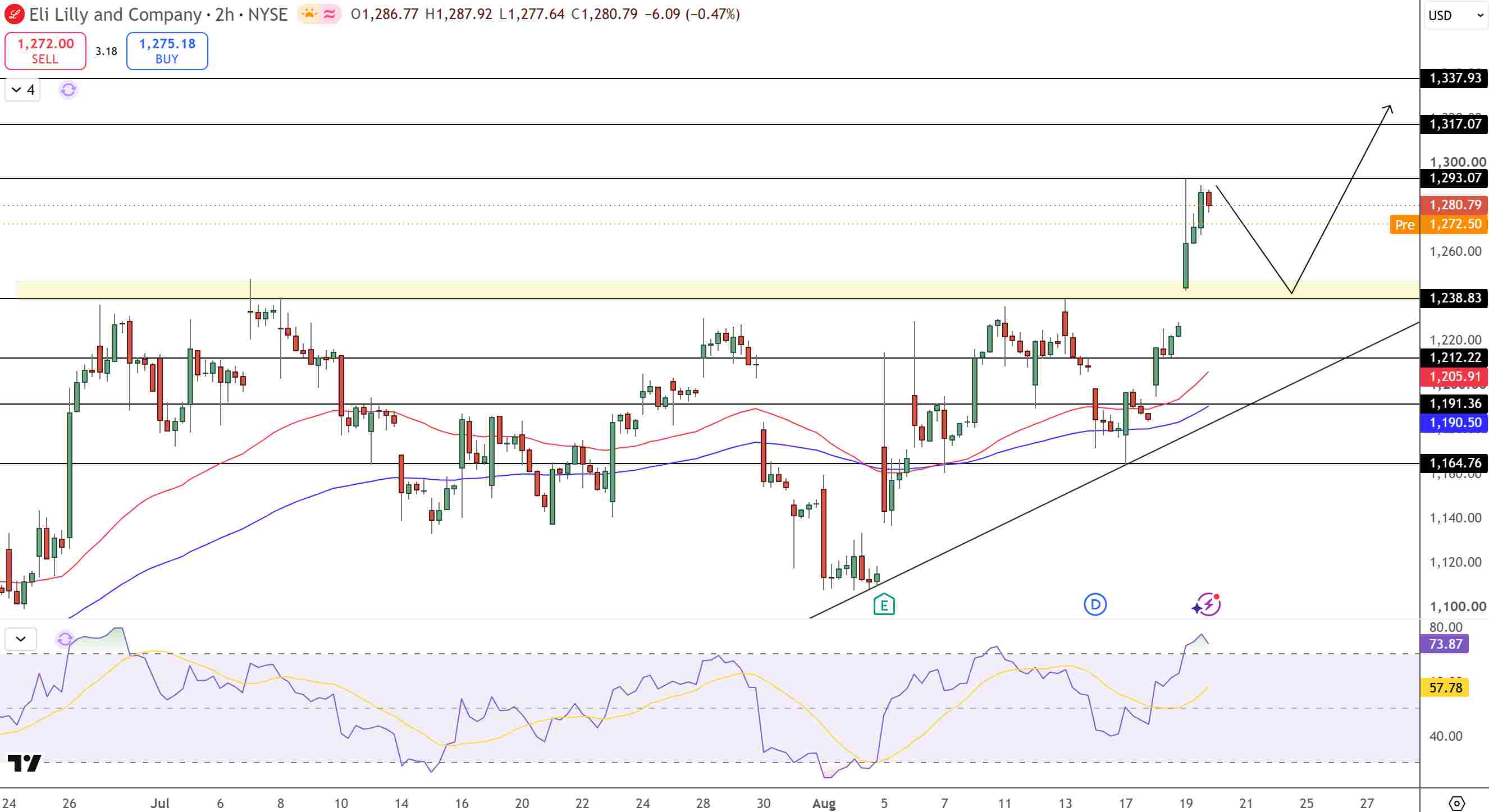
Eli Lilly Price Chart - Source: Tradingview
The nearest resistance is $1,293. A continued break of $1,293 will push the stock higher with potential targets of $1,317.07 and $1,337.93.
The stock consolidating near $1,292.65 after reaching another all time high is showing signs of overbought with the RSI of 74. With the stock consolidating and RSI of 74, $1,238.83 is the first major resistance. Breaching this level opens the stock for a potential sell off to $1,212.22 and the 50 period EMA at $1,205.91.
The technical bias is currently positive above $1,238.83, but the bullish RSI is making record high entries more tricky.
Bottom Line
Strong volume lift and combined Mounjaro and Zepbound sales of $14.87 billion during Lilly's Q2 had sparked positive market sentiments. Foundayo has an oral therapy and retatrutide, if approved by the regulators, has the potential to extend Lilly’s portfolio of therapies for obesity.
The main concerns of Lilly include: tirzepatide, price erosion, competition, the costs of recently acquired businesses, and the complexity of manufacturing. LLY continues to look technically positive from $1,238.83 as the RSI hovering around 74 signals little room for another quick bull move without a consolidation.
This is not investment advice.
Recommended Articles


